Business Process Management Market Size, Share & Industry Analysis, By Component (Solution/Tools/Platform and Services), By Deployment (On-Premise and Cloud), By Enterprise Type (Large Enterprises and Small and Medium Enterprises), By Functionality (Accounting & Finance, Sales & Marketing, Human Resource, Supply Chain Management, Operations Management & Support, and Others), By Industry (BFSI, IT & Telecommunication, Automotive, Healthcare, Manufacturing, Retail & Commercial, Government, and Others), and Regional Forecast, 2026 - 2034
 Download Free Sample
 KEY MARKET INSIGHTS
 Listen to Audio Version
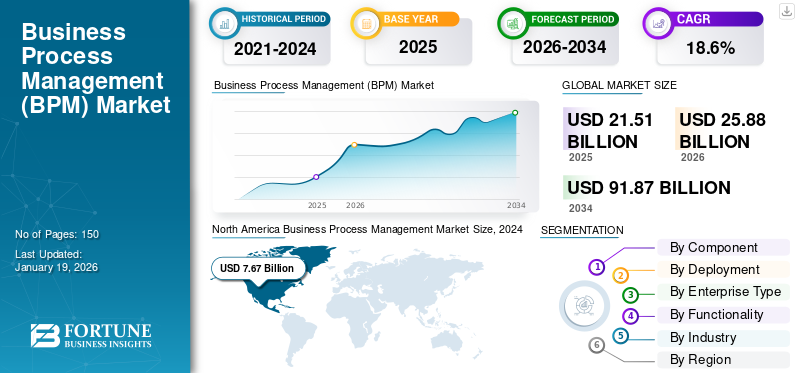
The global business process management market size was valued at USD 21.51 billion in 2025 and market is projected to grow from USD 25.88 billion in 2026 to USD 91.87 billion by 2034, exhibiting a CAGR of 17.2% during the forecast period. North America dominated the global business process management market with a market share of 43.2% in 2025.
The business process management (BPM) encompasses all of the technology-enabled and professional services/solutions that aid organizations in designing, modeling, automating, monitoring, improving, and maintaining their different types of business processes. BPM solutions help enterprises improve operational efficiency, ensure process standardization, enhance visibility, and support digital transformation initiatives. Also, BPM solutions have the ability to automate workflows (workflow), orchestrate processes (orchestration), manage rules (rule management), conduct analytics (analytics), and integrate with other enterprise systems, such as ERP, CRM, and HR.
Furthermore, many key industry players, such as IBM Corporation, Software AG, Oracle Corporation, Appian Corporation Inc., and OpenText, Inc., operating in the market, are increasingly engaging in acquisition activities to expand process intelligence, analytics, and automation depth, allowing them to address evolving enterprise requirements. For instance,
- In 2021, IBM strengthened its BPM and automation capabilities through its acquisition of two companies; Instana and Turbonomic, which enhance observability and intelligent automation across enterprise processes.
Download Free sample to learn more about this report.
IMPACT OF GENERATIVE AI
Growing Adoption of Generative AI Reduces Process Design Complexity and Increases BPM Adoption
Generative AI is significantly simplifying process design and workflow creation within BPM platforms by enabling the use of natural language inputs instead of manual configuration. According to IBM, generative AI capabilities embedded in enterprise automation platforms allow business users to describe processes in plain language, which the system then converts into structured workflows. This reduction in technical complexity enables non-technical users and business teams to actively participate in BPM initiatives. The use of generative AI in conjunction with other workflow and automation tools has also allowed Microsoft to promote the use of BPM at a broader level than only within IT departments, thus supporting the transformation of process issues across an enterprise.
BUSINESS PROCESS MANAGEMENT MARKET TRENDS
Convergence of BPM with AI, Process Mining, and Intelligent Automation is Emerging as a Key Market Trend
The BPM market is witnessing a significant shift from traditional BPM solutions, which typically involve rule-based workflow, to intelligent/adaptive process orchestration platforms that incorporate artificial intelligence (AI), process mining, and intelligent automation technologies. Process mining capabilities within BPM solutions give enterprises greater visibility into their processes functionality, reduction in the disconnect between the designed workflows, and real-world operations. For instance,
- In April 2025, OpenText, Inc. launched enhanced AI and automation features as part of its Titanium X platform update, reinforcing the market shift toward intelligent, analytics-driven BPM solutions that support end-to-end automation.
This convergence trend is driving enterprises to favor unified business automation platforms over standalone BPM tools, accelerating vendor consolidation and increasing demand for scalable, enterprise-grade BPM ecosystems.
Download Free sample to learn more about this report.
MARKET DYNAMICS
MARKET DRIVERS
Rise in Demand for Digital Transformation Initiatives Drives Market Growth
Enterprises around the globe are quickly adopting digital transformation strategies to evolve outdated business practices, gain more agility, and make better data-based decisions. BPM systems allow businesses to digitize, standardize, and automate their most important business processes throughout the organization and internationally. As a result of the increased emphasis on process transparency and real time visibility, digital transformation strategies are increasingly utilizing BPM solutions that are integrated with analytics and process intelligence to allow for immediate access to the status of all business processes in real time. This enables companies to use BPM to track performance, identify bottlenecks, and continuously improve their workflows through the cloud. For instance,
- In January 2025, Appian Corporation introduced enhanced AI-powered cloud BPM capabilities designed to support enterprise-scale digital transformation, reinforcing the growing preference for cloud-first BPM deployments among large organizations.
Thus, the growing popularity of digital transformation in enterprises is expected to fuel business process management market growth over the forecast period.
MARKET RESTRAINTS
High Initial Costs and Budget Constraints for Small and Mid-Sized Enterprises May Hinder Market Growth
SMEs face difficulties in adopting BPM due to the significant upfront investments required to purchase software licenses, set up infrastructure, implement BPM services, and provide employee training. Despite the growing number of cloud-based and low-code BPM platforms available to small and medium sized enterprises, they are still reluctant to adopt these solutions. Many companies are unsure if they will receive a return on investment in the near term since most of the benefits of automation occur over an extended period of time. Additionally, budget pressures on organizations are compounded by the need to work with system integrators and consulting partners to deploy a BPM solution. As a result, organizations become more reliant on the services of external vendors, driving up the cost of their overall BPM projects.
MARKET OPPORTUNITIES
Expansion of AI-Enabled Low-Code BPM Platforms to Create Lucrative Opportunities for the Market
The rapid evolution of AI-enabled low-code and no-code BPM platforms is creating lucrative growth opportunities by enabling faster process automation without heavy dependence on IT teams. These platforms allow business users to design, deploy, and modify workflows with minimal technical expertise. Using AI, ML, and generative AI, BPM platforms are enhancing their abilities to provide intelligent process routing, predictive decision-making, automated exception handling, and AI-enhanced workflow design, which enhances the value of their overall software solution offerings. For instance,
- In January 2025, Appian Corporation Inc. introduced its AI-enabled automation technology through its low-code BPM platform, which demonstrates the industry's movement toward integrating AI with low-code BPM technologies to facilitate accelerated business process transformation at the enterprise level.
As businesses continue to develop and implement enterprise-wide digital transformation initiatives, AI-enabled low-code BPM platforms will be core for their automation strategies, thereby, generating long-term revenue opportunities and growth for the BPM software industry worldwide.
Segmentation Analysis
By Component
Increasing Demand for Integrated BPM Platforms is Driving the Dominance of Solution/Tools/ Platform
Based on the component, the market is divided into solution/tools/platform and services.
The Solution/tools/platform segment is anticipated to hold a dominant market share of 44.05% in 2026. This is due to strong enterprise demand for integrated BPM suites that combine process modeling, automation, analytics, and system integration in a single environment. Organizations increasingly favored platform-based solutions as they enable scalable, repeatable process standardization across multiple departments while reducing long-term reliance on custom development and external services.
Services are anticipated to rise with a CAGR of 20.6% over the forecast period. This is due to increasing requirement of enterprises for implementation, consulting, integration, and changing management support to customize BPM platforms and ensure successful enterprise-wide adoption.
By Deployment
Data Security and Legacy Integration Sustains the Dominance of On-Premises Segment
Based on deployment, the market is bifurcated into on-premise and cloud.
In 2026, on-premise deployment dominated the global market, as organizations prioritize data control, security, and compliance over full cloud migration. Many organizations continues with on-premises BPM deployments to integrate seamlessly with legacy IT systems and maintain consistent performance for mission-critical processes. The on-premise deployment cloud segment will account for 52.16% market share in 2026.
Cloud deployment is projected to grow at a CAGR of 20.8% over the forecast period. This is owing to its lower initial investment costs, easy deployment, and scalability advantages that support agile process transformation and remote workforce requirements.
By Enterprise Type
Process Complexity and Scalability is Driving the BPM Adoption in Large Enterprises
Based on enterprise type, the market is classified into large enterprises and small and medium enterprises.
In 2026, large enterprises dominated the global market as they manage complex, high-volume processes across multiple business units that require standardized governance and automation. Their stronger IT budgets and structured digital transformation programs further support large-scale BPM platform adoption and long-term process optimization initiatives. The large enterprises segment will account for 52.28% market share in 2026.
Small and medium enterprises are projected to grow at a CAGR of 20.9% over the forecast period. This is owing to the increasing availability of cloud-based, low-code BPM platforms which lowers adoption barriers and enable smaller organizations to digitize processes without heavy upfront investment.
By Functionality
Rule-Based Driven Automation is Fueling the BPM Adoption in Accounting & Finance Functionality
Based on functionality, the market is segmented into accounting & finance, sales & marketing, human resource, supply chain management, operations management & support, and others (customer management, etc.).
Accounting & finance is expected to witness a dominating market share over the forecast period. The Accounting & Finance segment will account for 24.5% market share in 2026. This is owing to the high volume of rule-based, repeatable processes such as invoicing, approvals, payroll, and financial reporting that are well-suited for BPM automation. Strong regulatory and audit requirements further drove adoption as organizations used BPM to improve accuracy, compliance tracking, and process transparency.
Operations management & support is projected to grow at the highest CAGR of 20.5% during the forecast period. As enterprises significantly use BPM to streamline cross-functional workflows, reduce operational bottlenecks, and improve service responsiveness across supply chain, IT, and customer support processes.
By Industry
To know how our report can help streamline your business, Speak to Analyst
High-Volume Digital Workflows is Driving the BPM Adoption in IT and Telecommunication Industry
Based on the industry, the market is categorized into BFSI, IT & telecommunication, automotive, healthcare, manufacturing, retail & commercial, government, and others (oil & gas, media & entertainment, etc.).
IT & telecommunication is anticipated to witness a dominating market share over the forecast period. This is owing to their heavy dependency on complex, high-volume digital workflows, such as billing, incident management, service provisioning, and customer onboarding. Continuous network expansion, frequent process changes, and strong automation maturity further drove BPM adoption to improve agility, uptime, and operational efficiency.
BFSI is projected to grow at the highest CAGR of 20.1% during the forecast period, as financial institutions increasingly adopt BPM solutions to automate compliance-intensive processes, enhance risk management, and improve operational efficiency amid rising regulatory scrutiny and digital banking expansion.
Business Process Management Market Regional Outlook
By geography, the market is categorized into North America, Europe, Asia Pacific, the Middle East & Africa, and South America.
North America
North America Business Process Management Market Size, 2025 (USD Billion)
To get more information on the regional analysis of this market, Download Free sample
In 2025, North America held 43.20% of the global market share, reaching a valuation of USD 9.28 billion, and is projected to grow to USD 11.16 billion in 2026. This is owing to an early adoption of digital technologies and a strong enterprise IT infrastructure in the region. Additionally, BPM is also becoming more widely used in the various business processes within an organization for better control and visibility, as well as to create uniformity throughout all areas of the organization. These factors play a significant role in fueling the market growth.
U.S Business Process Management Market
Based on North America’s strong contribution and the U.S. dominance within the region, the U.S. market can be has been approximated to be around USD 5.69 billion in 2026, accounting for roughly 22.9% of global market sales.
To know how our report can help streamline your business, Speak to Analyst
Europe
The market in Europe reached USD 5.37 billion in 2025, representing 24.90% of total market revenue, and is projected to reach USD 6.3 billion in 2026. Europe’s BPM market is characterized by a strong emphasis on process standardization, compliance, and governance, driven by diverse regulatory frameworks across countries. Enterprises in the region adopt BPM solutions to ensure operational consistency across geographically distributed operations.
U.K Business Process Management Market
The U.K. market in 2025 is estimated at around USD 1.10 billion, representing roughly 5.2% of global market revenues. The United Kingdom market is projected to reach USD 1.26 billion by 2026
Germany Business Process Management Market
Germany’s market is projected to reach approximately USD 1.78 billion in 2026, equivalent to around 7.0% of global market sales.
Asia Pacific
Asia Pacific contributed approximately USD 3.96 billion to the global market in 2025, accounting for 18.40% share, and is expected to reach USD 4.93 billion in 2026. Asia Pacific is the fastest-growing region for BPM platforms, as cloud-based BPM platforms are widely adopted, particularly among SMEs, due to lower upfront investment and faster deployment. Key industries driving adoption include IT & telecommunication, manufacturing, and retail & e-commerce, where process automation supports growth and operational expansion. In the region, India and China are both estimated to reach USD 1.70 billion and USD 1.29 billion, respectively in 2026.
Japan Business Process Management Market
The Japan market in 2026 was estimated at around USD 0.56 billion, accounting for roughly 2.2% of global market revenues. Rising enterprise digital transformation fuels demand for process automation, and strong adoption of BPM to enhance operational efficiency and governance across manufacturing, Banking Financial Services and Insurance (BFSI), and public sector organizations. These factors play a vital role in driving market growth across the country.
China Business Process Management Market
China’s market is projected to be one of the largest markets with 2026 revenues estimated around USD 1.29 billion, representing roughly 5.0% of global market sales.
India Business Process Management Market
The India business process management market in 2026 is estimated at around USD 1.70 billion, accounting for roughly 6.2% of global market revenues.
South America
South America is expected to witness moderate growth in this market space during the forecast period. The South America market has been estimated to reach a valuation of USD 0.89 billion in 2025. The region shows steady progress in business process management adoption, owing to the growing need for operational efficiency, process consistency, and cost optimization across enterprises. Additionally, organizations adopt BPM solutions to streamline internal workflows and improve coordination across business functions. These factors drive the market growth across the region.
Middle East & Africa
The Middle East & Africa region captured 9.40% of the global market in 2025, generating USD 2.02 billion in revenue, and is projected to reach USD 2.49 billion in 2026. The market is at a developing stage in the region, driven by enterprise modernization and public-sector digitalization initiatives. Organizations increasingly implement BPM solutions to improve service delivery and operational efficiency. In the Middle East & Africa, the GCC is set to reach a value of USD 0.86 billion in 2025.
Latin America
In 2025, Latin America generated USD 0.89 billion, contributing 4.10% to global market revenue, and is projected to grow to USD 1.04 billion in 2026.
COMPETITIVE LANDSCAPE
Key Industry Players
Focus on Expanding Product Portfolio by Key Players to Propel Market Progress
The global business process management market holds a semi-consolidated market structure, constituting prominent players such as IBM Corporation, Software AG, Oracle Corporation, Appian Corporation Inc., and OpenText, Inc. These key vendors are actively enhancing their platforms by adding low code development, process mining, AI assisted automation, and advanced analytics to improve enterprise usability and scalability. For instance,
- In October 2025, Oracle expanded its BPM and workflow capabilities within Oracle Fusion Cloud Applications by embedding AI driven process automation, analytics, and tighter integration with enterprise applications to support end to end business processes.
Other notable players in the global market include TIBCO Software, Infosys Limited, HCL Technologies Limited, Kissflow Inc., and Newgen Software Technologies Limited. These companies are also acquiring niche technology providers to accelerate innovation and shorten development cycles to increase their global market share during the forecast period.
LIST OF KEY BUSINESS PROCESS MANAGEMENT COMPANIES PROFILED
- IBM Corporation (U.S.)
- Software AG (Germany)
- Oracle Corporation (U.S.)
- Appian Corporation Inc. (U.S.)
- OpenText, Inc. (Canada)
- TIBCO Software (U.S.)
- Infosys Limited (India)
- HCL Technologies Limited (India)
- Kissflow Inc. (U.S.)
- Newgen Software Technologies Limited (India)
KEY INDUSTRY DEVELOPMENTS
- March 2025: IBM Corporation enhanced its Cloud Pak for business automation with new generative AI capabilities aimed at accelerating process discovery, workflow design, and decision automation for large enterprises.
- February 2025: HCL Technologies Limited (HCLTech) expanded its enterprise automation and BPM services portfolio by strengthening partnerships with global hyperscalers to deliver AI-led workflow modernization for large-scale clients.
- December 2024: Oracle Corporation expanded its Oracle Process Automation capabilities within Oracle Cloud Infrastructure, focusing on tighter integration with Oracle Fusion applications to improve end-to-end business workflows.
- October 2024: Infosys Limited announced new digital BPM and intelligent automation solutions targeting banking and financial services clients, aimed at improving operational efficiency and regulatory compliance.
- April 2024: OpenText, Inc. announced expanded investments in AI-enabled process automation, embedding intelligent assistants and automation agents across its information management and workflow portfolio.
REPORT COVERAGE
Request for Customization to gain extensive market insights.
Report Scope & Segmentation
|
ATTRIBUTE |
DETAILS |
|
Study Period |
2021-2034 |
|
Base Year |
2025 |
|
Estimated Year |
2026 |
|
Forecast Period |
2026-2034 |
|
Historical Period |
2021-2024 |
|
Growth Rate |
CAGR of 17.2% from 2026-2034 |
|
Unit |
Value (USD Billion) |
|
Segmentation |
By Component, Deployment, Enterprise Type, Functionality, Industry, and Region |
|
By Component |
· Solution/Tools/Platform · Services |
|
By Deployment |
· On-Premise · Cloud |
|
By Enterprise Type |
· Large Enterprises · Small and Medium Enterprises |
|
By Functionality |
· Accounting & Finance · Sales & Marketing · Human Resource · Supply Chain Management · Operations Management & Support · Others (Customer Management, etc.) |
|
By Industry |
· BFSI · IT & Telecommunication · Automotive · Healthcare · Manufacturing · Retail & Commercial · Government · Others (Oil & Gas, Media & Entertainment, etc.) |
|
By Region |
· North America (By Component, Deployment, Enterprise Type, Functionality, Industry, and Country) o U.S. (By Industry) o Canada (By Industry) o Mexico (By Industry) · Europe (By Component, Deployment, Enterprise Type, Functionality, Industry, and Country) o U.K. (By Industry) o Germany (By Industry) o France (By Industry) o Italy (By Industry) o Spain (By Industry) o Russia (By Industry) o Benelux (By Industry) o Nordics (By Industry) o Rest of Europe · Asia Pacific (By Component, Deployment, Enterprise Type, Functionality, Industry, and Country) o China (By Industry) o India (By Industry) o Japan (By Industry) o South Korea (By Industry) o ASEAN (By Industry) o Oceania (By Industry) o Rest of Asia Pacific · Middle East & Africa (By Component, Deployment, Enterprise Type, Functionality, Industry, and Country) o Turkey (By Industry) o Israel (By Industry) o GCC (By Industry) o North Africa (By Industry) o South Africa (By Industry) o Rest of Middle East & Africa · South America (By Component, Deployment, Enterprise Type, Functionality, Industry, and Country) o Brazil (By Industry) o Argentina (By Industry) o Rest of South America |
Frequently Asked Questions
According to Fortune Business Insights, the global market value stood at USD 21.51 billion in 2025 and is projected to reach USD 91.87 billion by 2034.
In 2025, the market value stood at USD 9.28 billion.
The market is expected to exhibit a CAGR of 17.2% during the forecast period.
By industry, IT & telecommunication segment is expected to lead the market.
Rise in demand for digital transformation initiatives drives market growth.
IBM Corporation, Software AG, Oracle Corporation, Appian Corporation Inc., and OpenText, Inc. are the major players in the global market.
North America dominated the market in 2026.



- 2021-2034
- 2025
- 2021-2024
- 150
Get 20% Free Customization
Expand Regional and Country Coverage, Segments Analysis, Company Profiles, Competitive Benchmarking, and End-user Insights.




















Related Reports
-
US +1 833 909 2966 ( Toll Free )
-
Get In Touch With Us