Botulinum Toxin Market Size, Share & Industry Analysis, By Application (Therapeutic {Chronic Migraine, Spasticity, Overactive Bladder, Cervical Dystonia, Blepharospasm, Hyperhidrosis, Sialorrhea, & Others} and Aesthetics {Forehead Wrinkles, Glabellar Lines, Crow's Feet, & Others}), By Type (Botulinum Toxin Type A, Botulinum Toxin Type B, and Botulinum Toxin Type E), By Gender (Male and Female), Age Group (Below 18 Years, 18-30 Years, 31-45 Years, 46-60 Years, and Above 60 Years), By End-user (Specialty & Dermatology Clinics, Hospitals & Clinics, & Others), and Regional Forecast, 2026-2034
 Download Free Sample
Botulinum Toxin Market Size and Future Outlook
 Listen to Audio Version
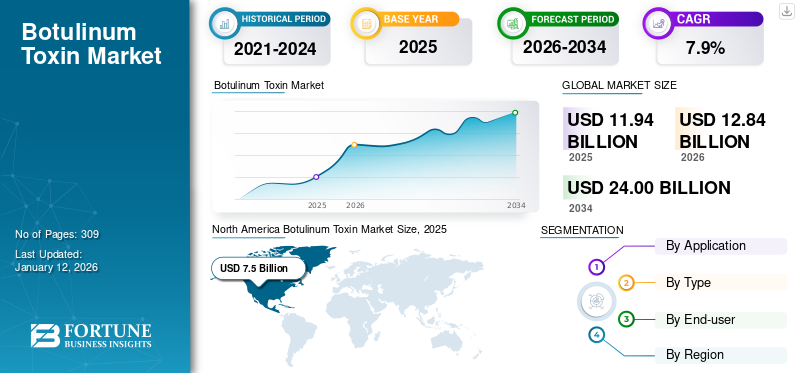
The botulinum toxin market size was valued at USD 11.87 billion in 2025. The market is projected to grow from USD 12.81 billion in 2026 to USD 24.10 billion by 2034, exhibiting a CAGR of 8.22% during the forecast period. North America dominated the botulinum toxin market with a market share of 62.09% in 2025.
A gram-positive anaerobic bacterium named Clostridium botulinum produces botulinum toxin. This toxin is divided into seven different types of neurotoxins with distinct antigenic and serological characteristics, with similar structures. The market growth is supported by increasing adoption of minimally invasive aesthetic procedures and the expanding therapeutic use of neurotoxin injections across neurological, muscular and autonomic disorders. Growing consumer acceptance of anti-aging injectable treatments, increasing availability of trained practitioners, and recurring nature of treatment are supporting market expansion. Manufacturers are also focusing on securing additional indications, improving treatment duration, expanding physician training and launching products across emerging markets. Major players in the global market are also focused on developing and launching innovative products for diverse indications to expand their neurotoxin portfolios and improve patient outcomes in the therapeutic and aesthetic settings.
- For instance, in July 2026, Allergan Aesthetics received approval from the European Commission for Boey (trenibotulinumtoxinE) in Europe, for the temporary improvement in the appearance of moderate to severe lines between the eyebrows seen at maximum frown (glabellar lines) in adult patients, when these have an important psychological impact. This type of innovative product launches by the key market players drives the market growth.
Furthermore, key players, such as AbbVie Inc., Evolus, Inc., Revance Therapeutics, Inc., and Supernus Pharmaceuticals, Inc., are actively participating in new product launches, strategic collaborations, and acquisitions, as well as regulatory approval and investment initiatives to expand market presence.
Download Free sample to learn more about this report.
BOTULINUM TOXIN MARKET TRENDS
Increasing Awareness Through Promotional Activities by Key Players to Emerge as a Significant Market Trend
Leading market players are increasingly conducting digital campaigns, consumer education programs, loyalty initiatives, and practitioner-focused events to improve awareness of botulinum toxin treatments. These activities help consumers understand the available aesthetic applications, expected outcomes and importance of receiving treatment from qualified healthcare professionals. Additionally, provider education and promotional events improve product visibility among dermatologists, plastic surgeons and aesthetic clinics. Therefore, continued investment in multichannel promotional activities is expected to support new patient acquisition, repeat treatments and stronger brand differentiation in the global market. Key players are also adopting several advanced marketing techniques to increase customer awareness.
- For instance, in September 2025, Allergan Aesthetics, an AbbVie company, launched “The One & Only,” a national multichannel campaign for BOTOX Cosmetic featuring real consumers and their individual treatment stories. The campaign used consumer experiences and self-expression-focused messaging to strengthen awareness and engagement with the brand. This initiative highlights the growing focus of key players on using personalized marketing and real-patient communication to educate consumers and encourage wider acceptance of botulinum toxin procedures.
MARKET DYNAMICS
MARKET DRIVERS
Download Free sample to learn more about this report.
Rise in Demand for Botulinum Toxin Procedures Across Aesthetic and Therapeutic Applications Boosts Market Expansion
Demand for botulinum toxin procedures is increasing due to growing consumer preference for minimally invasive aesthetics that require limited recovery time and provide natural-looking results. Aesthetic applications for facial lines and muscle-related aging concerns continue to attract both new and repeat patients, while therapeutic use is expanding across chronic migraine, spasticity, cervical dystonia, hyperhidrosis and overactive bladder. This is expected to generate sustained revenue growth and support market expansion.
- For instance, in June 2025, according to the International Society of Aesthetic and Plastic Surgery (ISAPS) report for 2023, the total number of BoT procedures globally was 7.8 billion in the year 2024.
|
Rank |
Market Driver |
Expected Impact on Market Growth |
Estimated Gross Market Growth Contribution (USD Billion) |
Impact: 2026-2028 |
Impact: 2029-2031 |
Impact: 2032-2034 |
|
1 |
Rising Demand for Minimally Invasive Aesthetic Procedures |
High |
4.15 |
High |
High |
High |
|
2 |
Expansion of Therapeutic Applications and Regulatory Approvals |
High |
3.20 |
Medium |
High |
High |
|
3 |
Increasing Prevalence and Diagnosis of Neurological and Muscular Disorders |
High |
2.45 |
High |
High |
Medium |
|
4 |
Heavy Investment in R&D and Product Innovation |
Medium-High |
1.95 |
Medium |
High |
High |
|
5 |
Geographic Expansion and Growing Adoption in Emerging Markets |
Medium |
1.55 |
Medium |
Medium |
High |
|
6 |
Others |
Low |
1.00 |
Low |
Low |
Low |
|
Total Gross Growth Contribution |
14.30 |
MARKET RESTRAINTS
High Cost of Treatment May Hinder Market Growth
The high cost of this treatment may limit botulinum toxin market growth during the forecast period. This restricts its adoption, particularly among patients requiring repeated injections for chronic medical conditions or long-term aesthetic maintenance. In therapeutic applications, inadequate reimbursement, prior-authorization requirements, and differences between treatment costs and insurer payments can also discourage healthcare providers from offering botulinum toxin therapy. These financial barriers are more significant in lower-income markets and among patients without comprehensive insurance coverage. Consequently, high out-of-pocket expenditure and limited reimbursement may reduce treatment continuity, restrict patient access, and hinder the overall growth of the market.
- For instance, in October 2023, according to the NICE guideline NG236 Economic analysis report, 2023, the cost of botulinum toxin A treatment is high. In the probabilistic scenario analysis (SA11), a 1-year treatment with Xeomin 250U costs approximately USD 2,448.1, while Dysport 500U costs around USD 1,768.7.
|
Rank |
Market Restraint |
Expected Impact on Market Growth |
Estimated Reduction in Market Size (USD Billion) |
Impact: 2026-2028 |
Impact: 2029-2031 |
Impact: 2032-2034 |
|
1 |
High Treatment Cost and Limited Reimbursement |
High |
1.20 |
High |
High |
Medium |
|
2 |
Availability of Counterfeit and Unapproved Products |
Medium-High |
0.85 |
High |
Medium |
Medium |
|
3 |
Stringent Regulatory, Manufacturing and Safety Requirements |
Medium |
0.61 |
Medium |
Medium |
Low |
|
4 |
Others |
Low |
0.35 |
Low |
Low |
Low |
|
Total Market Reduction |
3.01 |
MARKET OPPORTUNITIES
Heavy R&D Investment in Therapeutic Applications of Botulinum Toxin to Create Market Growth Opportunities
Major market players are increasing investments in clinical trials and next-generation neurotoxin platforms to expand botulinum toxin use beyond established aesthetic procedures. Rise in the use of botulinum toxin for therapeutic indications, such as cervical dystonia, chronic migraine, spasticity, blepharospasm, hyperhidrosis, and achalasia, is expected to boost market growth in the future. Successful development of additional therapeutic indications can significantly increase the eligible patient population and reduce the market’s dependence on discretionary aesthetic spending. Therefore, continued R&D investment and successful regulatory approvals for new indications are expected to create substantial revenue opportunities and strengthen the long-term growth of the global market. Additionally, with increasing number of regulatory approvals for therapeutic applications, key market players are investing heavily in research and development for product launches.
- For instance, in February 2026, Galderma received acceptance from the U.S. FDA for the BLA resubmission for RelabotulinumtoxinA for the temporary improvement of moderate-to-severe glabellar lines treatment and lateral canthal lines treatment (crow’s feet) in adults.
MARKET CHALLENGES
Availability of Counterfeit Products May Limit Market Growth
The increasing availability of counterfeit, unapproved, and improperly stored botulinum toxin products represents a major challenge to market growth. These products are often distributed through unauthorized online platforms or administered in unlicensed settings at prices lower than those of approved brands. The use of counterfeit products can cause treatment failure, botulism-like symptoms, hospitalization, and other serious health complications. Such incidents may reduce consumer confidence in botulinum toxin procedures and create reputational risks for legitimate manufacturers and trained healthcare providers. Moreover, companies and regulatory authorities must invest additional resources in product authentication, supply-chain monitoring and public awareness programs. Therefore, the continued circulation of counterfeit products could discourage potential patients, increase regulatory scrutiny and negatively affect the adoption of approved botulinum toxin treatments.
- For instance, in November 2025, the U.S. FDA issued 18 warning letters to owners of websites illegally marketing unapproved and misbranded botulinum toxin products, commonly called Botox.
Segmentation Analysis
By Application
Broad Therapeutic Utility Contributed to Therapeutic Segment Dominance
Based on application, the market is bifurcated into aesthetic and therapeutic.
The therapeutic segment dominated the market due to the wide use of botulinum toxin across chronic neurological, muscular, and autonomic disorders. These products are administered for conditions such as spasticity, chronic migraine, cervical dystonia, overactive bladder, sialorrhoea and excessive sweating, creating a large and diverse patient population. Many of these conditions require treatment at regular intervals, which generates recurring demand and improves long-term product consumption. Therapeutic procedures may also require higher toxin doses than aesthetic treatments, increasing the revenue generated per treatment session. In addition, reimbursement for medically required procedures reduces the financial burden on eligible patients and supports continued treatment.
- For instance, in June 2024, Merz Therapeutics received Swissmedic approval for XEOMIN to treat focal spasticity of the lower limb in Switzerland. The expanded indication allowed qualified healthcare professionals to treat upper- and lower-limb spasticity separately or together, with repeated treatment permitted at intervals of at least 12 weeks.
The aesthetic segment is expected to grow at a CAGR of 7.95% over the forecast period.
To know how our report can help streamline your business, Speak to Analyst
By Type
Extensive Product Availability Positioned Botulinum Toxin Type A as the Dominant Segment
On the basis of type, the market is segmented into botulinum toxin type A, botulinum toxin type B, and botulinum toxin type E.
The botulinum toxin type A segment dominated the global market in 2025. The botulinum toxin type A injection is the most common cosmetic procedure used globally. The segment’s dominance is due to its established clinical profile, extensive commercial availability, and broad coverage across aesthetic and therapeutic indications. These are most widely recognized neurotoxin brands and have accumulated substantial clinical evidence, regulatory approvals, and physician experience. Surveys from core aesthetic specialty organizations consistently rank this type first on the lists of member-reported nonsurgical aesthetic procedures.
- For instance, in July 2025, Evolus announced the publication of an independent JAMA Dermatology study directly comparing four leading FDA-approved botulinum toxin type A product—Jeuveau, BOTOX, Dysport and XEOMIN. The study evaluated their onset, peak effect and duration in patients treated for glabellar lines. The presence of several established type A products supported by comparative clinical evidence demonstrates the strong commercial and scientific concentration within this segment.
The botulinum toxin type E segment is expected to grow at a CAGR of 82.46% over the forecast period.
By Gender
Higher Aesthetic Procedure Uptake Among Women Supported Female Segment Dominance
Based on gender, the market is segmented into male and female.
The female segment held the largest market share. This high share is attributed to stronger awareness and acceptance of minimally invasive aesthetic procedures among women. Growing exposure to aesthetic treatments through social media, beauty platforms, and healthcare-provider education has further encouraged women to opt for these procedures. The expanding availability of personalized treatment plans for different facial structures and aging concerns further supports utilization. Therefore, higher procedure participation and repeat treatment behavior enabled the female segment to account for largest market share.
- For instance, the American Society of Plastic Surgeons reported that women accounted for approximately 9.29 million, or 94%, of the 9.88 million neuromodulator injection procedures recorded in the U.S. during 2024. The substantial difference between female and male procedure volumes highlights the considerably stronger adoption of botulinum toxin and related neuromodulator treatments among women.
The male segment is expected to grow at a CAGR of 8.27% over the forecast period.
By Age Group
Growing Age-related Aesthetic Concerns Positioned the 46–60 Years Segment as the Leading Age Group
On the basis of age group, the market is segmented into below 18 years, 18-30 years, 31-45 years, 46-60 years, and above 60 years.
Based on age group, the 46–60 years segment captured the largest global botulinum toxin market share. The most widespread application for these toxins is for visible facial lines, loss of skin elasticity, and other age-related changes that become more prominent during this period. The rising disposable incomes and stronger purchasing power also make repeat botulinum toxin injections more affordable for this age group. Moreover, patients who began receiving injections at a younger age frequently continue maintenance treatments into their late forties and fifties. These factors supported higher treatment frequency and enabled segment’s dominance.
- For instance, in January 2026, Galderma released findings from a global survey of more than 4,300 women aged 45–60 years across nine countries. The survey found that 59% had experienced facial lines and wrinkles, while 47% stated that they would consider anti-wrinkle treatments for menopause-related skin changes. These findings demonstrate the strong treatment interest generated by visible aging concerns among consumers within this age group.
The 18-30 years segment is expected to grow at a CAGR of 10.68% over the forecast period.
By End-User
Concentration of Skilled Injectors Augmented Specialty and Dermatology Clinics Segment’s Dominance
On the basis of end-user, the market is segmented into specialty & dermatology clinics, hospitals & clinics, and others.
The specialty & dermatology clinics segment held the largest market share in 2025. This is due to botulinum toxin administration demanding trained professionals with detailed knowledge of facial anatomy, injection techniques, dosing, and adverse-event management. These clinics offer dedicated consultation, customized treatment planning and short outpatient procedures, making them convenient for aesthetic patients. They also maintain specialized infrastructure for product storage, patient documentation and follow-up care. Therefore, specialized expertise, procedural convenience and a strong recurring patient base enabled specialty and dermatology clinics to hold the leading market share.
- For instance, in February 2025, Allergan Aesthetics announced plans to open three new Allergan Medical Institute training centers in the U.S. for licensed aesthetic providers. The centers were designed to improve consultation skills, injection techniques, complication management and patient outcomes through hands-on training.
The hospitals & clinics segment is expected to grow at a CAGR of 8.43% over the forecast period.
Botulinum Toxin Market Regional Outlook
By geography, the market is categorized into Europe, North America, Asia Pacific, Latin America, and Middle East & Africa.
North America
North America Botulinum Toxin Market Size, 2025 (USD Billion)
To get more information on the regional analysis of this market, Download Free sample
North America was valued at USD 6.95 billion in 2024 and maintained its growth momentum with the leading position in 2025 at USD 7.37 billion. The market is growing due to high awareness of minimally invasive aesthetic treatments, the presence of a large number of trained injectors, and strong demand for repeat procedures. The region also benefits from the established therapeutic use of botulinum toxin for chronic migraine, muscle spasticity management, overactive bladder and excessive sweating.
U.S. Botulinum Toxin Market
Given North America's substantial contribution and the U.S. dominance in the region, the U.S. market is estimated at around USD 7.63 billion in 2026, accounting for roughly 59.58% of the global market.
Europe
Europe is projected to grow at 7.15% CAGR over the coming years, the third-highest among all regions, and reach a valuation of USD 1.66 billion by 2026. An aging population, established dermatology and neurological care systems, and strong acceptance of non-surgical facial rejuvenation support the European market. Also, medical tourism is supporting treatment volumes in countries offering comparatively affordable aesthetic services.
U.K. Botulinum Toxin Market
The U.K. market is estimated at USD 0.23 billion in 2026, accounting for roughly 1.83% of the global market.
Germany Botulinum Toxin Market
Germany's market is projected to reach approximately USD 0.47 billion in 2026, equivalent to around 3.68% of the global market.
Asia Pacific
Asia Pacific accounted for the second-largest share in the market in 2025 and is estimated to reach USD 2.82 billion in 2026. The Asia Pacific market is expanding due to rising disposable income, increasing interest in facial aesthetics, and the growing influence of social media and Korean beauty trends. A large young and middle-aged population is increasing demand for preventive aesthetic treatments, while growing diagnoses of migraine, spasticity and other neurological conditions are supporting therapeutic use.
Japan Botulinum Toxin Market
The Japanese market in 2026 is estimated at around USD 0.77 billion, accounting for approximately 6.01% of the global market.
China Botulinum Toxin Market
China's market is projected to be among the largest worldwide, with 2026 revenues estimated at around USD 1.28 billion, accounting for approximately 10.01% of global sales.
India Botulinum Toxin Market
The Indian market is estimated at around USD 0.14 billion in 2026, accounting for roughly 1.08% of global revenue.
Latin America and the Middle East & Africa
The Latin America region is expected to witness significant growth in this market during the forecast period and is estimated to reach a valuation of USD 0.29 billion in 2026. The region is growing due to a strong cultural preference for aesthetic procedures, increasing numbers of specialized clinics, and the expansion of medical tourism. In the Middle East & Africa, the UAE is set to reach USD 0.01 billion in 2026.
South Africa Botulinum Toxin Market
The South African market is projected to reach approximately USD 0.03 billion by 2026, accounting for roughly 0.24% of global revenue.
COMPETITIVE LANDSCAPE
Key Industry Players
Established Brands and Wide Regulatory Approvals Augment Market Competition
The botulinum toxin market has a relatively concentrated competitive structure, with AbbVie Inc., Galderma Group AG, Ipsen S.A., Merz Therapeutics GmbH, Evolus, Inc., Revance, and HUGEL, Inc. holding notable positions across therapeutic and aesthetic applications. The market presence of these companies is supported by established neurotoxin brands, extensive clinical evidence, broad regulatory approvals, practitioner-training programs, and international distribution networks. Competition is expected to increase as companies develop ready-to-use liquid formulations, long-acting neurotoxins, expand therapeutic indications, and enter high-growth markets.
- For instance, in January 2026, Galderma Group AG announced the presentation of new clinical data for Relfydess and Dysport at the TOXINS 2026 International Conference. The company presented findings supporting the rapid onset and efficacy of Relfydess for up to six months, along with patient and practitioner satisfaction data for Dysport. This development highlights the increasing focus of leading companies on differentiated formulations, clinical evidence, and physician education to strengthen their position in the competitive market.
Other notable market participants include Medytox Inc., Daewoong Pharmaceutical Co., Ltd., and Lanzhou Institute of Biological Products Co., Ltd. These companies primarily compete through competitively priced products, alternative toxin formulations and serotypes, local manufacturing, regional distribution partnerships, and expansion across emerging markets. Medytox offers multiple botulinum toxin types. During the forecast period, companies are expected to prioritize new regulatory approvals, additional therapeutic indications, manufacturing-capacity expansion, clinical differentiation, practitioner training, and partnerships with local distributors to improve their global market positions.
LIST OF KEY BOTULINUM TOXIN COMPANIES PROFILED
- AbbVie Inc. (U.S.)
- Galderma Group AG (Switzerland)
- Ipsen S.A. (France)
- Merz Pharma GmbH & Co. KGaA (Germany)
- Evolus, Inc. (U.S.)
- HUGEL, Inc. (South Korea)
- Medytox Inc. (South Korea)
- Revance Therapeutics, Inc. (U.S.)
- Daewoong Pharmaceutical Co., Ltd. (South Korea)
- Lanzhou Institute of Biological Products Co., Ltd. (China)
- Huons BioPharma Co., Ltd. (South Korea)
- Supernus Pharmaceuticals, Inc. (U.S.)
KEY INDUSTRY DEVELOPMENTS
- July 2026: HUGEL Inc. launched Letybo, its botulinum toxin product, in the Indian market at the Global Aesthetics Summit (GAS). The development sought to establish an early foothold in the country’s rapidly expanding medical aesthetics market.
- December 2025: Merz Therapeutics received approval for XEOMIN (incobotulinumtoxinA) from Health Canada for the treatment of post-stroke lower limb spasticity involving the ankle and foot in adults.
- October 2025: Allergan Aesthetics (AbbVie) received the U.S. FDA approval for BOTOX Cosmetics for the temporary improvement in the appearance of moderate to severe vertical bands connecting the jaw and neck (platysma bands).
- June 2025: Daewoong Pharmaceutical launched NABOTA, its high-purity botulinum toxin product, in Qatar through a symposium attended by approximately 200 local healthcare professionals. The launch enabled NABOTA's availability across all three key Gulf Cooperation Council markets—Qatar, Saudi Arabia, and the UAE—targeting high-income populations with growing demand for aesthetic procedures.
- May 2025: Hesperos received a USD 2.0 billion research grant from the National Center for Advancing Translational Sciences (NCATS) in partnership with the U.S. FDA. This project aimed to create an advanced testing platform that can evaluate the potency of Botulinum Toxin (BoT) without relying on animal testing.
- March 2025: HUGEL Inc. received marketing approval for its botulinum toxin Letybo, used in the treatment of moderate-to-severe glabellar lines (frown lines) in adults, from the U.S. FDA.
REPORT COVERAGE
The global botulinum toxin report provides market size & forecast by all the segments included in the report. The market outlook also details the market dynamics and trends expected to drive the market in the forecast period. It offers information on the prevalence of chronic diseases in key regions/countries, key industry developments, new product launches, details on partnerships, mergers & acquisitions in key countries. The report also provides comprehensive market analysis and covers a detailed competitive landscape with information on the market share and profiles of key players.
Request for Customization to gain extensive market insights.
Report Scope & Segmentation
| ATTRIBUTE | DETAILS |
| Study Period | 2021-2034 |
| Base Year | 2025 |
| Estimated Year | 2026 |
| Forecast Period | 2026-2034 |
| Historical Period | 2021-2024 |
| Growth Rate | CAGR of 8.22% from 2026-2034 |
| Unit | Value (USD Billion) |
| Segmentation | By Application, Type, Gender, Age Group, End-user, and Region |
| By Application |
|
| By Type |
|
|
By Gender
|
|
|
By Age Group
|
|
|
By End-User
|
|
| By Region |
|
Frequently Asked Questions
Fortune Business Insights says that the global market size was USD 11.87 billion in 2025 and is projected to reach USD 24.10 billion by 2034.
In 2025, the market in North America stood at USD 7.37 billion.
The market is projected to grow at a CAGR of 8.22% during the forecast period (2026-2034).
The therapeutic segment is the leading segment in this market by application.
The rise in demand for botox procedures and increasing R&D initiatives to gain regulatory approvals for newer products are the key factors that drive the market.
AbbVie Inc., Ipsen S.A., and Merz Pharma GmbH & Co. KGaA are the top players in the market.
North America held the highest share of the market.
Strong surge in therapeutic use of botulinum toxin coupled with the ever burgeoning aesthetic demand is expected to drive the product adoption across the globe.



- 2021-2034
- 2025
- 2021-2024
- 309
Get 30-60 hrs Free Customization
Expand Regional and Country Coverage, Segments Analysis, Company Profiles, Competitive Benchmarking, and End-user Insights.













.webp)






Related Reports
-
US +1 833 909 2966 ( Toll Free )
-
Get In Touch With Us