Mental Health Apps Market Size, Share & Industry Analysis, By Platform (iOS, Android, and Web-based & Others), By Application (Depression & Anxiety Management, Stress & Burnout Management, Meditation & Mindfulness, Sleep & Relaxation, Mood Tracking & Emotional Wellbeing, and Others), By Delivery Model (Self-guided, Therapist/Coach-assisted, and Hybrid), By Business Model (B2C, B2B, B2B2C, and Hybrid), By Payment Model (Freemium, Subscription-based, One-time Purchase, and Others), By End-user (Healthcare Providers, Homecare Settings, and Others), and Regional Forecast, 2026-2034
 Download Free Sample
What Is the Mental Health Apps Market Size and Share 2026?
 Listen to Audio Version
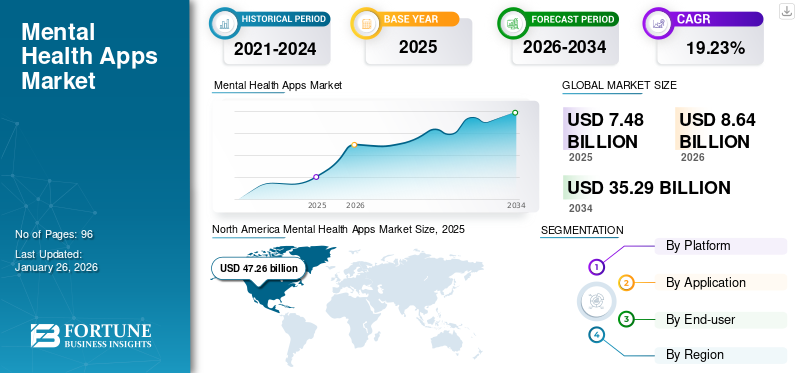
The global mental health apps market size was valued at USD 7.50 billion in 2025 and is projected to grow from USD 8.68 billion in 2026 to USD 25.45 billion by 2034, exhibiting a CAGR of 14.39% during the forecast period. North America dominated the mental health apps market with a market share of 47.2% in 2025.
The global Mental Health Apps market is shifting from consumer wellness toward integrated digital behavioral healthcare. Demand is expanding as employers, health plans, and healthcare providers seek lower-friction access, earlier intervention, and measurable outcomes. The addressable market is broad because mental health applications now span mindfulness, sleep, mood tracking, behavioral programs, coaching, therapy access, and clinical support.
The central commercial issue is no longer app availability. It is whether a platform can convert engagement into durable health, workforce, or economic outcomes. WHO estimates that 970 million people were living with a mental disorder in 2019, with anxiety and depression the most common conditions. This burden supports sustained demand, while workforce pressures strengthen the B2B case for digital support.
Four forces are reshaping the Mental Health Apps market size and market share. First, buyers are moving toward integrated benefit and care ecosystems rather than isolated applications. Second, artificial intelligence is improving personalization, triage, provider matching, and workflow automation, although governance requirements are increasing. Third, evidence requirements are becoming more explicit as buyers distinguish wellness tools from technologies that influence clinical decisions. NICE, for example, applies evidence standards according to intended purpose and risk.
The global market comprises various applications used for stress reduction, anxiety and depression support, and virtual counselling. The burden of mental health disorders, such as depression, anxiety, bipolar disorder, Post-Traumatic Stress Disorder (PTSD), and schizophrenia, is increasing significantly. These mental health applications provide solutions for diagnosing, preventing, and managing these disorders. The demand for these applications is increasing as individuals face growing mental health concerns. These applications help improve access to mental health resources, encourage early intervention, support regular engagement, and extend care beyond conventional clinical settings.
- For instance, in March 2026, Sword Health launched Dawn, its first direct-to-consumer AI-based mental health application. The platform provides users with immediate and personalized mental health support through continuous conversations and access to clinical care when required.
Furthermore, major players, such as Teladoc Health, Inc., Headspace, Inc., Calm, and Lyra Health, Inc., are actively pursuing strategic collaborations and acquisitions, as well as investment initiatives to expand their offerings, enhance market access, and strengthen their market presence.
Download Free sample to learn more about this report.
Global Mental Health Apps Market Trends Insights
Expanding Use of Mental Health Applications in Employee Wellness Programs to be a Significant Market Trend
Employers are increasingly integrating mental health applications into workplace wellness programs to help employees manage stress, burnout, and other emotional health concerns. The growing focus on employee productivity, retention, absenteeism reduction, and workplace satisfaction is encouraging companies to offer app-based mental health support as part of their benefit packages.
Mental Health Apps market trends are increasingly shaped by the convergence of digital therapeutics, artificial intelligence, and enterprise healthcare infrastructure. Applications are moving beyond static content libraries toward adaptive platforms that adjust interventions according to user behavior, reported symptoms, engagement patterns, and care pathways. This shift is increasing the strategic value of proprietary behavioral data and personalization capabilities.
Enterprise integration is becoming more important as employers, insurers, and providers seek unified access to mental health services. Application programming interfaces, single sign-on, electronic health record connectivity, and benefits-platform integration are reducing operational friction while allowing buyers to monitor utilization and program performance. Vendors with stronger interoperability can therefore compete on workflow fit rather than app functionality alone.
Moreover, digital platforms enable employers to extend support across remote, hybrid, and geographically dispersed workforces. As organizations seek accessible and scalable mental health solutions, the adoption of employer-sponsored mental health applications is emerging as a global market trend.
- For instance, in October 2026, Lyra Health joined the ParetoHealth ecosystem to provide its workforce mental health services to more than 3,500 small and medium-sized employers covering approximately 1.2 billion people. The collaboration expanded employer access to Lyra’s digital mental health platform and personalized care services.
Artificial intelligence is accelerating product differentiation but also increasing scrutiny. Conversational support, automated personalization, symptom pattern recognition, and intelligent triage can improve scalability, yet sensitive applications require stronger safeguards around accuracy, privacy, transparency, and escalation. Consequently, Mental Health Apps market growth is increasingly favoring vendors that combine adaptive intelligence with accountable care architecture, rather than treating artificial intelligence as a standalone engagement feature.
|
Impact of AI on the Mental Health Apps Market |
|
What Are the Key Drivers Influencing the Market?
Download Free sample to learn more about this report.
Limited Availability of Mental Health Professionals to Increase Demand for Digital Support Solutions
The shortage and uneven distribution of trained mental health professionals are limiting access to timely care in several countries. Long waiting periods, high consultation costs, and limited availability of specialists in rural areas are therefore encouraging individuals to use mental health applications for immediate support. These platforms provide self-guided therapy exercises, mental health coaching, symptom tracking, meditation, and virtual consultations without requiring frequent in-person visits.
Rising demand for accessible behavioral healthcare is expanding the commercial role of mental health applications across employers, healthcare providers, and digital-care platforms. Persistent shortages of behavioral health professionals make app-based screening, self-management, coaching, and remote support increasingly relevant where conventional services face capacity constraints. For B2B buyers, digital delivery can extend coverage without requiring equivalent increases in physical infrastructure or clinical staffing.
Employer adoption is also strengthening demand. Organizations increasingly treat mental health support as part of workforce wellbeing, retention, productivity, and benefits strategy, creating purchasing channels beyond direct consumer subscriptions. Platforms that provide utilization analytics, configurable programs, and integration with existing benefits infrastructure are better positioned to convert this demand into recurring enterprise contracts.
Clinical integration represents another important growth mechanism. Healthcare providers can use applications between appointments to support symptom monitoring, behavioral exercises, medication adherence, or referral pathways, allowing digital engagement to become part of longitudinal care rather than a standalone wellness activity.
Although these applications do not replace professional treatment for serious conditions, they can support early intervention, extend the reach of clinicians, and serve individuals with mild-to-moderate mental health needs. Thus, the continued shortage of mental health professionals is expected to increase the adoption of scalable digital support solutions.
- For instance, in April 2025, Headspace launched direct-to-consumer mental health coaching through its mobile application and announced plans to introduce therapy services later in the year. The service was introduced to improve access to care amid limited appointment availability and shortages of practicing mental health professionals.
|
Rank |
Market Drivers |
Expected Impact on Market Growth |
Estimated Gross Market Growth Contribution (USD Billion) |
Impact: 2026-2028 |
Impact: 2029-2031 |
Impact: 2032-2034 |
|
1 |
Shortage of mental health professionals and limited access to conventional care |
High |
5.10 |
High |
High |
High |
|
2 |
Rising prevalence and awareness of anxiety, depression, stress, and burnout |
High |
4.35 |
Medium |
High |
High |
|
3 |
Growing smartphone, internet, and digital-health adoption |
High |
3.70 |
High |
High |
Medium |
|
4 |
Integration of AI for personalized and continuous mental health support |
Medium-High |
3.20 |
Medium |
High |
High |
|
5 |
Increasing adoption by employers, insurers, and healthcare providers |
Medium |
2.80 |
Medium |
Medium |
High |
|
6 |
Others |
Low |
1.85 |
Low |
Low |
Low |
|
Total Gross Growth Contribution |
21.00 |
Latest Product Launches
|
Product Name |
Company Name |
Description |
|
Tee |
Talkspace, Inc. |
Tee is an AI-based mental health companion developed for adults seeking real-time support for stress, anxiety, relationships, and everyday life challenges. It incorporates risk-identification features, clinician oversight, and pathways for human intervention when higher-risk situations are detected. |
|
Headspace on Apple Watch |
Headspace |
Introduced on May 13, 2026, the updated Apple Watch experience provides personalized meditations, haptic breathing prompts, an SOS tap-to-calm function, and sleep-support content. With user permission, it can use Apple Health information such as heart-rate variability to personalize mindfulness prompts. |
|
Koa Care 360 |
Koa Health |
Koa Care 360 is a unified digital mental health platform that provides prevention, self-care, and clinical treatment through personalized care pathways. The platform combines evidence-based digital interventions, online therapy, care navigation, and population-level analytics, while allowing employers and health plans to connect users with appropriate mental health resources through a single digital access point. |
|
Lyra AI |
Lyra Health |
Lyra AI provides continuous conversational support for mild-to-moderate concerns such as burnout, stress, and sleep difficulties. The solution includes risk-flagging capabilities and escalation pathways connecting members with Lyra’s human care team. |
What Are the Major Restraints?
Growing Concerns Regarding User Data Privacy and Cybersecurity to Restrict Market Adoption
One of the major concerns hampering the global mental health apps market growth is data privacy. Mental health applications collect highly sensitive information, including users’ emotional conditions, behavioral patterns, symptoms, therapy interactions, medication details, and personal identifiers.
Privacy, clinical safety, and regulatory complexity constrain commercialization across the Mental Health Apps market. Applications can process highly sensitive behavioral and health information, increasing the consequences of weak consent management, insecure data handling, or inappropriate secondary use. Enterprise buyers therefore evaluate security architecture, data governance, interoperability, and compliance alongside user engagement, which raises procurement requirements and lengthens sales cycles.
Evidence quality presents a second constraint. Large download volumes do not establish clinical effectiveness, and engagement can decline when applications fail to deliver sustained behavioral value. Providers, insurers, and employers increasingly require outcome evidence before embedding digital tools into care or benefits programs, placing smaller vendors at a disadvantage when clinical validation requires substantial time and capital.
Weak data protection practices, unauthorized third-party sharing, and cybersecurity breaches can therefore expose users to privacy violations and misuse of confidential health information. Such risks may discourage individuals from sharing complete and accurate information through digital platforms, thereby reducing the effectiveness of app-based mental health support. Therefore, growing concerns regarding the security and commercial use of sensitive mental health data are expected to restrict user confidence and market adoption.
- For instance, in April 2025, the U.S. Federal Trade Commission announced a proposed order against online mental health service provider Cerebral over allegations that the company failed to secure and protect sensitive consumer health data adequately. The order restricted the company from using or disclosing sensitive information for advertising. It required it to pay more than USD 7 billion, highlighting the regulatory and reputational risks associated with inadequate data protection.
|
Rank |
Market Restraints |
Expected Impact on Market Growth |
Estimated Reduction in Market Size (USD Billion) |
Impact: 2026-2028 |
Impact: 2029-2031 |
Impact: 2032-2034 |
|
1 |
Data privacy, cybersecurity, and user-trust concerns |
High |
1.50 |
High |
High |
Medium |
|
2 |
Limited clinical validation, safety concerns, and regulatory uncertainty |
Medium-High |
1.20 |
High |
Medium |
Medium |
|
3 |
Low long-term engagement, app attrition, and subscription fatigue |
Medium |
0.95 |
Medium |
Medium |
Low |
|
4 |
Others |
Low |
0.58 |
Low |
Low |
Low |
|
Total Market Reduction |
4.23 |
What Are the Emerging Opportunities in the Market?
Expansion of Condition-specific Applications for Anxiety, Depression, PTSD, and Substance-use Disorders to Create Market Opportunities
The development of applications designed for specific mental health conditions is expected to create significant growth opportunities for market participants. Unlike general wellness apps, condition-specific platforms can provide targeted cognitive behavioral therapy exercises, symptom assessments, relapse-prevention support, medication reminders, and clinician-guided care based on the needs of a particular patient group. This specialization can improve clinical relevance, user engagement, and confidence among healthcare providers. The introduction of clinically validated applications across multiple indications is expected to widen the addressable population and support new prescription, employer-sponsored, and healthcare-provider-based revenue models.
- For instance, in April 2025, Otsuka Pharmaceutical and Click Therapeutics received U.S. FDA clearance for Rejoyn, a prescription digital therapeutic delivered through a smartphone application for reducing major depressive disorder symptoms as an adjunct to clinician-managed outpatient care. The authorization demonstrated the commercial and clinical potential of applications developed for specific mental health conditions.
The largest commercial opportunity lies in embedding mental health applications within enterprise care and benefits ecosystems. Employers, insurers, and healthcare providers can use digital platforms to extend access, support early intervention, and manage demand without relying exclusively on high-cost clinical encounters. Vendors that combine engagement tools with utilization reporting, outcomes measurement, and administrative integration can address procurement requirements more effectively than standalone consumer applications.
Healthcare provider partnerships offer another scalable route. Applications can support patients between consultations through symptom monitoring, behavioral exercises, appointment preparation, and structured follow-up. Integration with electronic health records and clinical workflows could strengthen retention while giving providers greater visibility into longitudinal patient engagement.
Artificial intelligence creates additional opportunities across personalization and operational efficiency. Adaptive intervention pathways, intelligent triage, conversational interfaces, and automated progress summaries can expand service capacity while reducing repetitive administrative work. However, commercial value will depend on governance, human oversight, and evidence rather than AI functionality alone.
Emerging markets also present expansion potential as smartphone penetration improves and behavioral healthcare capacity remains uneven. Local-language content, culturally adapted interventions, and low-bandwidth delivery can improve accessibility while creating differentiated regional positions.
MARKET CHALLENGES
Difficulty in Sustaining Long-term User Engagement Remains a Significant Challenge for Market Growth
Mental health applications may achieve high initial downloads and activation; however, maintaining regular usage over several weeks or months remains difficult. Users may discontinue an application when its content becomes repetitive, does not match their changing needs, requires frequent daily participation, or provides limited human guidance. Declining engagement reduces treatment adherence and restricts the ability of applications to generate measurable improvements in mental health outcomes. Therefore, companies need to invest continuously in personalization, reminders, user-centred design, and appropriate human support to retain users and build sustainable revenue models.
- For instance, in November 2026, a JAMA Psychiatry meta-analysis of 79 clinical trials reported that mental health apps achieved an initial uptake rate of 92.4%, while adherence was limited to 61.8%. Attrition increased from 18.6% at post-treatment assessment to 28.4% during follow-up, demonstrating the continued difficulty of retaining users beyond initial app activation.
|
SWOT Analysis |
|
|
Strengths |
|
|
Weaknesses |
|
|
Opportunities |
|
|
Threats |
|
Segmentation Analysis
By Platform
Android Segment Dominated Owing to Its Large Global User Base and Wider Device Accessibility
Based on platform, the market is categorized into iOS, Android, and web-based & others.
By platform, the Android segment dominated the mental health apps market share in 2025. The dominance is attributed to the platform’s extensive global reach across developed and emerging economies. The broad device availability makes mental health applications accessible to a larger population, including users in price-sensitive markets where affordable smartphones are the primary means of accessing digital health services. As a result, mental health app providers can achieve higher download volumes, expand into underserved regions, and reach consumers beyond premium smartphone user groups, supporting the segment’s leading market share.
- For instance, in October 2025, Calm launched a dedicated application for Android XR in partnership with Google. The application introduced more than 50 optimized meditations, soundscape, focus, and sleep experiences, along with immersive navigation, 3D breathing exercises, and 360-degree meditation environments, demonstrating the expansion of mental health applications across the wider Android device ecosystem.
The iOS segment is expected to grow at a CAGR of 14.67% over the forecast period.
To know how our report can help streamline your business, Speak to Analyst
By Application
High Burden of Common Mental Health Conditions Supported Dominance of Depression & Anxiety Management Segment
Based on application, the market is categorized into depression & anxiety management, stress & burnout management, meditation & mindfulness, sleep & relaxation, mood tracking & emotional wellbeing, and others.
The depression & anxiety management segment captured a significant share in the market in 2025, owing to the widespread occurrence of these conditions. Symptoms such as persistent worry, low mood, poor concentration, sleep disturbance, and emotional distress can be monitored and managed through digital tools. These applications provide users with immediate support before, during, or alongside professional treatment, thereby serving a larger population than applications developed for less common mental health conditions. The growing treatment gap also encourages individuals experiencing mild-to-moderate symptoms to begin with easily accessible app-based support. As anxiety and depressive disorders represent a substantial share of the global mental health burden, applications addressing these conditions generate high download volumes and frequent user demand.
- For instance, in December 2024, Syra Health launched Syrenity for direct download by adults. The evidence-based application uses clinically validated methods, personalized interventions, and an AI-powered companion to support users experiencing stress, anxiety, and depression.
The sleep & relaxation segment is expected to grow at a CAGR of 16.82% over the forecast period.
By Delivery Model
Accessibility and Lower Dependence on Professional Support Enabled Self-Guided Segment to Dominate
Based on delivery model, the market is categorized into self-guided, therapist/coach-assisted, and hybrid.
On the basis of delivery model, the self-guided segment held the largest market share in 2025. The segment enables users to independently access mental health resources without waiting for a therapist or arranging scheduled consultations. Self-guided applications provide meditation sessions, educational modules, cognitive behavioral exercises, mood tracking, journaling, and structured wellness programs that can be completed according to the user’s preferred time and pace. The model is particularly suitable for individuals seeking preventive care, stress management, emotional wellness support, or assistance with mild symptoms. Increasing adoption of these self-guided apps is expected to propel segmental growth in the upcoming years.
- For instance, in December 2024, the City of Seattle expanded youth mental health support through Talkspace. It provided residents aged 13–24 with access to Talkspace Go, a self-guided therapy app offering independent mental health support through mobile devices.
The hybrid segment is expected to grow at a CAGR of 19.69% over the forecast period.
By Business Model
Ease of Direct App Access and Wider Consumer Reach Supported B2C Segment Dominance
Based on business model, the market is categorized into B2C, B2B, B2B2C, and hybrid.
By business model, the B2C segment dominated the market in 2025. Most mental health applications can be downloaded and purchased directly by consumers through mobile application stores and company websites. This model enables companies to reach users without depending on employer contracts, insurance coverage, hospital procurement, or institutional approval. Consumers can select applications according to their personal needs, begin with a trial, and upgrade to premium programs covering meditation, anxiety management, sleep, mood improvement, or emotional wellness. As a result, the B2C model supports faster customer acquisition, broad geographic availability, and greater control over product positioning and pricing.
- For instance, in September 2025, Calm launched Calm Sleep, a standalone application offering personalized daily sleep plans and expert-supported tools directly to users. Calm described the platform as its first new direct-to-consumer product since the introduction of its flagship Calm app.
The hybrid segment is expected to grow at a CAGR of 18.70% over the forecast period.
By Payment Model
Recurring Access to Continuously Updated Content Supported Subscription-based Segment Dominance
Based on payment model, the market is categorized into freemium, subscription-based, one-time purchase, and others.
By payment model, the subscription-based segment accounted for the largest share in 2025. Mental health support generally requires continuous engagement. Monthly and annual subscriptions give users ongoing access to guided programs, therapy exercises, meditation libraries, sleep content, AI-based support, progress tracking, and newly added features. For developers, recurring payments create more predictable revenue and provide funds for content development, clinical review, platform maintenance, and personalization. Subscription applications can also offer different pricing tiers, enabling companies to serve both casual wellness users and consumers requiring more comprehensive support.
- For instance, in July 2024, The Way launched a structured meditation training application offering users a long-term guided program. The platform provides a seven-day free trial followed by subscription access, demonstrating the use of recurring payments to monetize continuously delivered mental wellness content.
The others segment is expected to grow at a CAGR of 20.46% over the forecast period.
By End User
Convenience, Privacy, and Continuous Access Supported Dominance of Homecare Settings Segment
Based on end user, the market is categorized into healthcare providers, homecare settings, and others.
The homecare settings segment dominated the market in 2025. These applications allow users to access therapy exercises, meditation, mood tracking, coaching, and virtual consultations from the privacy of their homes. Home-based use removes the need to travel to clinics, reduces scheduling barriers, and enables individuals to seek support during evenings, weekends, or periods of immediate emotional distress. The familiar home environment may also make users more comfortable discussing sensitive concerns and completing self-guided programs regularly.
- For instance, in August 2025, United We Care and Mason County, Washington, launched a digital mental health pilot that provided residents with confidential, 24/7 access to the Stella platform for mental health and substance-use support. The initiative enabled users to receive AI-based and human-assisted support remotely, strengthening the use of mental health applications within home and community settings.
The healthcare providers segment is expected to grow at a CAGR of 14.56% over the forecast period.
Mental Health Apps Market Regional Outlook
|
Regulatory Body |
Region |
Description |
|
U.S. FDA |
U.S. |
The FDA regulates mental health applications that perform a medical-device function, such as diagnosing, treating, monitoring, or providing patient-specific treatment recommendations for a mental health condition. |
|
European Commission, EU Competent Authorities, Notified Bodies and Data Protection Authorities |
Europe |
Mental health apps with an intended medical purpose may qualify as Medical Device Software under Regulation (EU) 2017/745. Manufacturers must establish the software’s intended purpose, determine its risk classification, generate clinical evidence, implement quality and post-market surveillance systems, and obtain CE marking through a Notified Body where required. |
|
Pharmaceuticals and Medical Devices Agency (PMDA) and Ministry of Health, Labour and Welfare (MHLW) |
Japan |
Under Japan’s PMD Act, software intended to diagnose or treat a disease may be regulated as Software as a Medical Device. The PMDA performs scientific review, regulatory consultation, compliance assessment, and post-market safety evaluation, while the MHLW grants the applicable marketing authorization. |
|
National Medical Products Administration (NMPA) and Cyberspace Administration of China (CAC) |
China |
The NMPA regulates mental health software that qualifies as a medical device. Products are subject to filing or registration according to their medical-device classification, with higher-risk products requiring formal review of safety, effectiveness, clinical evidence, software documentation, and quality-management systems before commercialization. |
By geography, the market is categorized into Europe, North America, Asia Pacific, Latin America, and the Middle East & Africa.
North America Mental Health Apps Market Analysis
North America held the leading share in 2024 at USD 3.08 billion and maintained its leading position in 2025 at USD 3.54 billion. High smartphone penetration, strong awareness of mental health, and widespread adoption of digital health services are some of the factors supporting market growth across North America.
North America has a strong commercial base for mental health applications, supported by employer benefits, virtual care, health-plan programs, and high smartphone penetration. The United States drives regional demand, while Canadian providers and employers are expanding digital behavioral health access. Procurement increasingly favors platforms offering clinical evidence, privacy controls, analytics, and integration with existing care or benefits infrastructure effectively. This shifts competition toward enterprise-ready solutions.
U.S. Mental Health Apps Market
Given North America's substantial contribution and the U.S. dominance in the region, the U.S. market is estimated at around USD 3.74 billion in 2026, accounting for roughly 43.07% of the global market. The United States remains the region’s largest opportunity because employers, health systems, insurers, and digital-care companies provide multiple distribution channels. Demand is moving beyond meditation toward therapy access, behavioral programs, coaching, and clinical monitoring.
Buyers increasingly assess evidence, security, interoperability, and measurable outcomes before deployment. This environment favors vendors capable of linking consumer engagement with employer benefits, provider workflows, or payer-supported care models more effectively.
Europe Mental Health Apps Market Analysis
Europe is projected to grow at a CAGR of 13.70% over the coming years, the second highest among all regions, and reach a valuation of USD 1.99 billion by 2026. Growing public focus on mental well-being and increasing acceptance of remote mental healthcare are driving the adoption of mental health applications across Europe.
Europe presents a fragmented but structured opportunity, with adoption shaped by national health systems, privacy regulation, reimbursement policies, and digital-health procurement standards. The United Kingdom, Germany, and Nordic markets offer stronger institutional pathways, while other countries remain more dependent on private or employer channels. Vendors therefore need localized evidence, language support, regulatory alignment, and integration capabilities rather than relying on a uniform regional commercialization strategy.
United Kingdom Mental Health Apps Market
The U.K. market is estimated at USD 0.48 billion in 2026, accounting for roughly 5.53% of the global market. The United Kingdom combines strong public-sector digital adoption with growing interest in digitally enabled mental health care. NHS England supports digital therapy pathways and has established assessment criteria for digitally enabled therapies, creating clearer institutional requirements. Employers also use wellbeing applications for workforce support. Vendors with evidence, clinical governance, interoperability, and commissioning readiness are better positioned than consumer-only platforms seeking broad institutional adoption strategies effectively.
Germany Mental Health Apps Market
Germany's market is projected to reach approximately USD 0.48 billion in 2026, equivalent to around 5.48% of the global market. Germany offers an unusually structured pathway for clinically positioned mental health applications through the Digital Health Applications framework, known as DiGA. Eligible applications can enter statutory reimbursement after regulatory and evidence review, creating a route beyond direct consumer payment. This model raises entry requirements but can strengthen commercial visibility for qualified vendors. B2B expansion also benefits from Germany’s established healthcare provider and statutory insurance infrastructure.
Asia-Pacific Mental Health Apps Market Analysis
Asia Pacific is estimated to reach USD 1.82 billion in 2026 and secure a leading place in the market. A large smartphone-using population, growing mental health awareness, and limited access to professionals in several countries are increasing demand for app-based support. The expansion of affordable, multilingual, and locally adapted platforms is further improving adoption across the Asia Pacific.
Asia-Pacific offers significant long-term potential because smartphone adoption, urbanization, workforce stress, and uneven access to behavioral healthcare support digital delivery. Market structures vary widely, requiring localized content, language capabilities, pricing, and clinical partnerships. Japan emphasizes regulated and institutional pathways, while China combines large digital ecosystems with distinctive regulatory requirements. Regional growth is therefore likely to favor adaptable platforms with localization and distribution partnerships across markets.
Japan Mental Health Apps Market
The Japanese market is estimated at around USD 0.94 billion in 2026, accounting for approximately 10.86% of the global market. Japan’s opportunity is supported by an aging population, workplace mental health priorities, and government-supported digital consultation channels. Smartphone-based counseling and crisis-support services are increasingly incorporated into public mental health initiatives. Commercial adoption remains sensitive to trust, language quality, clinical credibility, and privacy. Vendors that align applications with employers, healthcare organizations, and public programs can build stronger distribution than platforms relying solely on consumer acquisition alone.
China Mental Health Apps Market
China's market is projected to be among the largest globally, with 2026 revenues estimated at around USD 0.30 billion, accounting for approximately 3.49% of global sales. China represents a large potential user base for digital mental health services, supported by extensive smartphone usage and established internet-platform ecosystems. However, market access depends heavily on domestic partnerships, data governance, platform rules, and localized clinical content. Commercial opportunities are strongest where applications fit employer programs, healthcare services, or established digital ecosystems. Foreign vendors face additional localization and regulatory considerations when entering the Chinese market.
India Mental Health Apps Market
The Indian market is estimated at around USD 0.12 billion in 2026, accounting for roughly 1.39% of global revenue.
Latin America and Middle East & Africa
The Latin America and Middle East & Africa regions are expected to witness growth in this market during the forecast period. The market in Latin America is estimated to reach a valuation of USD 0.56 billion in 2026. Shortages of mental health professionals and high treatment costs are encouraging consumers to use affordable digital alternatives. Improving internet access and increasing awareness of anxiety, depression, and workplace stress are supporting market expansion.
Latin America remains an emerging opportunity where mental health service capacity is uneven and mobile access can extend basic behavioral support. Brazil and Mexico provide the strongest commercial anchors because of their population scale and expanding digital-health ecosystems. Employers, private providers, and telehealth platforms can support adoption, while affordability remains important. Local-language content, low-friction access, and partnerships with established healthcare channels will shape regional expansion.
Middle East and Africa present digital mental health opportunities, but adoption is constrained by unequal connectivity, healthcare infrastructure, affordability, and limited specialist capacity. Gulf markets offer stronger institutional purchasing power and digital-health investment, while African markets often require mobile-first, lower-cost delivery models. Vendors with localized content, flexible deployment, and partnerships across employers, providers, and public programs can address differences effectively.
GCC Mental Health Apps Market
The GCC market is set to reach USD 0.11 billion in 2026.
South Africa Mental Health Apps Market
The South African market is projected to reach approximately USD 0.08 billion by 2026, accounting for roughly 0.96% of global revenue.
Mental Health Apps Industry Competitive Landscape
Product Innovation and Platform Expansion by Key Companies to Strengthen Market Competition
The global mental health apps market is moderately fragmented, with competition led by companies offering meditation and mindfulness applications, virtual therapy, mental health coaching, AI-based support, digital therapeutics, and employer-sponsored care platforms.
The Mental Health Apps market is evolving from a fragmented consumer-app category into a broader digital behavioral health ecosystem. Competition now extends across wellness applications, virtual therapy, employer benefits, clinical platforms, and AI-enabled care navigation, making distribution and clinical infrastructure as important as application functionality.
Major global vendors include Headspace, Calm, BetterHelp, Talkspace, Lyra Health, Spring Health, and Wysa, while emerging and specialized players such as Woebot Health, Limbic, and Happify Health compete through narrower clinical, AI, or behavioral-health propositions. The strongest platforms increasingly combine self-guided content with coaching, therapy, assessment, referral, and employer reporting.
Partnerships are becoming a primary route to scale. Headspace has expanded through employer and health-plan ecosystems, while Lyra has built distribution through benefits platforms and healthcare organizations. Talkspace has similarly expanded its partner network across virtual care, specialty services, and benefits navigation.
The competitive divide is therefore shifting from app engagement to care orchestration. Consumer brands retain advantages in recognition and user acquisition, while clinically integrated platforms can defend enterprise relationships through provider networks, outcomes data, and workflow integration. For investors, the more durable positions are likely to sit where application engagement connects with contracted distribution and measurable healthcare or workforce outcomes.
Major players such as Teladoc Health, Inc., Headspace, Inc., Calm, and Lyra Health, Inc., are strengthening their market positions through product launches, artificial intelligence integration, clinical-service expansion, partnerships with employers and health plans, and wider geographical availability. The increasing focus on personalized care, continuous engagement, measurable clinical outcomes, and integration of self-guided tools with professional support is expected to improve commercial acceptance and strengthen competition among leading companies.
- For instance, in January 2026, Calm Health joined the Solera Health network, expanding access to its digital mental health platform to more than 16 million individuals covered through participating employers and health plans. The partnership enables Solera customers to integrate Calm Health's personalized mental health plans, self-guided programs, mindfulness and sleep content, and care-navigation capabilities into their employee and member benefit offerings.
Other notable participants in the market include Big Health, Meru Health, Wysa, MindDoc, and Woebot Health. These companies are expected to focus on clinically validated digital programmes, conversational AI, hybrid human-and-digital care, condition-specific applications, mood tracking, gamification, and integration with clinical referral systems. The market is expected to remain strongly innovation-driven, with established players maintaining stronger near-term positions due to large subscriber bases, employer relationships, clinical networks, and recognized brands. In contrast, specialized companies are likely to compete through condition-specific solutions, culturally adapted content, stronger clinical evidence, and more focused user experiences.
LIST OF KEY MENTAL HEALTH APPS COMPANIES PROFILED IN REPORT
- Teladoc Health, Inc. (U.S.)
- Headspace, Inc. (U.S.)
- Calm (U.S.)
- Lyra Health, Inc. (U.S.)
- Spring Care, Inc. (U.S.)
- Talkspace, Inc. (U.S.)
- Modern Life, Inc. (U.S.)
- Big Health Ltd (U.S.)
- Meru Health, Inc. (U.S.)
- Touchkin eServices Pvt. Ltd. (India)
- MindDoc Health GmbH (Germany)
- Woebot Labs, Inc. (U.S.)
- Youper, Inc. (U.S.)
- Habitics s.r.o. (Slovakia)
- Finch Care Public Benefit Corporation (U.S.)
What Are the Latest Mergers, Acquisitions, and Developments In The Market?
- May 2026: Labcorp launched MyLabcorp, an AI-powered mobile app that brings together lab results, AI-enabled features, and clinical guideline-based content in a secure, personalized mobile experience. The app is designed to give users additional context about their health and support more informed conversations with healthcare providers.
- April 2026: Spring Health launched Guide, an AI-led experience with clinical proof that it improves outcomes, and a safety framework developed by global technology and clinical experts to identify and close the failure modes that have caused harm elsewhere.
- April 2026: Healthcare Triangle, Inc. launched ZoraNex, an AI-driven digital self-care therapy platform developed under its wholly owned subsidiary, QuantumNexis Inc. The launch represented a key milestone in the Company's broader strategy to build a scalable, AI-powered healthcare ecosystem across global markets.
- October 2025: Solh Wellness unveiled Streffie, an artificial intelligence (AI)-based stress monitoring kiosk, at the Indian Mobile Congress (IMC) 2025, held at Yashobhoomi, Dwarka. Streffie marks a breakthrough in the way stress is detected, measured, and managed. Using AI-driven facial biomarker analysis, it captures 68 micro-expressions and facial points to assess stress levels in real time. These signals are then translated into measurable insights, allowing individuals, institutions, and organizations to track and manage emotional well-being proactively.
- May 2025: Aetna, a CVS Health company, collaborated with Aetna Mental Health On Demand to broaden access to care and give members greater control over their mental health journey. The company members enrolled in the service will have real-time access to care and a plan to receive ongoing support via the member website.
REPORT COVERAGE
The global mental health apps market report provides market size and forecast for all the segments included in the study, such as platform, application, delivery model, business model, payment model, end user, and geography. The market outlook also details the key drivers, restraints, trends, opportunities, and challenges expected to influence market growth during the forecast period. It offers information on the prevalence of anxiety, depression, stress, sleep disorders, and other mental health conditions across major regions and countries. The report further covers key industry developments, new application and feature launches, artificial intelligence integration, partnerships, collaborations, mergers, and acquisitions. It also provides a comprehensive global market analysis. It includes a detailed competitive landscape with information on the estimated market shares, product portfolios, strategic initiatives, and profiles of leading companies.
Request for Customization to gain extensive market insights.
Report Scope & Segmentation
| ATTRIBUTE | DETAILS |
| Study Period | 2021-2034 |
| Base Year | 2025 |
| Estimated Year | 2026 |
| Forecast Period | 2026-2034 |
| Historical Period | 2021-2024 |
| Growth Rate | CAGR of 14.39% from 2026 to 2034 |
| Unit | Value (USD billion) |
| Segmentation | By Platform, Application, Delivery Model, Business Model, Payment Model, End User, and Region |
| By Platform |
|
| By Application |
|
| By Delivery Model |
|
| By Business Model |
|
| By Payment Model |
|
| By End User |
|
| By Region |
North America (By Platform, Application, Delivery Model, Business Model, Payment Model, End User, and Country)
Europe (By Platform, Application, Delivery Model, Business Model, Payment Model, End User, and Country/ Sub-Region)
Asia Pacific (By Platform, Application, Delivery Model, Business Model, Payment Model, End User, and Country/ Sub-Region)
Latin America (By Platform, Application, Delivery Model, Business Model, Payment Model, End User, and Country/ Sub-Region)
Middle East & Africa (By Platform, Application, Delivery Model, Business Model, Payment Model, End User, and Country/ Sub-Region)
|
Research Methodology
1. Bottom-Up Approaches
Approach 1: Revenues and Market Share of Major Mental Health App Players
- Collection of mental health app revenues from annual reports, SEC filings, investor presentations, official company releases, and other public disclosures of key companies such as Teladoc Health/BetterHelp, Talkspace, Headspace, Calm, Lyra Health, Spring Health, Wysa, and others.
- Estimation of company-level mental health app revenues based on paid subscribers, active users, covered lives, enterprise clients, subscription prices, therapist-session volumes, and geographic presence where direct revenue disclosures were unavailable.
- Exclusion of revenues generated from unrelated telehealth, general healthcare, physical wellness, and other non-mental-health services.
- Geographic allocation of company revenues using regional subscriber distribution, app availability, enterprise-client locations, local pricing, and company-reported U.S. and international revenues.
- Triangulation of company revenues with regional mental health burden, smartphone penetration, internet access, digital-payment adoption, and mental health app utilization to derive the global market.
- Mapping of company revenues across platform, application, delivery model, business model, payment model, and end-user segments.
Approach 2: Product-Level Subscription and Sales Analysis
- Identification of leading consumer and enterprise mental health apps offered by companies such as BetterHelp, Talkspace, Headspace, Calm, Wysa, Lyra Health, Spring Health, Youper, Sanvello, Moodfit, and others.
- Collection of product-level monthly and annual subscription prices, premium plans, one-time purchase prices, therapy-session charges, coaching fees, and enterprise access models.
- Estimation of consumer subscription revenues using paid users, average subscription duration, renewal rates, and regional average revenue per user.
- Estimation of freemium revenues using active free users, premium conversion rates, average premium pricing, and advertising or partnership income where applicable.
- Estimation of therapist- and coach-assisted revenues using session volumes, sessions per user, average fee per session, and the platform’s retained revenue share.
- Estimation of employer, payer, healthcare-provider, and educational contracts using covered lives, activation rates, utilization rates, and annual per-member pricing.
- Summation of product-level consumer and institutional revenues to estimate country, regional, and global market values.
- Mapping of product revenues across depression and anxiety management, stress and burnout management, meditation and mindfulness, sleep and relaxation, mood tracking and emotional wellbeing, and other applications.
Approach 3: User Adoption and Monetization Model
- Assessment of the addressable user population across countries based on population, mental health prevalence, smartphone penetration, internet access, digital literacy, and willingness to use digital mental health services.
- Mapping of the addressable population across depression, anxiety, stress, burnout, sleep disorders, emotional wellbeing, and other relevant mental health needs.
- Estimation of potential mental health app users using the digitally connected population, relevant mental health population, awareness rates, and app adoption rates.
- Estimation of active users by applying download-to-active-user conversion, engagement rates, retention rates, and frequency of app usage.
- Estimation of paid users using active users, freemium-to-paid conversion rates, subscription uptake, employer-sponsored access, and payer-funded access.
- Multiplication of paid consumer users by average annual subscription revenue to estimate B2C revenues.
- Multiplication of institution-sponsored users by annual per-member fees and utilization rates to estimate B2B and B2B2C revenues.
- The summation of revenues across consumer, employer, healthcare-provider, payer, and educational channels was used to arrive at the global market.
2. Top-Down Approaches
Approach 1: Parent Market and Addressable Endocrine Testing Revenue Analysis
- Analysis of parent markets such as the global digital health market, digital behavioral health market, tele-mental health market, mental health services market, and consumer wellness market.
- Estimation of the proportion of parent-market spending attributable to app-based mental health and wellbeing services across major countries and regions.
- Application of factors such as smartphone penetration, internet access, digital health adoption, mental health expenditure, virtual-care utilization, employer benefit coverage, and digital-payment adoption.
- Exclusion of revenues from traditional in-person therapy, standalone teleconsultation services, psychiatric drugs, wellness devices, and non-app-based mental health services.
- The summation of country-level app-addressable expenditure across key markets was used to estimate the global mental health apps market.
- The resulting market estimate was validated against company revenues, product subscription revenues, user-based estimates, and regional adoption indicators.
3. List of Key Sources
- Validated inputs from annual reports, SEC filings, investor presentations, earnings releases, and official company announcements.
- Public disclosures from Teladoc Health/BetterHelp, Talkspace, Headspace, Calm, Lyra Health, Spring Health, Wysa, and other relevant companies.
- Apple App Store and Google Play product pages, subscription pages, pricing pages, and company websites.
- WHO, OECD, World Bank, International Telecommunication Union, Eurostat, CDC, national health ministries, and mental health agencies.
- FDA, FTC, European Commission, national data-protection authorities, PMDA, NMPA, and other regulatory bodies.
- Product launches, partnership announcements, enterprise contracts, reimbursement decisions, app downloads, user disclosures, and service-expansion announcements.
4. Primary Interviews
Supply Side Interviews: 60%
- Key respondents: Discussions with mental health app developers, platform providers, enterprise benefit providers, digital mental health companies, and distribution partners operating in the market.
- Key respondents include founders, senior executives, product managers, business development managers, enterprise sales executives, clinical directors, therapists, app developers, and channel partners.
- Interviews were used to validate market size, subscription pricing, enterprise pricing, active-user levels, conversion rates, churn, geographic revenue distribution, and segment shares.
- Discussions also covered AI adoption, product differentiation, regulatory requirements, competitive dynamics, and expected market developments.
- Demand Side Interviews: 40%
- Key Respondents: Discussions with individual app users, employers, human-resource benefit managers, healthcare providers, therapists, psychologists, psychiatrists, insurers, universities, and government or nonprofit mental health programs.
- Interviews were used to analyze preferred applications, usage frequency, willingness to pay, subscription preferences, therapist-assisted usage, employer-sponsored access, and renewal behavior.
- The interviews also validated adoption barriers, privacy concerns, clinical-effectiveness expectations, app engagement, and regional purchasing patterns.
- Demand-side feedback was used to validate platform, application, delivery model, business model, payment model, and end-user splits.

Frequently Asked Questions
Fortune Business Insights says that the market value stood at USD 7.50 billion in 2025 and is projected to reach USD 25.45 billion by 2034.
In 2025, the market value in North America stood at USD 3.54 billion.
The market is predicted to exhibit a CAGR of 14.39% during the forecast period of 2026-2034.
By platform, the android segment led the market.
Limited availability of mental health professionals’ increases demand for digital support solutions and drives market growth.
Teladoc Health, Inc., Headspace, Inc., Calm, and Lyra Health, Inc. are the top players in the market.



- 2021-2034
- 2025
- 2021-2024
- 160
Get 30-60 hrs Free Customization
Expand Regional and Country Coverage, Segments Analysis, Company Profiles, Competitive Benchmarking, and End-user Insights.













.webp)






Related Reports
-
US +1 833 909 2966 ( Toll Free )
-
Get In Touch With Us