Military Robots Market Size, Share & Industry Analysis, By Platform (Airborne, Land, Naval), By Mode of Operation (Semi-Autonomous and Autonomous), By Mode of Propulsion (Manual, Electric, and Hybrid), By Application (Intelligence, Surveillance, and Reconnaissance, Search and Rescue, Combat Support, Transportation, and Others), and Regional Forecast, 2020-2027
 Download Free Sample
 KEY MARKET INSIGHTS
 Listen to Audio Version
The global military robots market size was valued at USD 13.87 billion in 2019 and is projected to grow from USD 13.03 billion in 2020 to USD 64.13 billion in 2032 at a CAGR of 12.50% during the forecast period 2020-2032. Europe dominated the military robots market, with a 33.74% market share in 2019. The industry growth is driven by force modernization programs, asymmetric warfare requirements, autonomous systems integration, battlefield digitization initiatives, and increasing defense investments across advanced and emerging military powers.
The sudden fall in CAGR is attributable to this market’s demand and growth, returning to pre-pandemic levels once the pandemic is over. The growing demand for surveillance and border security issues among countries has facilitated the procurement of technologically advanced robots. There have been no recent announcements related to the cancellation of defense procurement post-COVID-19 pandemic.
Technological advancements in modern warfare activities have facilitated the demand for autonomous machines or robots to minimize military personnel risk and optimize operational efficiency during battlefield management. Leading countries such as the U.S., China, and Russia are investing in advanced aerial robots to conduct critical operations during combat, rescue activities, surveillance, and others.
The military robots market is undergoing sustained structural expansion as defense forces prioritize automation, autonomy, and risk reduction across operational domains. Military organizations increasingly deploy robotic systems to enhance situational awareness, extend operational reach, and minimize personnel exposure in high-risk environments. This market encompasses a broad spectrum of unmanned platforms supporting land, air, and naval missions across intelligence, logistics, combat support, and humanitarian operations.
The military robots market size growth is primarily driven by defense modernization programs and shifting operational doctrines. Armed forces are transitioning from manpower-intensive operations toward technology-enabled force structures that emphasize speed, precision, and data dominance. Robotic systems are central to this transformation, enabling persistent surveillance, autonomous navigation, and real-time data collection across contested environments.
The military robots market share remains concentrated among established defense contractors with proven integration capabilities, certification expertise, and long-standing government relationships. However, competitive dynamics are evolving as specialized robotics firms and artificial intelligence developers contribute modular subsystems, autonomy software, and sensor technologies. This diversification supports faster innovation cycles and incremental capability upgrades.
Military robots market trends indicate accelerating adoption of autonomous and semi-autonomous platforms supported by advances in artificial intelligence, machine vision, and secure communications. Interoperability with command-and-control networks and joint-force architectures has become a procurement priority. Land-based robotic systems dominate deployment volumes, while airborne and naval platforms command higher unit values.
Military robots market growth is expected to remain resilient through the forecast period. Expansion is supported by geopolitical tensions, increased defense budgets, and demand for persistent intelligence, surveillance, and reconnaissance capabilities. Regional adoption patterns vary, but robotics is becoming a foundational component of future military force structures worldwide.
Moreover, key companies based in the U.S. and Russia are adopting various marketing strategies, including mergers & acquisitions, new product launches, collaboration, and others, to expand their business across different geographies. For instance, in February 2019, FLIR Systems, Inc. acquired Endeavor Robotics for around USD 382 million.
This acquisition enabled FLIR Systems to establish a competitive edge in platforms such as ground-based robots and unmanned aerial vehicles.
Short-term Impact of the COVID-19 Pandemic on Military Robots
The COVID-19 pandemic has significantly changed the dynamics of the defence industry. The sudden slowdown in the supply chain has hampered the long-term contracts for military robots. However, companies are redesigning their supply chain strategies to overcome the impact of the pandemic. Key companies such as Raytheon Technologies, BAE Systems, and Northrop Grumman Corporation have experienced a lesser impact of the pandemic than small-scale defence companies. Thus, according to our study, the pandemic will have a short-term impact on the market.
Market Trends
Download Free sample to learn more about this report.
Growing Human Augmentation and Robotics to Contribute to Growth
The growing trends of synergizing humans and robots on the battlefield are expected to accelerate unmanned military systems. Robots can perform tasks faster with more precision, thus minimizing the number of casualties during the war. For instance, in November 2019, the Australian military introduced killer robots to protect and defend Australian armed forces from enemies.
Besides, the establishment of multi-mission robots is creating a potential impact on the military robots market share. These robots are integrated with the miniaturization of electronic components and other explosive elements and weapons. The combination of robots with advanced electronic components enables military personnel to make tactical decisions during warfare.
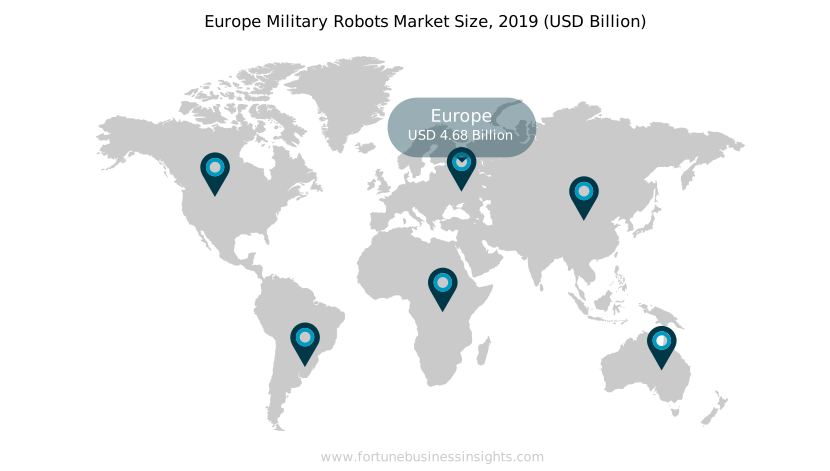
- Europe witnessed military robots market growth from USD 3.97 billion in 2018 to USD 4.68 billion in 2019.
Military robots market trends increasingly reflect a shift toward higher autonomy and intelligent decision support. Armed forces prioritize systems capable of navigating complex environments with limited human intervention. Advances in artificial intelligence and machine learning enable adaptive behavior and mission flexibility. Swarm and collaborative robotics concepts are gaining attention. Coordinated groups of robotic platforms offer redundancy, scalability, and enhanced coverage. These approaches are particularly relevant for surveillance and reconnaissance missions.
Modular design is another prominent trend. Defense organizations favor platforms that support rapid reconfiguration and payload upgrades. Modular architectures reduce lifecycle costs and extend operational relevance. Cybersecurity integration has become a critical focus. Military robots are increasingly hardened against cyber intrusion and electronic warfare. Secure communications and encrypted data links are essential procurement requirements.
Market Drivers
Integration of Advanced Technologies in Military Robots to Propel Market
Integration of technologies such as artificial intelligence, real-time data monitoring, and the Internet of Things (IoT) in military robots has drastically changed modern warfare dynamics. Soldiers' uncertain threat could be easily identified and monitored through AI-integrated robots on air, ground, and sea platforms. These robots are used to track, record, and perform required counterattacks on the targets located far away from the soldiers. This is also known as intelligence, surveillance, and reconnaissance (ISR) activity through robots.
Moreover, companies are involved in designing and developing small robots capable of transmitting images and videos of the ground-based station's target enemy base. This assists soldiers in making the required real-time decisions on battlefield scenarios. Thus, advancement in technologies is creating a potential impact on this market size.
Defense modernization initiatives represent the primary driver of the military robots market. Armed forces are restructuring force compositions to emphasize automation, networked operations, and reduced human exposure. Robotic platforms support these objectives by performing surveillance, logistics, and combat support tasks in high-risk environments. Operational risk mitigation further accelerates adoption. Military robots enable missions in contaminated, hostile, or inaccessible areas without endangering personnel. This capability is increasingly valued in counterterrorism, border security, and explosive ordnance disposal operations.
Technological advancement reinforces market momentum. Improvements in artificial intelligence, sensor fusion, navigation systems, and secure communications enhance robot autonomy and reliability. These advancements expand mission scope and operational confidence. Geopolitical tensions also contribute to sustained demand. Heightened security concerns and regional conflicts drive investment in advanced military capabilities. Robotic systems offer scalable force multipliers that align with evolving threat environments.
Market Restraints
High Initial Costs to Inhibit Market Growth
The market is growing rapidly due to its multi-tasking abilities across various military applications. These robots are integrated with various programming software to perform different tasks. This involves high costs associated with procuring and programming such robots, resulting in slowing down the market. Also, small companies find it difficult to invest in such robots due to their high design and manufacturing costs, further limiting the market's growth. In addition, this robot performs a repetitive task that enables enemies to track such robots' operations, leading to a disadvantage for the market.
Despite strong demand drivers, the military robots market faces notable constraints. High development and procurement costs remain a primary barrier. Advanced robotic platforms require sophisticated sensors, autonomy software, and secure communication systems, increasing unit costs and limiting deployment scale.
Technical reliability challenges also restrain adoption. Military robots must operate under extreme environmental conditions, electronic warfare threats, and unpredictable terrain. Ensuring consistent performance and mission endurance requires extensive testing and validation. Ethical and legal considerations influence procurement decisions. Autonomous weapon systems raise concerns regarding accountability, rules of engagement, and compliance with international humanitarian law. These issues can delay approvals and restrict deployment parameters.
Integration complexity further constrains adoption. Robotic systems must interface seamlessly with legacy command, control, communications, computers, intelligence, surveillance, and reconnaissance architectures. Integration failures can reduce operational effectiveness and increase lifecycle costs. Supply chain security presents additional challenges. Dependence on advanced electronics and specialized components exposes programs to geopolitical and sourcing risks. These restraints do not negate long-term potential but influence adoption pacing and capability prioritization across the military robots market.
Market Opportunities
Significant opportunities exist through the expansion of autonomous logistics and transportation systems. Military supply chains face increasing complexity and vulnerability. Robotic transport platforms improve resupply efficiency and reduce personnel risk in contested environments. Naval robotics presents additional growth potential. Unmanned surface and underwater vehicles support mine countermeasures, surveillance, and anti-submarine operations. Increased maritime security concerns drive investment in these capabilities.
Emerging economies offer long-term opportunities. As defense budgets expand, these nations seek cost-effective force multipliers. Modular and scalable robotic systems align well with such requirements. Dual-use technology integration creates further opportunity. Advances in commercial robotics, artificial intelligence, and autonomy can be adapted for military use, accelerating innovation and reducing development costs.
Military Robots Market Segmentation Analysis
The military robots market is segmented across platforms, operating modes, propulsion systems, and applications, each reflecting distinct operational doctrines, procurement priorities, and technological maturity levels. Segmentation trends highlight how defense organizations allocate budgets, manage risk, and pursue capability advantages. Understanding these dynamics is critical for assessing the military robots market size evolution, value concentration, and long-term military robots market growth.
By Platform Analysis
To know how our report can help streamline your business, Speak to Analyst
Rising Border Security Concerns to Exhibit a Higher Growth Rate
Based on the platform, the market is segmented into airborne, land, and naval.
Airborne
The land segment is expected to grow significantly during the forecast period due to the higher adoption of land robots across various countries, rising investment and research & development activities conducted to upgrade ground robots, and increasing border security concerns in Asian countries. Furthermore, the deployment of such robots is used for extensive tactical military applications and is expected to fuel the market's growth.
Airborne and naval segments are expected to grow at a considerable rate due to rising manufacturers' interest in upgrading existing robots, government initiatives to invest in military & defence sectors, and various military modernization programs.
- The Airborne segment is expected to hold a 26.3% share in 2019.
Airborne military robots, primarily unmanned aerial vehicles, represent a strategically important segment driven by intelligence, surveillance, and reconnaissance requirements. Armed forces deploy airborne platforms to achieve persistent situational awareness, rapid deployment, and operational reach beyond traditional assets. Demand is strongest for systems capable of extended endurance, secure communications, and real-time data transmission. This segment commands a significant share of the military robots market value due to advanced avionics, sensors, and autonomy software. Adoption continues to expand as airspace integration frameworks mature and multi-mission payload capability improves.
Land
Land-based military robots account for the largest deployment volumes within the military robots market. These platforms support explosive ordnance disposal, reconnaissance, logistics, and combat support missions. Demand is driven by the need to reduce personnel exposure in urban and hazardous environments. Land robots emphasize mobility, ruggedization, and payload flexibility. Modular designs allow rapid role adaptation, supporting sustained procurement. This segment anchors the military robots market growth due to frequent deployment cycles and broad mission applicability.
Naval
Naval military robots include unmanned surface and underwater vehicles supporting mine countermeasures, surveillance, and maritime security. Adoption is driven by rising naval modernization efforts and the need to monitor contested maritime zones. These platforms require advanced navigation, endurance, and secure command links. Although volumes are lower, high system complexity results in elevated unit values. Naval robotics represents a growing contributor to the military robots market share in coastal and blue-water operations.
By Mode of Operation Analysis
The Autonomous Segment is Expected to Grow Significantly during the Forecast Period
The market is classified into semi-autonomous or human-operated robots and autonomous robots based on the mode of operation.
Autonomous
The autonomous segment is expected to grow significantly in the coming years due to the augmentation of advanced aerial robots equipped with missiles and weapons used for reconnaissance without endangering pilots. Further, the usage of technologies such as light detection and ranging (LiDAR), fiber optics tether, and 3D imaging integrated into autonomous robots is driving the market.
Autonomous military robots represent a high-growth segment as artificial intelligence capabilities mature. These systems execute missions with minimal human input, improving responsiveness and scalability. Adoption remains selective, constrained by legal and doctrinal factors. However, autonomous navigation, target recognition, and coordination capabilities continue to advance. Long-term military robots market growth is closely tied to the broader acceptance of autonomous operations across defense forces.
Semi-Autonomous
Semi-autonomous systems dominate current deployments due to regulatory, ethical, and operational considerations. These platforms combine automated functions with human oversight, enabling controlled decision-making. Defense organizations favor this mode to balance efficiency and accountability. Semi-autonomous robots are widely used in surveillance, logistics, and support roles. This segment captures a substantial portion of the military robots market size and remains central to near-term procurement strategies.
The semi-autonomous segment is expected to grow rapidly due to government initiatives to procure and invest in conventional military robots and robots for border surveillance activities.
By Mode of Propulsion Analysis
Growing Demand for electric-propelled robots for Aerial and Naval applications is expected to boost the Growth of the Market.
Based on the mode of propulsion, the market is segmented into manual, electric, and hybrid.
Manual
The manual segment accounted for the largest market share in 2019. These robots are generally known as command control robots, widely used for long-range ground-based operations. Engines, thrusters, and other transmissions propel these robots. These robots use a global positioning system (GPS) and 3G technology for navigation and communication purposes.
Manual propulsion systems remain relevant in smaller land robots and specialized platforms. These systems emphasize simplicity and reliability. Adoption persists in scenarios requiring direct operator control. While technologically limited, manual propulsion supports cost-sensitive procurement and training applications.
Electric
The electric propulsion segment is anticipated to grow at the highest CAGR during the forecast period. The wide use of electric motors and battery-operated robots for aerial and naval-based robots is expected to drive the growth. These robots are controlled by using ultrasonic and infrared sensors. The hybrid segment comprises robots operated with integrated electric propulsion and manual systems. Solar panels and electric propulsion systems can also propel hybrid robots.
Electric propulsion dominates the military robots market due to efficiency, reduced acoustic signature, and lower thermal visibility. Electric systems support endurance and stealth requirements across land, air, and naval platforms. Advances in battery technology enhance mission duration. This segment aligns with broader defense sustainability initiatives and supports sustained market expansion.
Hybrid
Hybrid propulsion systems combine electric and fuel-based power sources to extend range and endurance. Adoption is strongest in larger platforms requiring sustained operation. Hybrid systems increase complexity but provide operational flexibility. This segment is gaining relevance as missions demand longer deployment cycles.
By Application Analysis
ISR Activities to Dominate the Market
The market is segmented into intelligence, surveillance and reconnaissance, search and rescue, combat support, transportation, and others based on application.
Intelligence, Surveillance, and Reconnaissance
The intelligence, surveillance, and reconnaissance segments are estimated to be the largest market segment in 2019. The ISR segment is also expected to be the fastest-growing segment during the forecast period. The growth is attributed to a rise in ISR activities in North America and Asian countries. Intelligence, surveillance, and reconnaissance applications represent the largest share of the military robots market demand. Robots provide persistent monitoring, data collection, and threat detection. Adoption is driven by the need for real-time intelligence and reduced risk exposure. This application segment anchors long-term market growth.
The major countries' defense forces in these regions are highly dependent on unmanned aerial vehicles (UAVs) and unmanned ground vehicles (UGVs) for aerial and ground operations. Similarly, unmanned surface vehicles (USVs), Autonomous Underwater Vehicles (AUVs), and remotely operated vehicles (ROVs) are used for naval operations. Defence forces rely on these advanced robots to monitor and gather minute details related to the enemy locations and their activities.
Transportation
The transportation segment is expected to grow considerably due to the wide usage of robots for transporting weapons, ammunition, and soldiers to remote locations on the battlefield. Advanced robots such as R-gator, iRobot Warrior, Armored Combat Engineer Robot (ACER), Squad Mission Support System (SMSS), and Multifunction Utility/Logistics and Equipment vehicle (MULV) are some of the widely used military autonomous robots for transportation applications. Transportation robots support resupply and equipment movement. Adoption is driven by logistics vulnerability concerns. Autonomous transport systems represent a significant opportunity area.
Combat Support And Search & Rescue
Combat support and search and rescue segments are expected to show a substantial growth rate. These applications serve militaries to gauge real-time situations and support rescue activities based on critical operations in remote locations. Combat support robots provide logistics, engineering, and tactical assistance. Adoption improves operational tempo and reduces manpower requirements. This segment benefits from modular payload integration and growing autonomy. Search and rescue applications leverage robots to operate in hazardous or inaccessible environments. These platforms support disaster response, combat recovery, and humanitarian missions. Demand is driven by safety and operational effectiveness. While smaller in scale, this segment reinforces diversification.
REGIONAL INSIGHTS
Geographically, the global market is segmented across five major regions: North America, Europe, Asia Pacific, the Middle East & Africa, and Latin America. They are further categorized into countries.
Europe Military Robots Market Analysis:
The European military robots market is shaped by defense cooperation initiatives and modernization programs. Armed forces emphasize robotic systems for reconnaissance, border security, and logistics support. Regulatory alignment and multinational procurement influence adoption patterns. Investment in interoperability and joint capability development supports steady military robots market growth across regional defense organizations and allied operational frameworks.
In 2019, Europe's military robots market size was USD 4.68 billion, holding the highest share in the market owing to the presence of major manufacturers operating in this market. According to The World Robotics 2019, 700 service robot manufacturing companies are identified across the globe, out of which 307 companies are operating in Europe.
Moreover, this region has a strong command over integrating a broad spectrum of technologies. This includes speech and haptics-based human-machine interface, navigation and collision avoidance, motion and task planning, and others. However, due to the COVID-19 pandemic, European countries are presently focusing on national security aspects and are restructuring their defense planning in 2020. This may hamper the growth of the market in 2020 and 2021.
Germany Military Robots Market:
Germany’s military robots market reflects emphasis on engineering reliability, operational safety, and compliance standards. The armed forces deploy robots for explosive ordnance disposal, reconnaissance, and logistics. Domestic industry collaboration and European defense programs support capability development. Investment priorities focus on modular platforms and secure integration, sustaining measured military robots market growth within national and allied defense strategies.
United Kingdom Military Robots Market:
The United Kingdom military robots market prioritizes force protection and expeditionary capability enhancement. Robotic platforms support surveillance, counter-explosive operations, and logistics. Defense innovation programs encourage rapid testing and adoption of autonomous technologies. Collaboration with allied forces and industry partners supports consistent military robots market growth aligned with modernization and operational resilience objectives.
Asia-Pacific Military Robots Market Analysis:
Asia-Pacific represents the fastest-growing military robots market due to rising defense budgets and regional security concerns. Armed forces invest in unmanned systems to enhance surveillance, border monitoring, and maritime security. Domestic development programs and technology partnerships accelerate adoption. These factors support strong military robots market growth across land, air, and naval platforms regionally.
Asia Pacific is expected to grow exponentially in the coming years. This is mainly due to China’s investment in military programs for air, land, and sea defense. China and India emphasize investing in emerging technologies such as artificial intelligence and nanotechnology that will fundamentally change military robots' capabilities.
Japan Military Robots Market:
Japan's military robots market emphasizes defensive capability, disaster response, and surveillance applications. Robotic systems support reconnaissance, logistics, and hazardous environment operations. Government investment focuses on autonomy, reliability, and interoperability. Strong technology foundations and cautious deployment strategies support steady military robots market growth aligned with national security and humanitarian priorities.
China Military Robots Market:
China holds a significant share of the military robots market, driven by large-scale modernization and indigenous development programs. Armed forces deploy robotic systems across surveillance, logistics, and combat support roles. Strong state investment and manufacturing capacity accelerate deployment. These dynamics contribute to expanding the military robots market size and influence global competitive balance.
North America Military Robots Market Analysis:
North America is expected to grow significantly during the forecast period due to a considerable number of suppliers and electronic component providers, and government interest in investing in research & development activities deliberately. North America represents a leading military robots market driven by sustained defense modernization and advanced research investment. Armed forces prioritize robotic systems for surveillance, logistics, and force protection. Strong funding for autonomy, artificial intelligence, and joint-domain operations supports rapid capability development. Close collaboration between defense agencies and industry sustains a high military robots market share and continued technological leadership.
United States Military Robots Market:
The United States dominates the global military robots market through extensive procurement programs and an innovation-led defense strategy. Investment focuses on autonomous land systems, unmanned aerial platforms, and naval robotics. Integration with network-centric warfare architectures remains a priority. Strong defense budgets and experimentation programs support consistent military robots market growth across multiple operational domains and mission profiles nationwide.
Latin America Military Robots Market Analysis:
Latin America shows gradual adoption within the military robots market, driven by border security, counter-narcotics, and disaster response needs. Defense organizations deploy limited robotic systems for surveillance and explosive ordnance disposal. Budget constraints moderate procurement scale. However, regional security challenges support long-term military robots market growth potential across selected applications.
Middle East & Africa Military Robots Market Analysis:
The Middle East and Africa military robots market is driven by security challenges and force protection priorities. Armed forces deploy robots for surveillance, explosive ordnance disposal, and base security. Government investment and foreign partnerships support capability acquisition. Market growth depends on defense spending trends, technology transfer, and operational requirements across regional conflict environments.
Military Robots Industry Competitive Landscape
Leading Key Players are Focusing on Introducing Technologically Advanced Military Robots
Key manufacturers are proactively strengthening their market position by upgrading robots to cater to different military applications. Further, key suppliers integrate the robots with advanced technology, such as artificial intelligence, IoT, and big data, to enhance their features. In addition, governments of developed countries are allocating funds to uplift the defense sector, further propelling this market.
The military robots industry's competitive landscape is characterized by a concentration of large defense contractors alongside specialized robotics and autonomy firms. Leading vendors leverage system integration expertise, long qualification cycles, and trusted relationships with defense ministries. Their offerings span land, air, and naval robotic platforms integrated into broader command-and-control ecosystems.
Major defense contractors dominate high-value contracts by delivering end-to-end solutions, including hardware, software, training, and lifecycle support. Their scale enables compliance with stringent military standards and supports multinational deployments. These firms maintain a strong military robots market share through continuous innovation and platform upgrades. Emerging players focus on autonomy software, artificial intelligence, sensors, and mobility subsystems. While smaller in scale, these firms influence technology direction and accelerate innovation cycles. Partnerships with prime contractors allow integration into large programs and improve market access.
Strategic collaboration is central to competition. Joint ventures, defense research partnerships, and allied procurement initiatives shape vendor positioning. Governments increasingly favor interoperable systems developed through collaborative frameworks. Competitive differentiation increasingly depends on autonomy, maturity, cybersecurity resilience, and modularity. Vendors capable of rapid capability upgrades and integration with joint-domain operations are best positioned to sustain long-term military robots market growth.
List of Top Military Robots Companies:
- Northrop Grumman Corporation (The U.S.)
- Thales Group (France)
- FLIR Systems, Inc. (The U.S.)
- Clearpath Robotics Inc. (Canada)
- Cobham Limited (The U.K.)
- QinetiQ (The U.K.)
- AeroVironment, Inc. (The U.S.)
- BAE Systems. (The U.K.)
- Elbit Systems Ltd. (Israel)
- Raytheon Technologies (The U.S.)
Latest Military Robots Industry Developments:
- January 2024: Northrop Grumman advanced autonomous ground vehicle testing to support logistics missions, aiming to improve operational efficiency using artificial intelligence-based navigation and obstacle avoidance systems.
- April 2024: Rheinmetall expanded its unmanned ground systems portfolio to enhance combat support capability, strengthening modular payload integration through advanced robotics and control technologies.
- August 2024: Boeing demonstrated collaborative unmanned aerial systems for surveillance missions, supporting force multiplication through autonomous coordination and secure communications capability development.
- February 2025: General Dynamics introduced upgraded robotic systems for explosive ordnance disposal, enhancing safety performance through improved sensor fusion and remote operation technologies.
- June 2025: Elbit Systems partnered with a defense agency to deploy autonomous reconnaissance robots, targeting enhanced situational awareness using machine vision and encrypted command-and-control systems.
REPORT COVERAGE
The military robots market research report provides detailed information regarding various insights into the industry. Some of them are growth drivers, restraints, competitive landscape, regional analysis, and challenges. It further offers an analytical depiction of the military robot market trends and estimations to illustrate the forthcoming investment pockets. The market is quantitatively analyzed from 2020 to 2027 to provide financial competency. The information gathered in the report has been taken from several primary and secondary sources.
Report Scope and Segmentation
|
ATTRIBUTE |
DETAILS |
|
Study Period |
2016-2027 |
|
Base Year |
2019 |
|
Forecast Period |
2020-2027 |
|
Historical Period |
2016-2018 |
|
Unit |
Value (USD billion) |
|
Segmentation |
By Platform
|
|
By Mode of Operation
|
|
|
By Mode of Propulsion
|
|
|
By Application
|
|
|
By Region
|
Frequently Asked Questions
According to Fortune Business Insights, the global military robots market size was USD 13.87 billion in 2019 and is projected to reach USD 64.13 billion by 2032, growing at a CAGR of 12.50% from 2020 to 2032. The market experienced a brief slowdown in 2020 due to COVID-19 but is expected to rebound strongly.
Military robots are used for intelligence, surveillance, and reconnaissance (ISR), combat support, search and rescue, transportation, and border patrol. These robots enhance battlefield efficiency while reducing risk to human soldiers.
The market is projected to grow at a CAGR of 10.15 % during the forecast period (2020-2027).
Leading investors in military robotics include the United States, China, and Russia. These nations are focusing on autonomous aerial and ground systems to enhance combat capabilities, surveillance, and rescue operations.
Key trends include the integration of AI and IoT, adoption of autonomous drones, and development of human-robot collaboration systems. Countries are also focusing on multi-mission robots and electronic warfare-ready platforms.
Military robots are deployed across land, airborne, and naval platforms. Land-based robots are currently leading due to rising investments in border security and ground reconnaissance.
Military robots operate in semi-autonomous (human-operated) and fully autonomous modes. The autonomous segment is expected to grow rapidly due to advancements in LiDAR, 3D imaging, and sensor integration.
The main propulsion types are manual, electric, and hybrid. Electric propulsion is the fastest-growing segment due to its applications in aerial and naval systems, offering improved control and low operational noise.
High initial costs, cybersecurity risks, and predictability of robot behavior in warfare environments are key challenges. Smaller defense contractors also struggle with the high cost of design and R&D.
Europe held the largest market share in 2019 at 33.74%, supported by over 300 service robot companies. However, Asia Pacific is expected to experience rapid growth due to defense investments by China and India.
Key players include Northrop Grumman, Thales Group, FLIR Systems, Clearpath Robotics, BAE Systems, QinetiQ, AeroVironment, and Raytheon Technologies. These companies are focused on AI integration, product innovation, and global expansion.



-
REPORT UPDATE
IN PROCESS -
2019-2032
(IN PROCESS) -
2025
(IN PROCESS)




















Related Reports
-
US +1 833 909 2966 ( Toll Free )
-
Get In Touch With Us