Smoothies Market Size, Share & Industry Analysis, By Type (Fruit Based, Dairy Based, Vegetable Based, and Others), By Form (RTD, Fresh, and Frozen), By Distribution Channel (Retail {Supermarkets/Hypermarkets, Convenience Stores, Online Retail, and Others} and Foodservice), and Regional Forecast, 2026-2034
 Download Free Sample
 Smoothie Market Overview
 Listen to Audio Version
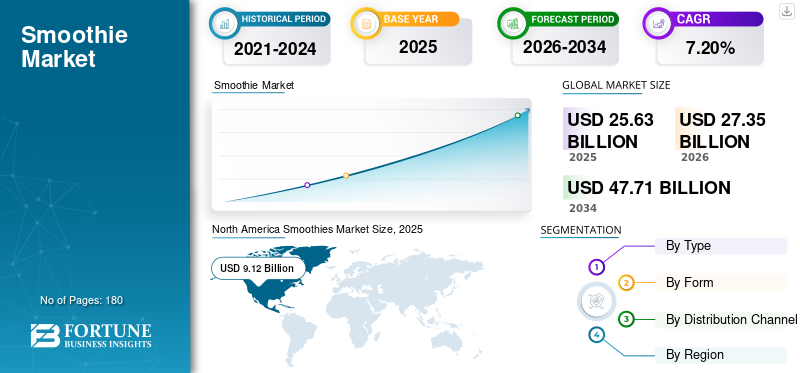
The global smoothies market size was valued at USD 25.63 billion in 2025. The market is projected to grow from USD 27.35 billion in 2026 to USD 47.71 billion by 2034, exhibiting a CAGR of 7.20% during the forecast period. North America dominated the smoothies market with a market share of 35.58% in 2025.
Smoothies are thick blended beverages made by combining fruits, vegetables, and additional ingredients such as protein powders, seeds, or sweeteners. They are typically consumed as nutritious beverages, meal replacements, or healthy snacks due to their high content of vitamins, minerals, antioxidants, and fiber. Consumers are choosing plant-based diets and clean-label products, which is driving up demand for smoothie blends. The growth of smoothie bars, juice chains, cafés, and quick-service restaurants has increased accessibility of such drinks.
Companies such as Smoothie King, Tropical Smoothie Café, Jamba, and others are some of the key players operating in this market. New product launch is the key strategy, which is boosting product sales and supporting the market growth.
Download Free sample to learn more about this report.
SMOOTHIES MARKET TRENDS
Functional Nutrition Trends Accelerating Innovation and Premiumization in the Market
Consumers are shifting away from basic fruit smoothies toward options with added ingredients, such as plant proteins, probiotics, collagen, adaptogens, vitamins, and superfoods such as spirulina, chia seeds, and acai. This shift is driven by more people, especially millennials and urban consumers, who are conscious of gut health, immunity, energy, and overall wellness. Brands are launching smoothies with less sugar, more fiber, and extra protein to meet the needs of people focused on weight management and sports nutrition. As a result, companies are investing in product innovation and premium functional formulations to differentiate themselves in an increasingly competitive market. For instance, Getaway smoothie blends focus on refreshing, fruit-forward beverage options designed for convenient and healthy consumption.
MARKET DYNAMICS
MARKET DRIVERS
Rising Health Consciousness and Demand for Convenient Nutrition Drives Market Growth
The market is growing as consumers focus on health, wellness, and easy, convenient nutrition. As consumer awareness of balanced diets and the benefits of eating fruits, vegetables, and other healthy ingredients increases, they are choosing smoothies as a healthier drink option. Consumers prefer smoothies as nutritious since they usually contain natural ingredients such as fruits, vegetables, yogurt, plant-based milk, and superfoods, which provide important vitamins, minerals, and fiber. Busy lifestyles and high urbanization have led to greater demand for quick meals and snacks. This makes smoothies a popular choice for those who want something fast and healthy, which supports the smoothies market growth.
MARKET RESTRAINTS
High Product Prices and Sugar Content Concerns Limiting Wider Consumer Adoption of Smoothies
The market is hampered mainly by the high cost of products and consumer concerns about the sugar content of fruit-based drinks. Many store-bought smoothies use premium ingredients such as fresh fruits, superfoods, plant-based milk, and protein supplements. These ingredients make smoothies more expensive to produce than soft drinks or juice. Due to the higher prices, some cost-conscious consumers, especially in developing countries, may not buy smoothies as often. Even though many people consider smoothies as healthy, some ready-to-drink options have added sugar. This deters health conscious consumers from purchasing such products. Increased regulatory restrictions on sugar labeling and greater awareness of calories are also leading some people to pick low-sugar drinks instead.
MARKET OPPORTUNITIES
Expansion of Plant-Based and Functional Beverage Innovation Creating Growth Opportunities in the Market
The smoothies market is witnessing new opportunities as more people seek plant-based and functional drinks. As more people choose vegan, flexitarian, and lactose-free diets, manufacturers can create smoothies with plant proteins such as pea, almond, oat, soy, and coconut. Emerging markets in the Asia Pacific, South America, and the Middle East offer new potential as urbanization grows, incomes rise, and more people discover healthy, convenient drinks. Companies that focus on clean-label ingredients, creative flavors, and eco-friendly packaging are likely to reach new customers and grow in the changing global market.
Download Free sample to learn more about this report.
Segmentation Analysis
By Type
High Consumer Preference for Naturally Sweet, Nutrient-Rich Beverages Drives Fruit-Based Smoothies Segment Growth
Based on type, the market is segmented into fruit based, dairy based, vegetable based and others.
Fruit based smoothies segment accounted for the largest market share in 2025. Fruit-based smoothies appeal to consumers, taste naturally sweet, and are considered healthy. Bananas, berries, mangoes, and apples add natural flavor, vitamins, antioxidants, and fiber. People also consider them as clean-label, minimally processed drinks, which aligns with the rising interest in natural and plant-based diets. They also mix well with ingredients such as chia seeds, protein powders, and superfoods, which helps keep them popular in the market.
Dairy based smoothies make up the second-largest share of the market and is expected to grow at a CAGR of 7.05% during the forecast period. Their creaminess, higher protein, and ability to keep people full make them a popular choice for those who want a more satisfying drink. Milk, yogurt, and kefir in these smoothies offer extra nutrition, including calcium, protein, and probiotics. These nutrients help with digestion and muscle recovery. People especially prefer dairy smoothies as meal replacements for breakfast and for sports nutrition. Strong dairy supply chains and the popularity of yogurt drinks in North America and Europe also help drive demand for these smoothies. Manufacturers are now offering low-fat, lactose-free, and high-protein dairy smoothies, making these drinks more appealing to consumers.
To know how our report can help streamline your business, Speak to Analyst
By Form
Rising Consumer Preference for Natural, Fresh, and Customizable Beverages Drive Fresh Segment Growth
By form, the market is segmented into RTD, fresh, and frozen.
The fresh smoothies segment held the largest smoothies market share in 2025. The segment dominates the market, as people consider them natural, less processed, and made with simple ingredients. The popularity of smoothie bars, juice chains, cafés, fitness centers, and quick-service restaurants has helped fresh smoothies become popular. More people are choosing fresh smoothies as they want healthier options and prefer picking ingredients that fit their diets, such as extra protein, fiber, or superfoods.
The RTD smoothies hold the second-largest market share, and is expected to grow at a CAGR of 7.07% during the forecast period. They are convenient, easy to carry, and last longer. Manufacturers are adding more options to their RTD smoothie lines, including functional blends, plant-based choices, and low-sugar versions, to attract health-conscious buyers. New methods such as cold-pressed processing, aseptic packaging, and better refrigeration help keep the smoothies nutritious and tasty. With wider distribution and growing interest in premium functional drinks, RTD smoothies are experiencing strong growth in both developed and emerging markets.
By Distribution Channel
Strong Consumer Demands for Freshly Prepared and Customizable Beverages Drive the Foodservice Segment Growth
By distribution channel, the market is segmented into retail and foodservice.
The foodservice segment led the global market in 2025. Foodservice is the dominant channel, driven by the popularity of smoothie bars, cafés, quick-service restaurants, juice chains, and fitness centers that offer freshly made drinks. Many people choose to buy smoothies from foodservice outlets as they can be freshly made, choose their own ingredients, and enjoy better taste. The growth of branded smoothie chains and health cafés worldwide is helping foodservice stay on top of the market.
Retail is another major segment expected to grow at a CAGR of 7.56% during the forecast period. Retail is the second largest segment of the market. This growth is driven by higher demand for ready-to-drink and packaged smoothies sold in supermarkets, hypermarkets, convenience stores, and online. Additionally, manufacturers are also increasing their presence in retail by offering new types of smoothies, such as functional, organic, and plant-based options.
Smoothies Market Regional Outlook
By geography, the market is categorized into Europe, North America, Asia Pacific, South America, and the Middle East & Africa.
North America
North America Smoothies Market Size, 2025 (USD Billion)
To get more information on the regional analysis of this market, Download Free sample
The market in North America reached a valuation of USD 9.12 billion in 2025, and it is the leading region. North America is one of the most developed markets for smoothies. Consumers’ awareness of healthy drinks, functional nutrition, and meal replacement options supports regional market growth. The region has many smoothie chains, juice bars, cafés, and quick-service restaurants. This strong network helps boost fresh smoothie sales. There is also high demand for plant-based drinks, protein-rich smoothies, and products with simple ingredients. This demand keeps driving new ideas in the market. Major beverage companies and a strong retail system help ready-to-drink smoothie products grow in the market.
U.S. Smoothies Market
In 2025, the U.S. market reached USD 7.27 billion. The U.S. is one of the biggest markets for smoothies. This is due to strong health and wellness trends, active lifestyles, and a network of popular smoothie chains. People often buy smoothies from juice bars, cafés, and places that focus on fitness. These outlets are the main way smoothies reach customers. More people are seeking plant based smoothies, drinks with extra protein, and options that support energy, immunity, or weight control. A wide range of ready-to-drink smoothies in supermarkets and convenience stores is also helping the market grow. Ongoing new product ideas and the demand for clean-label and organic ingredients are keeping the market strong.
Asia Pacific
The Asia Pacific market was valued at USD 5.93 billion in 2025. The Asia Pacific market is growing rapidly due to increasing urbanization and industrialization, as well as a greater focus on health. Consumers in countries such as China, Japan, India, and Australia are increasingly adopting convenient and nutritious beverage options. More international café chains, juice bars, and quick-service restaurants are opening, which is helping smoothies become more popular.
Additionally, demand for fruit-based beverages and functional drinks is rising among younger consumers and urban professionals.
India Smoothies Market
The Indian market in 2025 was valued around USD 0.85 billion, accounting for roughly 3.32% of global market revenues.
China Smoothies Market
China’s market in 2025 was valued at USD 1.43 billion, representing roughly 5.59% of the global market share. China’s market is expanding rapidly as more people join the middle class, live in cities, and seek healthier drinks. People are increasingly choosing fruit-based and functional drinks over sugary sodas as they believe these options are healthier.
As tea shops, juice bars, and cafés open up in cities, more people are drinking smoothies.
Japan Smoothies Market
The Japanese market in 2025 reached a valuation of around USD 0.97 billion, accounting for roughly 3.77% of global market revenues.
Europe
The European market reached a valuation of USD 6.57 billion in 2025. Consumers in this region are choosing natural, organic, and less processed drinks. People in countries such as the U.K., Germany, and France are becoming more health-conscious and turning to smoothies as an easy way to get fruits, vegetables, and other healthy ingredients. The rise of plant-based diets and vegan lifestyles in Europe is also boosting demand for dairy-free smoothies. Strict rules that support clean-label and natural ingredients are leading manufacturers to create better quality smoothies.
Germany Smoothies Market
The market in Germany in 2025 reached around USD 1.20 billion, representing roughly 4.69% of global market revenues. The market in Germany is growing as consumers need natural, organic, and clean-label drinks. Health-conscious consumers are choosing smoothies over sugary drinks as they contain vitamins and natural ingredients and are considered more nutritious.
U.K. Smoothies Market
The U.K. market reached approximately USD 1.38 billion in 2025, equivalent to around 5.36% of global market sales.
South America and Middle East & Africa
Over the forecast period, South America is expected to experience significant market growth. The South America market in 2025 recorded USD 2.41 billion. The market in this region is growing, due to its wide variety of tropical fruits such as mango, pineapple, papaya, and acai. People in countries such as Brazil and Argentina often enjoy smoothies as refreshing drinks and healthy snacks. As more people choose health-focused diets and natural drinks, many are switching from sodas to fruit-based smoothies. The growth of juice bars, cafés, and other food outlets is also helping the market expand. Wider retail distribution and more interest in functional drinks and antioxidant-rich fruit blends are further boosting the market. Middle East & Africa region reached a valuation of USD 1.61 billion in 2025. The market in the Middle East & Africa is slowly growing due to changes in eating habits, which are boosting demand for healthier drinks. Consumers are learning more about the benefits of fruit-based and healthy drinks, especially in the UAE, Saudi Arabia, and South Africa. More cafés, restaurants, and hotels are opening, which is helping boost demand for freshly made smoothies. The hot weather in the region also makes people want to drink more cold drinks, including fruit smoothies. New stores and the arrival of packaged smoothie products are also helping the market grow.
UAE Smoothies Market
UAE market is set to grow at a CAGR of 4.58% during the forecast period. The market in the UAE is growing as the expatriate population increases, and demand for premium health drinks rises. Cafés, smoothie bars, gyms, and high-end restaurants are opening quickly in cities such as Dubai and Abu Dhabi, which boosts demand for food and drinks.
COMPETITIVE LANDSCAPE
Key Industry Players
Increasing Product Innovation and Expansion of Functional Offerings Intensifying Competition in the Market
The smoothies market is very competitive, with global beverage companies, specialized smoothie brands, and regional juice bar chains all trying to stand out through new products, strong branding, and wider distribution. Top companies are creating functional, plant-based, and clean-label smoothies to match changing consumer interests in health and wellness. Many brands now offer smoothies with added protein, probiotics, vitamins, and superfoods to appeal to fitness-focused customers. Companies are also growing their ready-to-drink product lines and building stronger partnerships with supermarkets, convenience stores, and online retailers to reach more customers. To strengthen their brands and meet rising demand, companies are launching new flavors, using sustainable packaging, making acquisitions, and expanding into new markets.
LIST OF KEY SMOOTHIES COMPANIES PROFILED
- Smoothie King (U.S.)
- Tropical Smoothie Cafe (U.S.)
- Jamba (U.S.)
- Innocent Drinks (U.K.)
- Bolthouse Farms (U.S.)
- Maui Wowi Hawaiian Coffees & Smoothies (U.S.)
- Getaway And Go Go Goji Crunch (U.S.)
- PepsiCo (U.S.)
- The Coca-Cola Company (U.S.)
- Drunken Monkey (India)
KEY INDUSTRY DEVELOPMENTS
- February 2026: ITC Sunfeast launched a new smoothie for breakfast named “Breakfast Smoothie,” which is made of Banana, Oats, Almonds, Dates, and 4 Super Seeds. The product is available on e-commerce platforms and Reliance stores across India.
- November 2025: Naked Smoothies, a leading bottled smoothie manufacturer, launched a newly refreshed smoothie lineup for consumers seeking on-the-go options that deliver both flavor and nutritional benefits. The new flavor of smoothies includes Coco Gauff's Protein Pineapple Orange, Strawberry Lemon Ginger Fiber, and Tropical Greens Fiber.
- September 2025: Innocent Drinks introduced a new range of smoothies with a high vegetable content to meet the rising demand for healthy, low-sugar choices. With the launch of Green Goodness and Red Goodness smoothies, Innocent expanded its product range to offer a fruity-tasting option for consumers.
- August 2025: Smoothie King, a leading smoothie brand launched its first food menu nationwide. The new "Power Eats" menu is made to go well with Smoothie King's smoothies and offers protein-rich, tasty choices made from high-quality ingredients.
- June 2023: Keventers, a leading Indian dairy brand, introduced an additional product to its lineup. The brand unveiled a new range of smoothies made of 100% real fruit, free of artificial colors, preservatives, or flavors. The new product is available in Blueberry Blast Smoothie, which comprises flavors such as blueberries, cranberries, strawberries, and juicy apples.
REPORT COVERAGE
The global smoothies market research provides an in-depth study of market size and forecast for all the market segments included in the report. The market analysis includes details on the market dynamics and trends expected to drive the market during the forecast period. It offers information on the technological advancements, new product launches, key industry developments, and details on partnerships, mergers, and acquisitions. The industry also encompasses detailed competitive landscape with information on the market segmentation, market share and profiles of key operating players.
Request for Customization to gain extensive market insights.
Report Scope & Segmentation
| ATTRIBUTE | DETAILS |
| Study Period | 2021-2034 |
| Base Year | 2025 |
| Estimated Year | 2026 |
| Forecast Period | 2026-2034 |
| Historical Period | 2021-2024 |
| Growth Rate | CAGR of 7.20% from 2026-2034 |
| Unit | Value (USD Billion) |
| Segmentation | By Type, By Form, By Distribution Channel, and Region |
| By Type |
|
| By Form |
|
| By Distribution Channel |
|
| By Region |
|
Frequently Asked Questions
Fortune Business Insights says that the global market value stood at USD 25.63 billion in 2025 and is projected to reach USD 47.71 billion by 2034.
In 2025, the North Americas market value stood at USD 9.12 billion.
The market is expected to exhibit a CAGR of 7.20% during the forecast period.
By form, fresh segment led the global market in 2025.
Rising health consciousness and demand for convenient nutrition are the key factors driving the market.
Smoothie King, Tropical Smoothie Café, and Jamba are few of the top players in the market.
North America held the largest market share in 2025.
Functional nutrition trends accelerating innovation and premiumization in the market.



- 2021-2034
- 2025
- 2021-2024
- 180
Get 20% Free Customization
Expand Regional and Country Coverage, Segments Analysis, Company Profiles, Competitive Benchmarking, and End-user Insights.




















Related Reports
-
US +1 833 909 2966 ( Toll Free )
-
Get In Touch With Us