Battery Test Equipment Market Size, Share & Industry Analysis, By Equipment Type (Battery Cyclers / Charge-Discharge Systems and Other Battery Testing Equipment), By Product Type (Stationary Battery Test Equipment and Portable Battery Test Equipment), By Function Type (Cell Testing, Module Testing, and Pack Testing), By Application (Automotive, Industrial, Electronics & Telecommunication, Medical, Grid & Renewable Energy, and Others), and Regional Forecast, 2026 – 2034
 Download Free Sample
(Offer valid till 15th Oct 2026)

Battery Test Equipment Market Size
 Listen to Audio Version
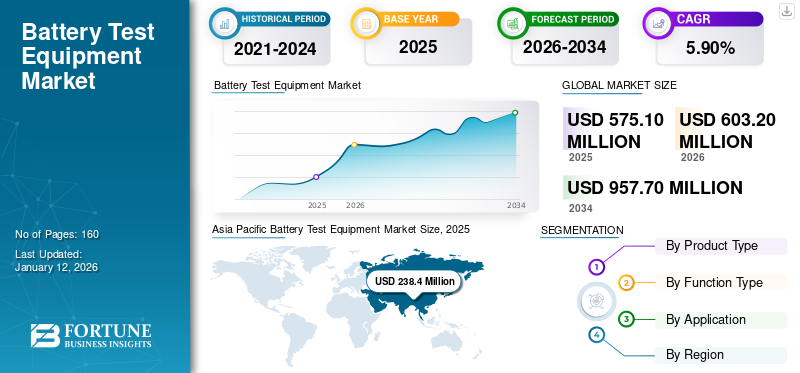
The battery test equipment market size was valued at USD 575.1 million in 2025. The market is projected to grow from USD 603.2 million in 2026 to USD 923.5 million by 2034, exhibiting a CAGR of 5.5% during the forecast period.
Battery test equipment comprises specialized instruments and systems used to measure battery performance, capacity, efficiency, impedance, durability, safety, and degradation under controlled operating conditions. The market includes battery cyclers, charge-discharge systems, impedance meters, battery analyzers, environmental test chambers, safety-testing systems, diagnostic equipment, data-acquisition platforms, and portable testers designed for cell, module, and pack testing. These systems are used across automotive, industrial, electronics and telecommunication, medical, grid and renewable energy, and logistics applications. Growing electric vehicle adoption, expansion of energy storage systems, stricter battery-safety requirements, and increasing investment in advanced battery technologies are driving demand for battery test equipment globally. The adoption of regenerative testing systems, automated validation platforms, real-time diagnostics, high-voltage pack testers, and integrated temperature and charge-discharge testing solutions is further improving testing accuracy, laboratory efficiency, energy recovery, and battery reliability.
For instance,
- In August 2025, Chroma ATE introduced the 17040E regenerative battery-pack test system for electric vehicle and battery energy storage applications. The system supports output voltage of up to 1,700 V, power of up to 2.4 MW, and energy-recovery efficiency exceeding 93%, enabling performance and safety testing of high-voltage battery packs.
Chroma ATE Inc., Arbin Instruments, Maccor Inc., ANDRITZ Bitrode Corporation, and AVL List GmbH, are among the major companies operating in the market.
Download Free sample to learn more about this report.
BATTERY TEST EQUIPMENT MARKET TRENDS
Integration of Battery Cyclers with Environmental Chambers is Emerging as a Key Market Trend
Demand for integrated battery test equipment is rising as manufacturers seek to evaluate electrical performance, temperature response, degradation, and safety within a single testing environment. Battery developers traditionally procure cyclers, environmental chambers, fixtures, safety controls, and software from different suppliers, resulting in longer installation periods and compatibility issues. Manufacturers are therefore introducing preconfigured testing platforms that combine charge-discharge testing with controlled temperature conditions and automated data management. These systems support cell, module, and pack validation while improving laboratory productivity, testing consistency, and equipment utilization. The transition toward integrated solutions are particularly evident across electric vehicles, energy storage systems, consumer electronics, aerospace, and industrial battery applications.
For instance,
- In October 2025, Associated Environmental Systems and Maccor launched FUSION, an integrated system combining battery cyclers, environmental chambers, fixtures, safety controls, cabling, and unified software. The system supports temperatures from −20°C to 80°C and offers up to 90% return-to-grid efficiency in higher-amperage configurations.
MARKET DYNAMICS
MARKET DRIVERS
Download Free sample to learn more about this report.
Expansion of Electric Vehicles and Energy Storage Systems Drives Market Growth
The battery test equipment market growth is owing to rising battery production for electric vehicles, consumer electronics, industrial machinery, telecommunication backup systems, and grid-scale energy storage systems. Every new battery design must be checked for capacity, efficiency, cycle life, charging behavior, thermal performance, and safety before commercial deployment. The adoption of electric vehicles is also increasing demand for high-voltage testing platforms capable of validating larger cells, modules, and complete EV battery packs under realistic operating conditions. Similarly, renewable energy projects require long-duration performance and battery aging tests to confirm that storage systems can operate reliably over thousands of cycles. These requirements are supporting demand for battery cyclers, charge-discharge systems, environmental chambers, battery impedance testing instruments, and automated battery validation platforms across research, manufacturing, and certification facilities.
For instance,
- In May 2025, UL Solutions opened its Europe Advanced Battery Testing Laboratory in Aachen, Germany. The facility performs lifetime, performance, off-gassing, misuse, and thermal-runaway testing for cells, modules, and packs used in electric vehicles and large-scale stationary energy storage systems.
Market Drivers - Impact & CAGR Contribution (2026–2034)
| Rank | Market Drivers | Expected Impact on Market Growth | Estimated Gross Market Growth Contribution (USD Million) | Impact: 2026-2028 | Impact: 2029-2031 | Impact: 2032-2034 |
|---|---|---|---|---|---|---|
| 1 | Expansion of electric vehicle production and battery manufacturing capacity | High | 123.20% | High | High | High |
| 2 | Increasing battery safety, quality, performance, and lifecycle-validation requirements | High | 98.70% | High | High | High |
| 3 | Growing deployment of grid-scale and renewable-energy storage systems | Medium-High | 79.50% | Medium | High | High |
| 4 | Development of fast-charging, high-voltage, solid-state, and other advanced battery technologies | Medium-High | 65.40% | Medium | High | High |
| 5 | Rising adoption of automated, regenerative, and multichannel battery-testing systems | Medium | 51.80% | Medium | Medium | High |
| 6 | Growing battery-testing demand across electronics, telecommunications, industrial, medical, and aerospace applications | Medium-Low | 36.40% | Medium | Medium | Medium |
| Total Positive Growth Contribution | 455.00% | |||||
Source: Fortune Business Insights
MARKET RESTRAINTS
High Equipment and Laboratory Setup Costs are Limiting Market Expansion
Advanced battery test equipment requires significant investment in high-current cyclers, regenerative power systems, environmental chambers, cooling infrastructure, safety enclosures, fire-suppression systems, sensors, and data-management software. The cost rises further for module and pack testing, as laboratories must handle higher voltage, greater power, and increased thermal-runaway risk. Regular calibration, specialized fixtures, software integration, and trained technical staff add to operating expenses. Testing requirements also change across battery chemistries, cell formats, voltage classes, and applications, making it difficult for smaller battery manufacturers, research institutes, and independent laboratories to achieve high equipment utilization. These financial and technical barriers can delay the adoption of advanced battery diagnostic equipment, particularly in price-sensitive markets.
Market Restraints - Impact & Negative CAGR Contribution (2026–2034)
| Rank | Market Restraints | Expected Impact on Market Growth | Estimated Reduction in Market Size (USD Million) | Impact: 2026-2028 | Impact: 2029-2031 | Impact: 2032-2034 |
|---|---|---|---|---|---|---|
| 1 | High acquisition, installation, calibration, and maintenance costs of advanced battery-testing systems | High | 32.80% | High | Medium | Medium |
| 2 | Rapidly changing battery chemistries, cell formats, voltage architectures, and testing requirements | Medium-High | 27.40% | Medium | High | Medium |
| 3 | Long battery-testing cycles and substantial energy, laboratory-space, and thermal-management requirements | Medium | 24.10% | Medium | Medium | Low |
| 4 | Shortage of skilled testing professionals and limited advanced laboratory infrastructure in developing markets | Medium-Low | 22.30% | Medium | Medium | Low |
| Total Negative Growth Impact | 106.60% | |||||
Source: Fortune Business Insights
MARKET OPPORTUNITIES
Growing Battery Manufacturing Capacity Creating Opportunities for Market Growth
The expansion of lithium-ion battery plants is creating opportunities for equipment used in incoming inspection, formation, charge-discharge testing, end-of-line validation, and defect detection. Large manufacturing facilities must test thousands of cells at consistent speed and accuracy, encouraging the integration of multichannel cyclers, battery inspection systems, automated material handling, and centralized data platforms. Demand is also moving beyond individual cell testing toward module testing and pack testing as battery manufacturers assume greater responsibility for complete systems. Battery manufacturing automation can reduce manual intervention, detect production defects earlier, and connect test results with cell-traceability records. This creates long-term opportunities for battery test equipment manufacturers offering scalable hardware, software, and battery safety validation solutions.
For instance,
- In November 2024, Volkswagen Group’s PowerCo selected AVL to plan and equip a battery-cell testing laboratory at its Salzgitter facility in Germany. The project covers testing systems and supporting infrastructure for PowerCo’s battery-cell development activities
MARKET CHALLENGES
Testing Diverse Battery Chemistries and Formats Creates Technical Challenges for Market
One of the main challenges faced by the market is the rapid change in battery technologies. Lithium-ion chemistries such as LFP, NMC, and NCA differ in voltage, thermal behavior, charging profiles, degradation patterns, and safety risks. Solid-state, sodium-ion, silicon-anode, and other next-generation batteries introduce further variations in test conditions. Equipment manufacturers must therefore develop flexible systems that can support different cell formats, voltage ranges, current levels, communication protocols, and cooling arrangements. Reproducing real-world operating conditions while maintaining measurement accuracy is particularly difficult during accelerated aging, fast charging, temperature testing, vibration, and fault simulation. Longer validation periods can also delay product launches, while differences among international standards and OEM test procedures increase software, calibration, and system-integration complexity.
Segmentation Analysis
By Equipment Type
Battery Cyclers/Charge-Discharge Systems to Register Highest CAGR Owing To Broad Adoption Of Electric Vehicles
By equipment type, the market is segmented into battery cyclers/charge-discharge systems and other battery testing equipment.
Battery cyclers/charge-discharge systems are expected to register the highest growth rate during 2026–2034. Demand is supported by controlled charge-discharge testing, lifecycle evaluation, capacity measurement, fast-charging assessment, and battery aging analysis. A modern testing platform supports cell testing, module testing, and complete pack evaluation through regenerative, multichannel, and software-integrated configurations. The adoption of electric vehicles and expansion of stationary storage production are increasing demand for battery aging test systems and battery validation platforms. Companies such as Arbin Instruments serve the battery test equipment industry with testing solutions designed for evolving battery technologies and research, production, and validation requirements.
For instance,
- In October 2024, AVL launched the Cell Tester ECO, an air-cooled multichannel battery cycler available in power classes ranging from 12 A to 600 A and configurations supporting eight to 72 channels. The system can be integrated with climate chambers, fixtures, automation software, laboratory-management systems, and data-analytics solutions for efficient battery-cell testing and validation.
Other battery testing equipment held the largest battery test equipment market share in 2025. The segment includes battery analyzers, battery diagnostic equipment, impedance meters, environmental chambers, temperature testing systems, vibration equipment, battery safety validation platforms, battery inspection systems, and digital battery diagnostics. These solutions evaluate internal resistance through battery impedance testing and assess temperature response, structural integrity, leakage, thermal runaway, and performance under abnormal operating conditions. Increasing safety requirements and the growing complexity of lithium ion battery technologies are supporting demand across EV battery manufacturing, electronics and telecommunication, medical, industrial, renewable energy, and energy storage systems. Battery test equipment manufacturers are also integrating computer vision battery inspection and battery manufacturing automation into next-generation battery validation processes.
To know how our report can help streamline your business, Speak to Analyst
By Product Type
Stationary Battery Test Equipment Led Due to its Extensive Laboratory and Manufacturing Deployment
By product type, the market is segmented into stationary battery test equipment and portable battery test equipment.
Stationary battery test equipment held the largest market share in 2025. These systems are widely installed across battery-manufacturing facilities, automotive research centers, independent laboratories, certification facilities, universities, and energy storage systems development centers. Their higher power capacity, channel density, measurement accuracy, temperature testing, and battery safety validation capabilities make them suitable for long-duration cell testing, module testing, and complete pack evaluation. Stationary systems can also be integrated with environmental chambers, cooling equipment, automated fixtures, and data-management software. The segment is expected to record the highest growth during the forecast period. Expansion of gigafactories, EV battery laboratories, and large-scale energy-storage validation facilities is increasing investment in high-current cyclers, environmental testing systems, and integrated battery validation platforms.
Portable battery test equipment is projected to grow steadily, supported by its use in field diagnostics, preventive maintenance, state-of-health assessment, battery impedance testing, and fault detection. These systems are deployed across telecom backup installations, data centers, industrial fleets, medical equipment, warehouses, and renewable-energy facilities. Their compact design enables technicians to conduct digital battery diagnostics and evaluate installed batteries without removing them from operating environments.
Top of Form
Bottom of Form
By Function Type
Cell Testing Led Owing to High Testing Volumes Across Battery Development and Production
By function type, the market is segmented into cell testing, module testing, and pack testing.
Cell testing held the largest market share of 43.8% in 2025, generating USD 252.1 million revenue share. Individual cells undergo repeated testing during material research, product development, formation, grading, quality inspection, and lifecycle validation. Manufacturers assess capacity, voltage stability, internal resistance, charging performance, self-discharge, temperature response, and degradation before cells are assembled into modules and packs. The large number of cylindrical, prismatic, pouch, and coin cells produced worldwide create sustained demand for multichannel cyclers, impedance-testing equipment, environmental chambers, and automated inspection systems. The segment is expected to grow with a CAGR of 5.1% over the forecast period.
Module testing and pack testing are each expected to register a CAGR of 5.7% during 2026–2034. Module testing is gaining importance for evaluating cell balancing, electrical connections, insulation, cooling performance, and temperature differences before final assembly. Pack testing benefits from higher-voltage EV architectures and large energy storage systems that require validation under dynamic loads, thermal cycling, vibration, rapid charging, communication faults, and safety events.
By Application
Automotive Segment Dominated Owing to Extensive Testing Requirements Across EV Battery Development
By application, the market is segmented into automotive, industrial, electronics and telecommunication, medical, grid and renewable energy, and others.
Automotive held the largest market share of 29.4% in 2025, with revenue of USD 168.9 million. The segment’s leading position is supported by increasing production of battery-electric, plug-in hybrid, and hybrid vehicles. Automotive batteries require performance, durability, fast-charging, thermal-management, vibration, abuse, and safety validation from the individual cell stage through complete EV battery packs. Investments in battery plants, 800-volt vehicle architectures, and next-generation battery technologies are increasing demand for high-current cyclers, impedance meters, environmental chambers, battery emulators, and automated testing platforms.
Automotive segment is expected to register the highest CAGR of 6.2% during 2026–2034. Growth is being driven by the adoption of electric vehicles, shorter battery-development cycles, expanding cell-manufacturing capacity, and increasingly demanding safety and performance requirements.
Battery Test Equipment Market Regional Outlook
By geography, the market is categorized into Europe, North America, Asia Pacific, South America, and Middle East & Africa.
North America
Asia Pacific Battery Test Equipment Market Size, 2025 (USD Million)
To get more information on the regional analysis of this market, Download Free sample
The North America market accounted for USD 122.4 million in revenue in 2025, supported by substantial battery R&D spending, domestic cell-manufacturing initiatives, advanced automotive engineering capabilities, and the modernization of grid-storage and backup-power infrastructure. Strong demand is driven by expanding battery R&D activities, stringent safety and performance validation requirements, and growing investments in EV battery production and grid-scale energy storage systems across the U.S. and Canada. The region also benefits from advanced testing laboratories, strong technical expertise, and increasing adoption of regenerative battery cyclers, high-voltage pack-testing systems, environmental chambers, impedance analyzers, and automated battery-testing platforms.
U.S. Battery Test Equipment Market
The U.S. is expected to dominate the North American market, generating approximately USD 64.9 million in revenue in 2026. Growth is supported by federal and private investment in domestic battery supply chains, the expansion of high-capacity cell plants, and increasing validation requirements for electric vehicles, aerospace systems, defense applications, and stationary storage projects. Demand is further driven by stringent battery safety and performance requirements, increasing R&D activities, and the need to evaluate battery capacity, cycle life, thermal behavior, fast-charging performance, and degradation. The country also benefits from advanced testing laboratories and growing adoption of battery cyclers, impedance analyzers, environmental chambers, high-voltage pack-testing systems, and automated validation platforms.
Europe
The Europe market is expected to witness steady growth during the forecast period, and generated USD 104.4 million in revenue in 2025. This growth is supported by stringent battery-safety and sustainability regulations, expansion of European cell-production capacity, and increasing validation requirements for electric mobility, second-life batteries, and grid-balancing applications. Regional demand is closely linked to stringent battery safety regulations, growing emphasis on performance validation, and the development of higher-capacity and fast-charging battery systems. Europe remains a key market for advanced battery testing solutions, supported by its strong automotive engineering base, expanding energy storage infrastructure, and established testing laboratories. Germany, the U.K., France, Italy, and Russia continue to be major contributors, benefiting from investments in battery R&D, electrification, and high-voltage module and pack-testing capabilities.
U.K. Battery Test Equipment Market
The U.K. market in 2026 is estimated at around USD 23.7 million, representing roughly 3.9% of global sales.
Germany Battery Test Equipment Market
Germany’s market is projected to reach approximately USD 28.9 million in 2026, equivalent to around 4.8% of the global market.
Asia Pacific
The Asia Pacific dominated the global market, generating USD 238.4 million in revenue and accounting for 41.5% of the total market in 2025. This regional growth is driven by large-scale cell production, extensive consumer-electronics manufacturing, continued electrification of two- and four-wheelers, and rapid expansion of battery supply chains across China, Japan, South Korea, and India. The region benefits from established battery supply chains, growing gigafactory investments, and strong demand for automated battery cyclers, environmental chambers, impedance analyzers, and module and pack-testing systems. China, Japan, India, and South Korea remain major contributors due to continued investments in battery R&D, electric mobility, advanced battery technologies, and grid-scale energy storage. Asia Pacific is also expected to grow with fastest CAGR of 6.9% during 2026–2034.
China Battery Test Equipment Market
China’s market is projected to remain dominant in the Asia Pacific region, with 2026 revenues estimated at around USD 76.8 million, representing roughly 12.7% of global sales.
Japan Battery Test Equipment Market
The Japan market in 2026 is estimated at around USD 48.3 million, accounting for roughly 8.0% of the global sales.
India Battery Test Equipment Market
The India market in 2026 is estimated at around USD 23.3 million, accounting for roughly 3.9% of global sales.
Middle East & Africa
The Middle East & Africa market is supported by expanding investment in solar-energy integration, telecom backup networks, data-center infrastructure, and remote power systems. This is increasing the need for reliable battery evaluation across GCC countries, South Africa, and other regional markets. Testing requirements are particularly associated with high-temperature operating conditions, off-grid installations, long-duration storage, and lifecycle assessment of batteries deployed in demanding environments. GCC countries lead regional demand due to investments in clean energy infrastructure and economic diversification, supporting the adoption of battery analyzers, portable testers, environmental chambers, and charge-discharge systems.
GCC Battery Test Equipment Market
The GCC market is projected to reach around USD 20.3 million in 2026, representing roughly 3.4% of the global sales.
South America
The South America market is supported by electrification of public transportation, expansion of renewable-power capacity, modernization of telecommunications networks, and the use of battery-powered equipment in mining and material handling. Testing demand is particularly influenced by harsh operating environments, variable temperatures, intensive duty cycles, and the need to verify batteries used in commercial fleets, industrial equipment, and distributed energy installations. Brazil leads regional demand due to its established automotive and electronics industries, expanding renewable energy infrastructure, and growing battery research activities, supporting the adoption of battery cyclers, portable analyzers, environmental chambers, and charge-discharge testing systems.
Brazil Battery Test Equipment Market
The Brazil market is projected to reach around USD 28.2 million in 2026, representing roughly 4.7% of the global sales.
COMPETITIVE LANDSCAPE
Key Industry Players
Key Player’s Focus on New Product Launch and Regional Service Network Expansion Boosts Market Competition
The battery test equipment market is moderately fragmented, with competition shaped by measurement accuracy, power range, channel scalability, testing speed, system reliability, software capabilities, and global after-sales support. Leading companies, including Chroma ATE Inc., Keysight Technologies, AVL, Arbin Instruments, maintain strong positions through battery cyclers, charge-discharge systems, impedance analyzers, battery emulators, environmental testing equipment, and automated validation platforms. These companies are expanding their presence through new product launches, integrated laboratory solutions, regional service networks, and partnerships with battery manufacturers, automotive OEMs, research institutes, and testing laboratories.
Competitive differentiation increasingly depends on the ability to test different battery chemistries, cell formats, modules, and high-voltage packs with consistent accuracy. Manufacturers are investing in regenerative power systems, multichannel testing, real-time data analytics, automated test sequencing, thermal-chamber integration, and energy-efficient equipment. Solutions that shorten testing cycles, recover electrical energy, support higher currents, and connect test data with laboratory management systems are gaining importance as battery development and production volumes rise across electric vehicles, electronics, industrial systems, and energy storage applications.
For instance,
- In November 2025, Keysight Technologies introduced three high-power automated test equipment families—the RP5900 regenerative DC power supplies, EL4900 regenerative DC electronic loads, and DP5700 system DC power supplies. The portfolio supports automated long-duration cycling and battery state-of-charge emulation while returning energy to the grid during regenerative operation.
LIST OF KEY BATTERY TEST EQUIPMENT COMPANIES PROFILED
- Chroma ATE Inc. (Taiwan)
- Keysight Technologies (U.S.)
- AVL List GmbH (Austria)
- Arbin Instruments (U.S.)
- Maccor Inc. (U.S.)
- Neware Technology Limited (China)
- ANDRITZ Bitrode Corporation (U.S.)
- Digatron Power Electronics GmbH (Germany)
- BioLogic Science Instruments (France)
- BaSyTec GmbH (Germany)
KEY INDUSTRY DEVELOPMENTS
- December 2025: Webasto Power Test Systems and Maccor entered a partnership to provide integrated battery-testing solutions covering cell and module cycling, high-voltage battery-pack testing, and drivetrain emulation for OEMs, laboratories, and universities.
- December 2025: HORIBA introduced its STARS platform for automated testing and Battery-in-the-Loop validation, supporting integrated control, real-time simulation, data management, and validation of batteries and electrified powertrains.
- May 2025: EA Elektro-Automatik introduced the EA-BIM 20005 battery impedance meter, featuring 20 electrochemical impedance spectroscopy channels, integrated temperature measurement, multisine testing, and compatibility with battery cycle-testing systems.
- April 2025: BioLogic unveiled the BCS-900 battery cycler and BT-Lab software suite for high-precision battery cycling, real-time monitoring, test control, and data analysis across battery research and industrial R&D applications.
- February 2025: Hioki launched the CT6833 and CT6834 AC/DC current probes for automotive power and battery testing. The compact probes support precise current and power measurements during battery charging and discharging tests conducted under WLTP and SAE J1634 standards
REPORT COVERAGE
The battery test equipment market research report provides a detailed assessment of market size and forecast estimates across all segments covered in the study. The analysis examines battery cyclers/charge-discharge systems and other battery testing equipment. It evaluates stationary and portable equipment used for cell testing, module testing, and pack testing across automotive, industrial, electronics & telecommunication, medical, grid & renewable energy, and other applications. The study also covers regenerative power systems, multichannel testing, environmental-chamber integration, high-voltage pack testing, automated test sequencing, real-time data analytics, and laboratory-management software. It assesses performance, capacity, impedance, durability, temperature response, battery aging, and safety-testing requirements across different battery chemistries and formats. In addition, the report analyzes market drivers, restraints, opportunities, challenges, regional trends, competitive positioning, product launches, partnerships, and other strategic developments undertaken by manufacturers.
Request for Customization to gain extensive market insights.
Report Scope & Segmentation
| ATTRIBUTE | DETAILS |
| Study Period | 2021-2034 |
| Base Year | 2025 |
| Estimated Year | 2026 |
| Forecast Period | 2026-2034 |
| Historical Period | 2021-2024 |
| Growth Rate | CAGR of 5.5% from 2026-2034 |
| Unit | Value (USD Million) |
| Segmentation | By Equipment Type, Product Type, Function Type, Application, and Region |
| By Equipment Type |
|
| By Product Type |
|
| By Function Type |
|
| By Application |
|
| By Region |
|
Frequently Asked Questions
According to Fortune Business Insights, the global market value will be at USD 603.2 million in 2026 and reach USD 923.5 million by 2034.
In 2025, the Asia Pacific’s market value stood at USD 238.4 million.
The market is expected to grow at a CAGR of 5.5% during the forecast period (2026-2034).
Expansion of electric vehicle production, battery manufacturing, renewable energy storage, advanced battery technologies, stringent safety validation requirements, and demand for reliable, high-performance battery testing solutions drives market growth.
Chroma ATE Inc., Keysight Technologies, AVL List GmbH, Arbin Instruments, Maccor Inc., and Neware Technology Limited are among the top players in the market.
Asia Pacific held the largest market share in 2025.


- 2021-2034
- 2025
- 2021-2024
- 140
-
(Offer valid till 15th Oct 2026)
Get 30-60 hrs Free Customization
Expand Regional and Country Coverage, Segments Analysis, Company Profiles, Competitive Benchmarking, and End-user Insights.














Related Reports
-
US +1 833 909 2966 ( Toll Free )
-
Get In Touch With Us