 Download Free Sample



Get a Quote
Receive a tailored pricing based on your needs.
- Choose license type
- Multiple user options
- Custom scope & coverage
- Fast turnaround
"Smart Strategies, Giving Speed to your Growth Trajectory"
 Listen to Audio Version
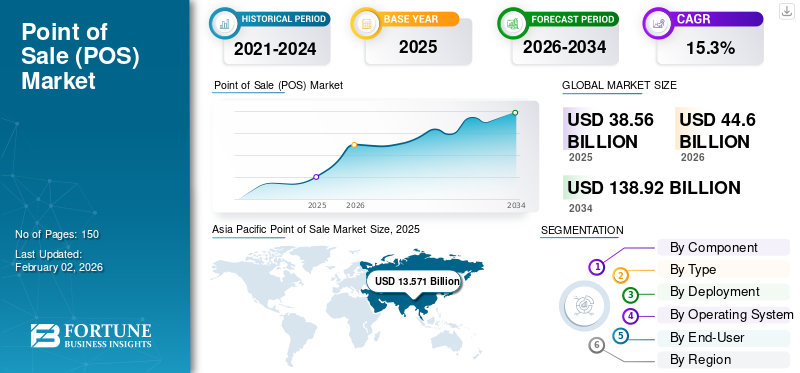
The global point of sale (PoS) market size was valued at USD 38.57 billion in 2025. The market is projected to grow from USD 43.32 billion in 2026 to USD 116.26 billion by 2034, exhibiting a CAGR of 13.1% during the forecast period. Asia Pacific dominated the point of sale (PoS) market with a market share of 35.64% in 2025.
Point of sale (PoS) systems offer several advantages to businesses across retail, restaurants, hospitality, healthcare, entertainment, and other service industries. These systems help minimize human errors in transactions by automating billing, pricing, tax calculation, discounts, and change management. Modern POS platforms are also integrated with inventory tracking, enabling businesses to monitor stock levels in real time data, reduce stockouts or overstocking, and improve reorder planning. In addition, POS systems generate detailed sales reports and analytics, helping businesses track customer preferences, product performance, peak sales periods, pricing trends, and promotional effectiveness.
The growing shift toward omnichannel retail is further increasing the importance of advanced POS systems. Retailers and restaurants now require POS platforms that can connect in-store sales, online orders, mobile payments, loyalty programs, delivery platforms, and inventory systems through a unified interface. This is encouraging businesses to adopt cloud-based, mobile, and integrated POS solutions that support both physical-store transactions and digital commerce workflows.
Leading companies in the market comprise Block, Inc., Toast, Inc., NCR Voyix Corporation, PAX Technology, Oracle Corporation, and Ingenico Group. These players are focusing on cloud POS, restaurant-specific platforms, smart terminals, AI-enabled applications, and unified commerce solutions to strengthen their market presence and maintain competitiveness.
Download Free sample to learn more about this report.
 Global Market Size & Forecast
 Market Share
 Key Regional Highlights
Asia Pacific
Asia Pacific led the market with a valuation of USD 13.75 billion in 2025.
North America
North America reached a market value of USD 10.52 billion in 2025, driven by strong adoption of digital payment solutions.
Europe
Europe was valued at USD 9.25 billion in 2025 and is projected to grow at a CAGR of 11.1% during the forecast period.
U.S.
The market reached USD 8.92 billion in 2025, accounting for approximately 23.1% of global sales.
Japan
The market was valued at USD 2.19 billion in 2025, representing approximately 5.7% of global revenue.
Read More

Personalized Shopping, Intelligent Store Operations, and Dynamic Pricing Optimization to Fuel Market Expansion
Generative AI is expected to significantly influence the point of sale (PoS) market growth by improving customer engagement, store operations, pricing decisions, and transaction security. AI-enabled POS systems can analyze customer purchase history, product preferences, basket behavior, and loyalty data to provide personalized recommendations, targeted promotions, and customized checkout experiences. This helps retailers and restaurants improve customer satisfaction, increase repeat purchases, and strengthen loyalty programs. Generative AI can also support store associates by providing real-time product information, inventory visibility, pricing insights, and customer-specific suggestions at the point of sale.
In addition, AI-based POS platforms can support dynamic pricing, demand forecasting, fraud detection, and inventory optimization. These systems can analyze transaction patterns, market demand, competitor pricing, and customer behavior to help businesses adjust pricing strategies and improve profitability.
Such developments indicate that generative AI is transforming POS systems from basic transaction tools into intelligent commerce platforms.
Rising Adoption of Cloud-based POS, AI Integration, and Unified Commerce Platforms to Aid Market Growth
The surging adoption of cloud-based and AI-enabled POS solutions is supporting the modernization of retail, restaurant, and service-sector operations. Businesses are moving away from traditional on-premise POS systems toward cloud platforms that offer remote access, faster software updates, real-time inventory visibility, omnichannel order management, customer data integration, and advanced analytics. AI integration is further improving POS capabilities by supporting personalized recommendations, inventory optimization, demand forecasting, loyalty management, and employee productivity. For instance,
Such developments indicate that cloud-based, AI-enabled, and unified commerce POS platforms are becoming key growth drivers in the global POS market.
Download Free sample to learn more about this report.
Rising Adoption of Digital Payments, Mobile Wallets, and QR-based Transactions to Fuel Market Growth
The growing adoption of digital payments, mobile wallets, QR-based payments, and contactless transactions is significantly supporting the demand for modern POS systems. Consumers are increasingly using payment apps, cards, mobile wallets, UPI, Apple Pay, Google Pay, and other contactless methods for daily transactions, encouraging retailers, restaurants, and service providers to upgrade their POS infrastructure. Younger consumers and digitally active shoppers are especially driving the adoption of mobile-first payment experiences, where speed, convenience, and secure checkout are key expectations. This is pushing POS providers to integrate multiple payment modes, including cards, wallets, QR codes, UPI, and tap-to-pay, into a single platform.
Such advancements are expected to strengthen POS adoption across retail, restaurants, hospitality, banking, and other service industries.
Data Security Concerns May Impede the Market Growth
Data security is a major concern in the PoS market for businesses and consumers. Unauthorized access to payment card data may lead to data breach. If PoS systems are compromised, it can lead to the exposure of payment card information, putting customers at risk of fraud and identity theft. Furthermore, inadequate password protection and weak authentication measures can make PoS systems vulnerable to unauthorized access. This may lead to unauthorized individuals gaining control over the PoS system and accessing sensitive data. In addition, integrations with third-party services or software can introduce security risks. If these third-party components are not adequately secured, they can serve as entry points for cyber attackers to gain access to PoS systems. These factors are expected to hamper the market growth.
Self-checkout and Kiosk-based POS Adoption to Create Strong Growth Opportunities in Retail and QSRs
The rising adoption of self-checkout and self-ordering kiosks is creating a strong opportunity for market players, especially across retail stores and QSR chains. Retailers are using self-checkout to reduce queues, improve store throughput, and manage labor shortages, while QSRs are using kiosks to support faster ordering, upselling, digital payments, and kitchen workflow integration For instance,
The National Restaurant Association reported that, in restaurants, operators increasingly view technology as a competitive advantage, with customers showing interest in tools that make ordering and payment faster. McDonald’s has also been testing cash-accepting self-service kiosks in U.S. stores, reflecting how QSRs are expanding kiosk use beyond card-only digital ordering. These developments indicate that self-checkout and kiosk-based POS systems will remain a major growth avenue across developed markets such as North America, Europe, Japan, South Korea, and GCC.
Greater Adoption of Point of Sale Solutions in Retail Shops to Spur Retail Segment Expansion
The market is divided into retail, restaurants, entertainment, and others (gas stations, transportation, and so on) based on end-user.
The retail segment held the largest market share of 43.7% in 2025. This is due to the increasing adoption of PoS systems in retail shops as it is time and cost-efficient and provides real-time data about sales performance. Moreover, this system makes it easy for retailers to manage promotions and discounts. They can apply discounts, track promotional effectiveness, and implement targeted marketing campaigns directly through the PoS solutions.
The restaurants segment is estimated to showcase the highest CAGR of 15.4% during the forecast period.
To know how our report can help streamline your business, Speak to Analyst
Increasing Installation of Hardware to Enhance Transaction Processing to Foster Hardware Segment Growth
Based on component, the market is classified into hardware and PoS terminal software.
The hardware segment secured the maximum share in the market in 2025 as it facilitates quick and accurate transaction processing. This leads to faster checkouts, reducing waiting times for customers and improving overall operational efficiency. As a result, the installation of PoS hardware has gained momentum in restaurants, retail, banking, and gas stations across the globe.
The PoS terminal software segment is expected to grow at the highest CAGR during the forecast period.
Capability to Enhance the Overall System’s Functionality in Retail to Fuel the Fixed PoS Segment Growth
Based on type, the market is divided into fixed PoS, mobile PoS, and others (barcode scanner, receipt printer, cash drawer, and so on).
The fixed PoS segment is likely to hold the largest share of 63.6% in the market in 2025. Fixed PoS solutions are designed for stability and reliability. The dedicated hardware and infrastructure at a fixed location contribute to consistent performance, reducing the risk of technical issues. These terminals have larger display screens and can accommodate additional peripherals such as customer displays, card readers, and others to enhance the overall functionality of the system in the retail sector. These factors are spurring the segment growth.
The mobile PoS segment is expected to grow at the highest CAGR of 15.80% during the forecast period.
Surge in Adoption of Cloud-based PoS Systems to Boost the Market Growth
Based on deployment, the market is bifurcated into on-premise and cloud-based.
The cloud-based segment held the maximum point of sale (PoS) market share in 2025 and it is expected to continue its dominance by growing at the highest CAGR of 16.40% over the analysis period. These solutions allow businesses to access their data and perform transactions from any location with an internet connection. This is particularly valuable for businesses with multiple locations, enabling centralized management and real-time visibility. In addition, cloud-based PoS systems often have lower upfront costs compared to traditional on-premises solutions. Businesses can avoid significant investments in hardware and infrastructure, and instead, pay a subscription fee based on usage.
The on-premise segment is expected to grow at the second-highest CAGR of 11.90% during the forecast period.
Windows/Linux OS Segment to Expand due to Rising Implementation with User-friendly Interface
Based on operating system, the market is categorized into Windows/Linux, Android, and iOS.
The Windows/Linux segment held the maximum share of 49.7% in the market in 2025, owing to its user-friendly interface, integration capabilities, and compatibility with a wide range of software applications. This familiarity makes it easier for staff to adopt point of sale system, reducing training time and minimizing errors during transactions. In addition, Windows OS supports multi-tasking, allowing small and medium sized businesses to run multiple applications simultaneously.
The Android segment is anticipated to grow at the highest CAGR of 17.10% during the forecast period.
Widespread Merchant Acceptance of Card Payments to Fuel Cards Segment Growth
Based on payment technology, the market is categorized into cards, NFC, QR codes, and mobile wallet.
The cards segment captured the maximum market share of 45.3% in 2025 due to their deeply established acceptance infrastructure across retail, hospitality, and service sectors. Banks, merchants, and payment networks have invested heavily in card issuance and POS terminal deployment over the past two decades, creating strong network effects that favor card usage. Additionally, credit and debit cards remain the preferred payment method for higher-value transactions due to their widespread consumer trust, security features, and access to credit and rewards programs.
The QR codes segment is anticipated to grow at the highest CAGR of 19.20% during the forecast period.
By region, the market is categorized into North America, South America, Europe, the Middle East & Africa, and Asia Pacific.
Asia Pacific Point of Sale (PoS) Market Size, 2025 (USD Billion)
To get more information on the regional analysis of this market, Download Free sample
Asia Pacific accounted for a valuation of USD 13.75 billion in 2025. The regional market is expected to hold a major share in the POS market and grow at the highest CAGR over the analysis period. This is due to its large retail base, fast-growing merchant digitization, and strong adoption of QR, wallet, mobile POS, and smart POS systems. China remains a major contributor, supported by its large retail economy, with total retail sales of consumer goods reaching USD 6.73 trillion in 2024, up 3.5% year-on-year.
India is also driving strong growth, as NPCI data shows UPI handled 23.20 billion transactions in May 2026, reflecting rapid digital payment adoption among small retailers, restaurants, and service merchants. In addition, India’s QR code deployments surged 126% to 633.44 million, while POS terminals crossed 10 million, showing strong merchant-side digital infrastructure expansion.
ASEAN further supports regional growth through QR payment systems such as QRIS, DuitNow QR, SGQR, PromptPay, VietQR, and QR Ph, which are improving merchant acceptance across retail, restaurants, tourism, and transportation. The Asia Pacific region leads as it combines China’s large existing POS base, India’s fast merchant digitization, ASEAN’s QR-led growth, and mature high-value markets such as Japan, South Korea, and Australia.
The Japan market was valued at around USD 2.19 billion in 2025, accounting for roughly 5.7% of global revenues.
The China market is projected to be one of the largest markets worldwide, with 2025 revenues touching around USD 5.33 billion, representing roughly 13.8% of global sales.
The India market was estimated at around USD 2.39 billion in 2025, accounting for roughly 6.2% of global market share.
The North America market value stood at USD 10.52 billion in 2025. The region holds the second-largest share in the POS market due to its mature retail infrastructure, high card and contactless payment penetration, strong restaurant technology adoption, and rapid shift toward cloud-based POS platforms. The U.S. remains the key contributor, supported by large-scale supermarkets, convenience stores, QSRs, full-service restaurants, hospitality outlets, and service businesses that require advanced POS systems for payments, inventory, loyalty, analytics, and omnichannel operations. Restaurant digitization is also a major driver. For instance,
Given North America’s strong contribution and the U.S. dominance in the region, the U.S. market reached a valuation of around USD 8.92 billion in 2025, accounting for roughly 23.1% of sales.
Europe is projected to grow at a CAGR of 11.1% over the forecast period and reached a valuation of USD 9.25 billion in 2025. The region already has a mature retail, restaurant, and payment acceptance infrastructure. Most large retailers, supermarkets, restaurants, and service businesses already use POS systems. Therefore, growth is driven more by replacement, cloud POS migration, self-checkout, contactless upgrades, and omnichannel retail rather than first-time adoption. The ECB’s 2024 payment study also shows that consumers are gradually shifting toward cards and other electronic payment methods. However, cash remains widely used at POS in several euro area countries, which keeps the transition gradual. Europe will continue adopting advanced POS solutions across restaurants, hospitality, tourism, and retail.
In 2025, the U.K. market was valued at around USD 1.40 billion, representing roughly 3.6% of global revenues.
The Germany market reached approximately USD 1.54 billion in 2025, equivalent to around 4.0% of global sales.
The Middle East & Africa market is expected to grow at a significant CAGR over the forecast period due to rising digital payment adoption, SME digitization, and strong growth in retail, restaurants, hospitality, and fuel retail. GCC countries are expanding cashless payment infrastructure, with Dubai’s Cashless Strategy targeting 90% cashless transactions across government and private sectors by 2026. Saudi Arabia also shows strong POS momentum, with SAMA (Saudi Central Bank) publishing weekly POS transaction data across business activities and cities.
In Africa, mobile money is creating new merchant payment opportunities, as GSMA reported that Sub-Saharan Africa had over 1.1 billion registered mobile money accounts in 2024. This combination of GCC-led cashless initiatives and Africa’s underpenetrated merchant base supports faster POS adoption across the region.
South America is expected to grow at the second-highest CAGR in the POS market due to rapid digital payment adoption, SME digitization, and rising use of mobile POS, QR payments, and instant payment systems across retail and restaurants. Brazil is the key growth driver, as the Central Bank of Brazil reported that Pix was the fastest-growing payment instrument in 2024, with transaction volume rising 52% and accounting for nearly 47% of all non-cash payment transactions by Q4 2024. According to PYMNTS, the region is also shifting away from cash, with digital payments accounting for 30% of Latin America’s POS transaction value in 2024, compared with only 2% in 2014.
Countries such as Chile, Colombia, Peru, and Argentina are also seeing higher wallet, QR, and card acceptance, creating strong demand for low-cost POS terminals and cloud-based POS systems. This combination of Brazil’s Pix-led payment expansion, underpenetrated SME merchants, and rising digital acceptance supports South America’s second-highest CAGR.
The GCC market reached a value of around USD 0.65 billion in 2025, representing roughly 1.7% of global revenues.
Market Players to Focus on Partnerships and Acquisition Strategies to Retain their Dominance
Key market players are focusing on expanding their geographical presence across the globe by presenting industry-specific services. Leading companies are emphasizing acquisitions and collaborations with regional players strategically to maintain dominance across regions. Moreover, top market participants are introducing novel products to increase their consumer base. A surge in constant R&D investments for product innovations is enhancing market expansion. Hence, top companies are rapidly implementing these strategic initiatives to sustain their competitiveness in the market.
The report provides a detailed analysis of the market and focuses on key aspects such as leading companies, product/service types, and leading applications of the product. Besides this, it offers insights into the market trends and highlights key industry developments. In addition to the factors above, the report encompasses several factors that have contributed to the growth of the market in recent years.
Request for Customization to gain extensive market insights.
| ATTRIBUTE | DETAILS |
| Study Period | 2021-2034 |
| Base Year | 2025 |
| Estimated Year | 2026 |
| Forecast Period | 2026-2034 |
| Historical Period | 2021-2024 |
| Growth Rate | CAGR of 13.1% from 2026-2034 |
| Unit | Value (USD Billion) |
| Segmentation | By Component, Type, Deployment, Operating System, Payment Technology, End-user, and Region |
| By Component |
|
| By Type |
|
| By Deployment |
|
| By Operating System |
|
| By Payment Technology |
|
| By End-User |
|
| By Region |
|
According to Fortune Business Insights, the global market value stood at USD 38.57 billion in 2025 and is projected to reach USD 116.26 billion by 2034
In 2025, the Asia Pacific market value stood at USD 13.75 billion.
The market is expected to grow at a CAGR of 13.1% over the forecast period.
By end-user, retail segment led the market in 2025.
The rising adoption of digital payments, mobile wallets, and QR-based transactions to enhance user experience is a key factor driving market growth.
Block, Inc., Toast, Inc., NCR Corporation, PAX Technology, Oracle Corporation, and Ingenico Group are the top players in the market.
Asia Pacific dominated the market in 2025.

Get 30-60 hrs Free Customization
Expand Regional and Country Coverage, Segments Analysis, Company Profiles, Competitive Benchmarking, and End-user Insights.




















Related Reports
Get In Touch With Us
US +1 833 909 2966 ( Toll Free )
Receive a tailored pricing based on your needs.
Discuss your questions with our industry experts.
Have questions? Get quick answers before you purchase.

