Email Security Market Size, Share & Industry Analysis, By Deployment (Cloud, On-Premises, and Hybrid), By Application (BFSI, Government, Healthcare, IT & Telecom, Media & Entertainment, and Others (Retail, Defense, etc.)) and By Regional Forecast, 2026-2034
 Download Free Sample
(Offer valid till 30th Sep 2026)

Email Security Market Size
 Listen to Audio Version
The email security market size was valued at USD 5.46 billion in 2025. The market is projected to grow from USD 6.06 billion in 2026 to USD 14.44 billion by 2034, exhibiting a CAGR of 11.5% during the forecast period. North America dominated the email security market with a market share of 32.05% in 2025.
Email security solutions are advanced platforms designed to protect email communications from cyber threats, unauthorized access, and compliance risks. These solutions leverage scalable cloud infrastructure to deliver real-time threat detection, malware protection, encryption, and data loss prevention capabilities. Cloud-based email security platforms provide enhanced flexibility, scalability, and collaboration across global teams, addressing the increasingly sophisticated nature of email-based cyber threats, including phishing, ransomware, business email compromise, and account takeover attacks.
The growing volume and complexity of cyber threats, especially in sectors such as finance, healthcare, government, and IT, are driving demand for robust e-mail security solutions. As organizations move to cloud-based email platforms such as Microsoft 365 and Google Workspace, the need for integrated email protection has become more urgent. Cloud email security provides organizations with advanced adaptive defense mechanisms that mitigate the risks posed by targeted cyberattacks and data breaches.
Key players in the market, including Cisco Systems, Broadcom, OpenText Corporation, and Proofpoint, are enhancing their cloud-based solutions through artificial intelligence, machine-learning-driven threat detection, and strategic collaborations with leading cloud providers. Their focus is on delivering scalable, secure, and flexible e-mail security environments that help organizations safeguard sensitive communications, comply with data protection regulations, and protect against advanced email threats.
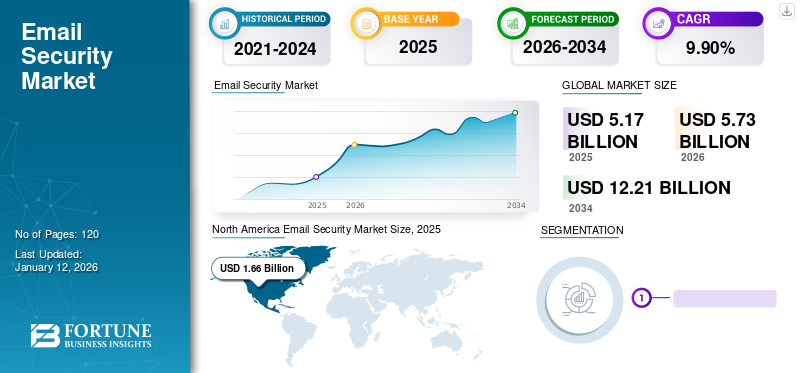
Download Free sample to learn more about this report.
Email Security Market Key Takeaways
 Global Market Size & Forecast
- 2025 Market Size: USD 5.46 billion
- 2026 Market Size: USD 6.06 billion
- 2034 Forecast Market Size: USD 14.44 billion
- CAGR: 11.5% from 2026-2034
 Market Share
- North America dominated the email security market with a 32.05% share in 2025.
- The cloud-based segment held the largest market share of 78.6% in 2025.
- The IT & telecom segment is projected to grow at the highest CAGR of 13.2% during the forecast period.
 Key Regional Highlights
North America
North America led the market in 2025, driven by rapid adoption of cloud-based email security platforms and rising enterprise cyber threats.
Europe
Europe accounted for USD 1.49 billion in 2025, making it the second-largest regional market.
Asia Pacific
Asia Pacific reached USD 1.31 billion in 2025 and is expected to register the highest growth during the forecast period.
U.S.
The market was valued at USD 1.41 billion in 2025, accounting for approximately 25.8% of global sales.
Japan
The market was valued at USD 0.25 billion in 2025, representing around 4.6% of global revenues.
Read More

Email Security Market Trends
Increased Adoption of Multi-Layered Security Solutions is Driving Market Growth
The email security market growth is expanding as organizations adopt multi-layered security solutions to combat rising cyber threats, particularly in email communications. With email being a primary attack vector, businesses are turning to comprehensive solutions that include spam filtering, malware detection, Data Loss Prevention (DLP), email encryption, and advanced threats protection.
Traditional e-mail security systems, focused on basic spam and virus protection, are no longer sufficient against complex threats such as Business Email Compromise (BEC) and phishing.
- According to the Anti-Phishing Working Group (APWG), phishing accounted for 55% of all email-based attacks in Q1 2025, underscoring the need for stronger defenses.
Multi-layered security integrates several components to protect email systems. These include real-time threat intelligence, anti-malware, and DLP tools, offering a more holistic approach to threat detection and response.
- Barracuda Networks reported that its solutions blocked over 1.2 billion phishing emails in 2025.
MARKET DYNAMICS
MARKET DRIVERS
Download Free sample to learn more about this report.
Increase in Remote Work and Cloud-Based Email Systems Drives Market Growth
The rise of remote working and cloud-based email platforms has introduced new vulnerabilities in email communications. As businesses increasingly rely on cloud-based systems such as Microsoft 365, Google Workspace, and Zoho Mail to facilitate collaboration, the rapid adoption of these platforms has expanded the potential attack surface for email-related cyber threats.
The number of users on cloud-based email platforms is projected to grow by 30% annually, reflecting a significant rise in cloud adoption, according to Gartner. The shift toward remote and hybrid work models, which accelerated during the COVID-19 pandemic, has amplified the need for secure email access from a variety of devices and locations. As employees access email systems on smartphones, laptops, and tablets, the risk of malware exposure increases.
- PwC reports that 83% of companies plan to continue offering remote work at least one day a week, emphasizing the need for secure email systems. Cloud-based email systems offer scalability and flexibility, but also present unique security challenges. Microsoft reported that more than 500 million users were on Microsoft 365 by 2025, underscoring the platform's growing reliance on daily business operations.
As cloud-based email adoption increases, businesses are turning to Email Security as a Service (ESaaS) providers for scalable, on-demand protection, particularly for remote teams.
MARKET RESTRAINTS
High Deployment Costs and Low Awareness among SMEs May Hinder Market Adoption
Many Small and Medium-sized Enterprises (SMEs) face challenges in adopting advanced email security solutions due to limited budgets, small IT teams, and low awareness of complex email-based threats. While large enterprises can invest in advanced security tools such as AI-driven phishing protection, encryption, and threat intelligence, SMEs often rely on basic email filters or the default security offered by cloud platforms.
The cost of advanced solutions can be a significant barrier for SMEs, as they often include subscription fees, integration costs, employee training, and ongoing monitoring. This increases the total cost of ownership, delaying adoption, especially when cybersecurity is not witnessed as a core business investment.
- According to Fortinet's 2025 Cybersecurity Skills Gap report, 56% of breaches were linked to a lack of security awareness, and 54% were due to insufficient IT security skills, indicating that limited resources continue to hinder protection levels.
Low awareness of email-based risks further impedes market growth. Many SMEs underestimate threats such as phishing, ransomware, and BEC. Despite understanding these risks, many businesses are reluctant to invest in advanced tools due to budget constraints or a lack of expertise.
Overall, high deployment costs and limited awareness slow the adoption of advanced email security solutions, particularly among SMEs in emerging markets with limited cybersecurity resources.
MARKET OPPORTUNITIES
Growing Demand for AI-Powered Email Threat Detection to Create New Market Opportunities
Cyber attackers are increasingly using AI to create more convincing phishing emails, impersonation messages, and BEC attempts, which traditional rule-based filters often struggle to detect. AI-powered email security solutions can identify suspicious patterns, abnormal sender behavior, malicious links, and spoofed domains in real-time.
This creates opportunities for vendors offering behavioral analytics, natural language processing, automated phishing triage, and adaptive threat intelligence.
- According to Microsoft’s 2025 Digital Defense Report, AI is shaping both cyberattacks and defenses, driving the need for AI-powered protection tools.
- The rise in AI-assisted phishing, as reported by KnowBe4’s 2025 phishing report, with 82.6% of phishing emails using AI, further opens the market for AI-based detection. Additionally, BEC remains a major area for AI detection, with BEC accounting for USD 2.77 billion in losses in 2024.
The growing use of AI by cybercriminals is driving enterprises to adopt smarter, AI-driven email security platforms, creating a significant market opportunity for vendors in this space.
Segmentation Analysis
By Application
IT & Telecom to Dominate the Market Due to Increasing Pressure for Digital Transformation
Based on the application, the market is segmented into BFSI, government, healthcare, IT & telecom, media & entertainment, and others (retail, defense, etc.).
The IT & telecom sector holds the majority share in the market due to the industry's critical need for secure communication channels and the large volume of data being exchanged daily. As telecom providers and IT companies handle vast amounts of sensitive information, including customer data and proprietary communications, robust email security is essential to protect against cyber threats such as phishing, malware, and data breaches.
IT & telecom is expected to witness the highest CAGR of 13.2% during the forecast period. It is due to the rapid expansion of cloud services, 5G technology, and the rising frequency of cyberattacks targeting telecom infrastructure. With the growing demand for secure communication amid sophisticated threats, telecom providers and IT companies are investing heavily in advanced email security solutions that enable real-time threat detection and automated response capabilities.
To know how our report can help streamline your business, Speak to Analyst
By Deployment
Growing Usage of Cloud-Based Email Security to Boost the Market Growth
Based on the deployment, the market is segmented into cloud, on-premises, and hybrid.
The cloud-based segment held the majority share of the market in 2024. In 2025, the segment continued to dominate the market with a 78.6% share. It is due to its ability to offer seamless scalability and enhanced flexibility, which are critical for businesses facing growing cyber threats. The shift toward cloud adoption, particularly in sectors such as finance and healthcare, has driven the demand for secure, easily manageable solutions that offer continuous monitoring and real-time updates.
Cloud is expected to witness the highest CAGR of 13.3% during the forecast period. It is due to the increasing reliance on cloud-hosted platforms such as Microsoft 365, Google Workspace, and Zoho Mail. As organizations increasingly migrate their business operations to the cloud, they require integrated, cloud-native email protection to secure their communications and mitigate evolving threats.
EMAIL SECURITY MARKET REGIONAL OUTLOOK
This market is regionally studied across North America, South America, Europe, the Middle East & Africa, and Asia Pacific, and each region is further studied across countries.
North America
North America Email Security Market Size, 2025 (USD Billion)
To get more information on the regional analysis of this market, Download Free sample
North America holds the majority in the global email security market share due to the region’s heavy exposure to enterprise email threats and its faster adoption of advanced security platforms across Microsoft 365 and cloud-based work environments.
- Microsoft reported screening around 5 billion emails daily for malware and phishing, reflecting the scale of email risk faced by largely cloud-driven enterprises.
In the U.S., e-mail security spending is also supported by strict cyber compliance needs across finance, healthcare, and federal agencies, where phishing, identity compromise, and BEC remain key concerns.
- Verizon’s 2025 DBIR noted that phishing was involved in 16% of breaches, while Microsoft’s 2025 report highlighted a 32% rise in identity-based attacks in the first half of 2025. Further, strengthening demand for phishing defense, email authentication, encryption, DLP, and cloud email protection in North America.
North America market held the largest market at USD 1.75 billion in 2025.
U.S. Email Security Market
Given North America’s strong contribution and the U.S. dominance in the region, the U.S. market was estimated at around USD 1.41 billion in 2025, accounting for roughly 25.8% of sales.
Europe
Europe holds the second-largest share of the market and was valued at USD 1.49 billion in 2025, driven by its strong regulatory environment and high enterprise exposure to phishing-led cyber incidents. GDPR, NIS2, and sector-specific rules in banking, healthcare, and public services are pushing organizations to strengthen email encryption, DLP, threat detection, and secure cloud email controls.
- ENISA’s 2025 Threat Landscape analyzed 4,875 incidents across the EU and found that phishing is a major intrusion method, underscoring why enterprises are prioritizing email protection.
- Eurostat reported that 52.7% of EU enterprises used paid cloud services in 2025, with email among the most widely used, underscoring the need for cloud-native e-mail security across the region.
U.K. Email Security Market
The U.K. market in 2025 was valued at approximately USD 0.40 billion, accounting for roughly 7.3% of global revenues.
Germany Email Security Market
Germany’s market reached approximately USD 0.31 billion in 2025, equivalent to around 5.7% of global sales.
Asia Pacific
Asia Pacific is expected to grow at the highest CAGR and reach a valuation of USD 1.31 billion by 2025. The growth is due to rapid cloud migration, expanding digital businesses, and rising email-based attacks across countries such as India, China, Japan, Singapore, and Australia. Enterprises in BFSI, healthcare, retail, and manufacturing are moving workloads to cloud platforms, increasing the need for cloud-native e-mail security, phishing protection, DLP, and identity-based threat detection.
- Abnormal Security found that advanced email attacks in Asia Pacific rose sharply, with the median monthly rate increasing from 472 to 600 attacks per 1,000 mailboxes between 2023 and 2024, strengthening demand for advanced e-mail security solutions.
Japan Email Security Market
The Japan market in 2025 was valued at around USD 0.25 billion, accounting for roughly 4.6% of global revenues.
China Email Security Market
China’s market is projected to be one of the largest worldwide, with 2025 revenues estimated at around USD 0.39 billion, representing roughly 7.1% of global sales.
India Email Security Market
The India market in 2025 was estimated at around USD 0.34 billion, accounting for roughly 6.2% of the global market share.
South America and Middle East & Africa
The Middle East & Africa region is expected to grow at the second-highest CAGR in the market. Such growth is driven by rapid digitalization across GCC countries, rising cloud adoption, and increasing cyber risk exposure across the banking, government, energy, telecom, and fintech sectors.
- Microsoft reported that in the first half of 2025, the UAE ranked 9th globally and 2nd in the Middle East & Africa for the number of customers impacted by cyber activity, underscoring the region’s growing threat intensity.
- In Africa, INTERPOL’s 2025 Cyberthreat Assessment highlighted phishing, business email compromise, ransomware, and online scams as dominant cyber threats, underscoring the need for advanced email protection.
The expansion of mobile money, digital banking, and cloud-based business communication across Africa is also pushing organizations toward phishing defense, email authentication, encryption, and cloud e-mail security platforms.
South America is expected to grow at a steady CAGR in the market, driven by rising phishing, malware, and BEC risks across Brazil, Argentina, Chile, Colombia, and Peru. However, adoption is more gradual than in Asia Pacific and the Middle East & Africa regions due to budget constraints and uneven cybersecurity maturity. Regional demand is mainly supported by banks, telecom firms, retail companies, and government agencies moving toward cloud-based communication and stronger email authentication.
GCC Email Security Market
The GCC market reached approximately USD 0.27 billion in 2025, accounting for roughly 4.9% of global revenues.
COMPETITIVE LANDSCAPE
Key Industry Players
Leading Email Security Vendors Strengthen Platforms Through AI, Cloud-Native Protection, and Threat Intelligence
Leading email security vendors are strengthening their platforms with AI-driven threat detection, behavioral analytics, and cloud-native security solutions to combat the growing volume of phishing, ransomware, business email compromise (BEC), and account takeover attacks. Companies such as Cisco Systems, Broadcom, OpenText Corporation, and Proofpoint are increasingly focusing on advanced email authentication, encryption, data loss prevention (DLP), and integrated threat intelligence to secure enterprise communications across Microsoft 365, Google Workspace, and hybrid environments. In addition, vendors are expanding their market presence through strategic partnerships, acquisitions, product enhancements, and managed security services to improve real-time threat detection, automated incident response, and overall cybersecurity resilience.
LIST OF KEY EMAIL SECURITY COMPANIES PROFILED
- Cisco Systems Inc. (U.S.)
- Broadcom Inc. (U.S.)
- Open Text Corporation (Canada)
- Proofpoint Inc. (U.S.)
- Fortinet Inc. (U.S.)
- Barracuda Networks Inc. (U.S.)
- DataFlowX (Turkey)
- Trend Micro Incorporated. (Japan)
- Sophos Ltd. (U.S.)
- net, Inc. (U.S.)
KEY INDUSTRY DEVELOPMENTS
- March 2026: Proofpoint Inc., a prominent cybersecurity and compliance service provider, announced innovations in its existing security portfolios. The company aims to strengthen the protection framework for the agentic workspace, ensuring end-to-end encryption for interactions between human users and AI agents to safeguard data and sensitive information. Additionally, Proofpoint is also planning to integrate two email security approaches, including API-based protection as well as Secure Email Gateway (SEG), into a single architecture. This will offer shared threat intelligence to improve detection of pre-delivery and post-delivery data.
- November 2025: Sophos introduced a new feature, Phish Threat, for its email security solutions. This is an essential upgrade to the company's e-mail security portfolio, combining email protection and user awareness training in a single suite to help customers prevent email-borne phishing attacks.
- August 2025: Sophos launched a new Email Monitoring System (EMS) as a part of the company’s email security suite. This will help users detect threats and provide control over services such as Managed Detection and Response (MDR) and Extended Detection and Response (XDR).
- July 2025: Broadcom updated its existing Symantec Email Security cloud solutions to provide additional support for hosted email providers, including Zoho, GoDaddy, Amazon SES, and IONOS. This is to help these organizations configure email inspection for outbound sources and enhance their existing threat protection in cloud e-mail security platforms.
- June 2025: Fortinet has launched an AI-powered FortiMail Workspace Security suite, expanding its email security platform to protect not just email but also browsers and collaboration tools. Combined with FortiDLP upgrades, it provides unified protection against phishing, malware, insider threats, and data leaks. The solution uses AI to secure user activity and sensitive data across hybrid work environments.
- May 2025: Open Text Corporation announced a transition offer that allows customers with an existing Voltage SecureMail Cloud solution to migrate to the new Core Email Encryption solution. This offer was made to support the organization’s email security framework by implementing newer encryption solutions to protect sensitive communications and meet regulatory compliance requirements.
REPORT COVERAGE
The report provides a detailed analysis of the market and focuses on key aspects, including leading companies, product types, and the product's leading applications. Besides, it offers insights into the market trends and highlights key industry developments. In addition to the factors above, the market's growth in recent years was driven by several other factors.
Request for Customization to gain extensive market insights.
REPORT SCOPE & SEGMENTATION
| ATTRIBUTE | DETAILS |
| Study Period | 2021-2034 |
| Base Year | 2025 |
| Estimated Year | 2026 |
| Forecast Period | 2026-2034 |
| Historical Period | 2021-2024 |
| Growth Rate | CAGR of 11.5% from 2026-2034 |
| Unit | Value (USD Billion) |
| Segmentation | By Deployment, Application, and Region |
| By Deployment |
|
| By Application |
|
| By Region |
|
Frequently Asked Questions
According to Fortune Business Insights, the global market value stood at USD 5.46 billion in 2025 and is projected to reach USD 14.44 billion by 2034.
In 2025, the market value stood at USD 1.75 billion.
The market is expected to grow at a CAGR of 11.5% over the forecast period.
By application, IT & telecom segment is expected to lead the market.
Increase in remote work and cloud-based email systems drives market growth.
Cisco Systems, Broadcom, Open Text Corporation, and Proofpoint are the major players in the global market.
North America dominated the market in 2025.



- 2021-2034
- 2025
- 2021-2024
- 120
-
(Offer valid till 30th Sep 2026)
Get 30-60 hrs Free Customization
Expand Regional and Country Coverage, Segments Analysis, Company Profiles, Competitive Benchmarking, and End-user Insights.




















Related Reports
-
US +1 833 909 2966 ( Toll Free )
-
Get In Touch With Us