 Download Free Sample



Get a Quote
Receive a tailored pricing based on your needs.
- Choose license type
- Multiple user options
- Custom scope & coverage
- Fast turnaround
"Smart Strategies, Giving Speed to your Growth Trajectory"
 Listen to Audio Version
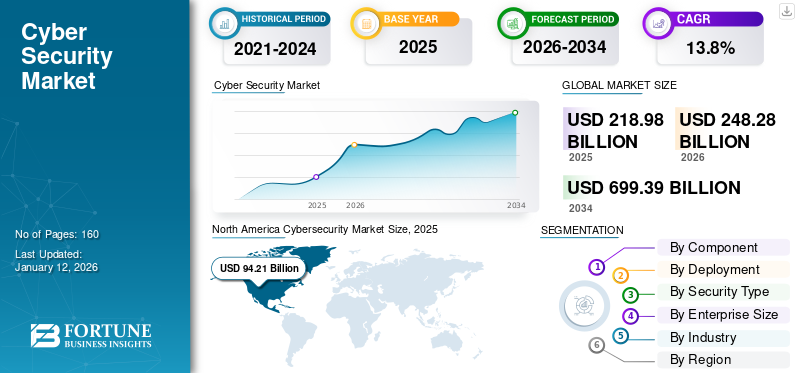
The global cybersecurity market size was valued at USD 218.98 billion in 2025 and is projected to grow from USD 248.28 billion in 2026 to USD 699.39 billion by 2034, exhibiting a CAGR of 13.8% during the forecast period. North America dominated the cybersecurity market with a market share of 43.0% in 2025.
Cybersecurity is a method of protecting systems, networks, and programs from digital attacks. Cyberattacks usually modify, access, or destroy sensitive information, extort users' money, or disrupt normal business processes. The increasing adoption of enterprise security solutions in manufacturing, Banking, Financial Services, and Insurance (BFSI), and healthcare is expected to drive market growth during the forecast period.
The global cybersecurity market is expanding as organizations confront increasingly complex cyber threats across connected infrastructure, cloud environments, and distributed workforces. Rising digitization, regulatory scrutiny, and escalating data protection requirements are increasing demand for security solutions that protect sensitive data, identities, applications, and critical systems. Consequently, the cybersecurity market size is expected to expand steadily throughout the forecast period.
Enterprise security strategies are shifting from isolated controls toward integrated risk management frameworks. Organizations increasingly combine endpoint protection, network security, identity and access management, cloud security, and security analytics within unified architectures. Real-time threat detection and response is becoming a strategic priority as ransomware, phishing, social engineering, and advanced persistent threats continue to evolve.
Cloud adoption remains a major structural driver. Enterprises are moving workloads and applications across hybrid and multi-cloud environments, creating broader attack surfaces and increasing requirements for continuous monitoring. Investments in advanced artificial intelligence and generative AI capabilities are also reshaping threat detection, incident response, and security operations.
In the scope of the research report, we have included component solutions and services offered by companies, including IBM Corporation, Microsoft Corporation, Palo Alto Networks, Inc., Broadcom, Inc., and others.
Through various customer services, companies offer comprehensive solutions for managing their communications effectively. Key players offer cyber services to manage customer communications across various touchpoints effectively. They provide various services covering various aspects, including threat detection, prevention, incident response, compliance, and risk management. Furthermore, the enhancement and expansion of the current product portfolio enhances the position of vendors in the market.
Download Free sample to learn more about this report.
 Market Size & Forecast
 Market Share
 Key Regional Highlights
North America
North America accounted for 43.00% of the global market in 2025, valued at USD 94.21 billion, and is projected to reach USD 105.81 billion in 2026.
Europe
Europe represented 25.60% of global demand in 2025, with a market value of USD 55.98 billion, rising to USD 63.11 billion in 2026.
Asia Pacific
Asia Pacific generated USD 45.28 billion in revenue in 2025, accounting for a 20.70% market share, and is expected to reach USD 52.04 billion in 2026.
U.S.
U.S. The market is projected to reach USD 81.61 billion in 2026.
Japan
Japan: The market is forecast to reach USD 11.13 billion in 2026.
Read More

Rising Awareness of Gen-AI for Data Security and Protection to Boost Market
Generative AI plays a prominent role in cybersecurity; in a few cases, it is already enhancing cybersecurity management tools in a planned manner. Generative AI utilizes neural networks and cutting-edge algorithms trained on huge datasets to produce information very similar to the original data in structure and form. Generative AI models, such as Generative Adversarial Networks and Variational Autoencoders, are employed to generate text, images, and videos. This process includes a constant feedback loop, where the model's output is regularly assessed and refined, ultimately enhancing its sanity and accuracy.
Additionally, generative AI provides an extra layer of security by creating complex, unique encryption keys or passwords that are particularly tough to crack.
Integration of Advanced Technologies in Business Security Units to Drive Market Growth
Key players implement core technologies, such as machine learning, the Internet of Things (IoT), cloud technologies, and big data in their business security units. They are further adopting IoT and machine learning signature-less security systems. This adoption would help the players understand uncertain activities and trials and identify and detect uncertain threats.
With the rising growth in the IoT market, IoT solutions are gaining popularity across various information security applications. Consequently, adopting advanced technologies in internet security is considered a rapidly emerging market trend. Moreover, big data and cloud technology support enterprises in learning and exploring potential risks.
Cybersecurity market trends center on integrated platforms that unify prevention, detection, investigation, and response. Organizations are consolidating security tools to improve visibility, reduce operational complexity, and accelerate incident response. This shift is encouraging vendors to combine endpoint, network, cloud, identity, and security analytics capabilities within architectures.
Zero trust principles are becoming more prominent as enterprises support remote work, hybrid infrastructures, and distributed applications. Continuous verification, least privilege access, and identity-centric controls are replacing assumptions based on network location. Identity and access management therefore remains strongly central to information security strategies across enterprises and growing digital businesses.
Artificial intelligence is reshaping security operations through automated analysis, behavioral detection, alert prioritization, and real-time response. Generative AI is creating new requirements for protecting prompts, models, sensitive data, and AI-enabled applications. Organizations are evaluating AI-driven tools for productivity while strengthening governance and security measures.
Download Free sample to learn more about this report.
Another trend that aids the cybersecurity market growth is the increased adoption of cloud computing. Players in the market, including Cisco Systems, IBM Corporation, and others, focus on developing advanced solutions based on cloud computing. These services are designed on the Analytics as a Service (AaaS) platform, assisting users in identifying and mitigating threats rapidly.
Growing Occurrence of Advanced Cyber Threats to Boost Market Growth
With the current global technology transformation, connected devices, digital solutions, and IT systems are growing drastically. This developing digital infrastructure is based on the communication between critical business applications and data across numerous devices, users, and platforms. Hence, to access crucial business information, cybercriminals are implementing guaranteed hacking methods to breach an organization’s IT infrastructure. For instance,
Many cyberattacks exist, including malware injections and phishing, DDoS attacks, brute-force attacks, and social engineering. These are capable of causing substantial data and financial losses. For instance,
Thus, with the growing number of security breaches, organizations across different businesses are installing cybersecurity solutions to protect their crucial networks, data, users, and endpoints against such attacks.
Rising cyber threats are the primary force accelerating the cybersecurity market, as ransomware, phishing, social engineering, and advanced persistent threats target organizations across every industry. Digital transformation is expanding connected systems, cloud environments, applications, and remote work, creating larger attack surfaces that require continuous protection. Consequently, organizations are steadily increasing investments in advanced security solutions, threat detection, and incident response capabilities.
Regulatory requirements are another important driver. Governments and industry regulators are strengthening cybersecurity frameworks, data protection obligations, and reporting requirements, encouraging enterprises to formalize risk management programs. Large enterprises are prioritizing integrated security architectures that combine network security, endpoint security, identity and access management, and cloud security.
Artificial intelligence is also accelerating cybersecurity market growth. AI-driven analytics can identify unusual behavior, prioritize alerts, and support real-time threat detection and response. Generative AI is further increasing demand for controls that secure models, applications, sensitive data, and enterprise interactions.
Key Regulations Shaping Cybersecurity Spending are acting as a major market driver. Governments and industry regulators are enforcing strict cybersecurity frameworks with impending deadlines. Notable mandates include the European Union's NIS2 Directive and the Digital Operational Resilience Act (DORA), alongside EU 2024/2847 and the CISA Cross-Sector Cybersecurity Performance Goals in the U.S. With specific enforcement dates looming in 2026, organizations are compelled to rapidly formalize risk management programs and upgrade their security architectures to avoid severe compliance penalties.
Lack of Experts and Budget Constraints for SMEs to Hinder Market Growth
With the rising number of online security threats, the requirement for advanced solutions is growing exponentially. Obsolete network security solutions are not proficient in securing enterprises from advanced network, cloud, and endpoint security threats. Factors such as a lack of professionals and experts in developing and advancing security solutions are considered key restraining factors. The high cost of implementing and updating internet security solutions and services impedes the adoption of market solutions among Small & Medium Enterprises (SMEs).
High implementation costs remain a significant restraint for the cybersecurity market, particularly among small and medium-sized enterprises with limited budgets and specialized personnel. Advanced security platforms often require substantial spending on software, infrastructure, integration, training, and ongoing monitoring. These costs can delay adoption even when organizations recognize increasing exposure to cyber threats.
The shortage of qualified cybersecurity professionals also constrains market development. Security teams face difficulties recruiting specialists across cloud security, threat intelligence, incident response, identity management, and security operations. Persistent staffing gaps can increase operational workloads, reduce response speed, and limit the effective use of sophisticated security solutions.
Complex technology environments create another restraint. Enterprises frequently operate multiple security products across legacy systems, cloud platforms, applications, and connected devices. Poor interoperability can produce fragmented visibility, duplicated controls, and excessive alerts, making it harder to manage security efficiently.
Rising Need for Cloud-Based Cybersecurity Solutions will Create a Great Opportunity for Market Growth.
Organizations are gaining more cloud expertise and shifting their core business functions to cloud platforms. The growing adoption of cloud technology requires organizations to extend security to cloud-based workloads and data. The cloud computing model possesses a robust and flexible infrastructure option. Several organizations are shifting toward cloud solutions to simplify data storage, allowing access to enormous computing power and remote server access.
Moving to the cloud has the potential to improve overall security since cloud vendors own robust security solutions in the IT space. Implementing a cloud-based model empowers organizations to manage all their applications securely. Also, implementing the cloud enables organizations to add complementary infrastructure technology such as SDP (Software-Defined Perimeters), creating a highly robust and secure platform.
The cybersecurity market presents opportunities through cloud adoption, artificial intelligence, connected infrastructure, and regulatory requirements. Enterprises are seeking security solutions that protect distributed environments while improving operational efficiency. Vendors that deliver integrated capabilities across cloud security, identity, endpoint protection, and threat response address demand for unified risk management.
Artificial intelligence creates opportunities for automated threat detection and response. Security providers apply machine learning and generative AI to analyze large data volumes, identify anomalous activity, accelerate investigations, and improve incident response. AI applications require specialized controls for model security, data protection, access management, and governance.
Small and medium-sized enterprises represent another opportunity. Many lack dedicated security teams and infrastructure, creating demand for managed security services, cloud-native platforms, and subscription-based protection. Simplified deployment, transparent pricing, and automated monitoring expand cybersecurity adoption across this underserved segment.
Solutions Segment Leads with Increasing Prioritization of IAM to Safeguard Sensitive Data
Based on component, the market is divided into solutions and services.
Solutions include network security, endpoint protection, cloud security, identity and access management, application security, security analytics, and threat detection platforms. These technologies help enterprises protect infrastructure, applications, identities, and sensitive data across increasingly distributed environments. Demand for integrated security solutions is rising as organizations seek centralized visibility and improved risk management.
The solutions segment accounts for the largest share of the market. The solutions in the market include firewall/antimalware/antivirus, Intrusion Detection and Prevention Systems (IDPS), Identity and Access Management (IAM), Data Loss Prevention (DLP) & disaster recovery, Security Information and Event Management (SIEM), and others. IAM solutions' popularity has grown among enterprises as they play a vital role in protecting digital assets by managing and controlling user access to sensitive information and resources within a firm. The solutions segment is projected to dominate the market with a share of 61.73% in 2026.
The solutions segment benefits from growing investments in artificial intelligence, automation, cloud security, and real-time threat detection. Vendors increasingly integrate multiple capabilities into unified platforms to reduce tool fragmentation. Services complement these platforms by providing expertise, deployment assistance, compliance support, and operational management.
Services include consulting, implementation, support, managed security services, and incident response. Managed services are gaining importance because organizations face shortages of specialized cybersecurity professionals. Service providers offer continuous monitoring, threat intelligence, detection, and response capabilities, allowing customers to strengthen security without maintaining large internal teams. Large enterprises generally maintain broad internal security operations while supplementing them with specialized external services.
The services segment is expected to grow with the highest CAGR in the coming years, owing to the complexity of the IT environment. With the digital transformation journey accelerating, businesses are adopting a complex IT infrastructure involving multi-cloud, on-premises, and hybrid environments. This complexity makes it difficult for internal teams to manage security effectively. For instance,
Growing Need for Scalable and Cost-Effective Cybersecurity Solutions to Drive Cloud Segment Growth
Based on deployment, the market is segmented into on-premises and cloud.
The cloud deployment segment holds the highest market share and is expected to continue its dominance during the forecast period. Cloud-based solutions can quickly scale up or down per business needs, making them suitable for businesses of all sizes. Cloud solutions offer lower upfront costs and predictable, subscription-based pricing models, making them cost-effective for businesses. The cloud segment is expected to lead the market, contributing 54.59% globally in 2026, recording a CAGR of 15.26% during the forecast period (2026-2034).
Cloud deployment is gaining substantial momentum as organizations migrate applications, workloads, and infrastructure toward public, private, and hybrid cloud environments. Cloud-based security solutions provide scalability, centralized management, rapid deployment, and flexible subscription models. These advantages are particularly relevant for organizations seeking to manage expanding attack surfaces without significant capital investment.
The growth of on-premises cybersecurity deployments is driven by the need for data privacy and regulatory compliance in industries including healthcare, finance, and government, where sensitive data cannot be hosted externally. Additionally, control over security infrastructure and low-latency requirements for critical applications push organizations to opt for on-premises solutions.
On-premises security remains important among organizations requiring direct infrastructure control, particularly in regulated industries and environments containing highly sensitive data. Enterprises with legacy systems, specialized applications, or strict operational requirements may continue deploying security technologies within internal data centers. This approach can provide greater control over configurations, policies, and data handling.
Network Security Segment’s Dominance Led by Increasing Virtual Enterprise Network Environments
Based on security type, the market is divided into network security, end-point security, cloud application security, secure web gateway, application security, and others.
The network security segment contributed the highest market share due to increasing virtual enterprise network environments. It protects critical infrastructure and sensitive data and ensures the integrity of information in networks, making it indispensable for businesses of all sizes. The network security segment will account for 23.89% market share in 2026.
Network security remains fundamental because enterprises must protect communication infrastructure, internal systems, remote connections, and critical digital assets. Firewalls, intrusion prevention, secure access technologies, network monitoring, and threat intelligence support protection against unauthorized activity.
Cloud application security is projected to grow at the highest CAGR of 18.01% over the forecast period (2026-2034), owing to the rapid adoption of cloud services and the shift to remote work. Integrating AI and machine learning in cloud security solutions enhances threat detection and response capabilities. For instance, Microsoft Defender for Cloud and AWS Shield are witnessing increasing adoption to secure cloud-native applications against evolving threats.
Cloud application security is becoming increasingly important as businesses deploy software and workloads across public and hybrid cloud environments. Organizations require controls that identify configuration risks, protect application data, secure interfaces, and monitor user activity. Growing cloud complexity is increasing demand for continuous visibility and automated security policies.
Endpoint security protects laptops, desktops, mobile devices, servers, and other connected endpoints. The expansion of remote work has increased endpoint exposure, making behavioral monitoring, malware prevention, endpoint detection, and response capabilities increasingly important. Artificial intelligence is improving the ability to identify unusual behavior and prioritize threats across large device populations.
Secure web gateways help organizations control internet access and protect users from malicious websites, phishing attempts, and unsafe content. Application security addresses vulnerabilities throughout software development and deployment processes, including code, interfaces, containers, and application infrastructure.
Other categories include data security, email security, identity protection, security information and event management, and specialized industrial controls. Increasingly, enterprises prefer integrated platforms that combine multiple security types. Vendors are therefore competing through broader portfolios, automation, artificial intelligence, and real-time threat detection.
Increasing Adoption of End-Point Security Solutions by SMEs to Lead to Market Dominance
Based on enterprise size, the market is divided into Small & Medium Enterprises (SMEs) and large enterprises.
Small & Medium Enterprises (SMEs) are projected to grow at the highest CAGR of 15.47% over the forecast period. This growth is owing to the increasing demand for end-point security solutions across various e-commerce startups, including retail and financial sectors.
SMEs represent a rapidly developing segment. Smaller organizations increasingly recognize that cyber threats can disrupt operations, compromise customer information, and create financial or reputational losses. However, limited budgets and shortages of cybersecurity professionals can restrict their ability to deploy complex technologies independently.
Large enterprises currently account for the largest market share because they operate extensive digital infrastructure, manage significant volumes of sensitive data, and face complex regulatory obligations. The Large Enterprises segment is expected to account for 65.62% of the market in 2026. Their broad attack surfaces require comprehensive security architectures covering networks, endpoints, applications, identities, cloud environments, and connected devices.
Large enterprises held a major market share in 2024, owing to the rising complexity of IT environments, with hybrid and multi-cloud infrastructures creating greater attack surfaces. Additionally, escalating cyber threats such as data breaches and ransomware are pushing enterprises to invest in comprehensive, advanced cybersecurity frameworks.
Large organizations typically maintain dedicated security teams and substantial cybersecurity budgets. They invest in advanced threat detection, security analytics, identity and access management, incident response, and cybersecurity frameworks. Many also deploy security operations centers that integrate automated monitoring with specialized analysts. Strategic consolidation is becoming important as enterprises seek to reduce fragmented security technologies and improve operational efficiency.
To know how our report can help streamline your business, Speak to Analyst
BFSI Takes Center Stage with Rising Demand for Robust Security and Digital Privacy Systems
Based on industry, the market is segmented into BFSI, IT and telecommunications, retail, government, manufacturing, travel and transportation, healthcare, energy and utilities, and others.
The BFSI segment holds the highest share of the market due to the increasing demand for robust security and digital privacy systems across financial, insurance, and banking institutions. Cloud application security solutions help banks, insurance, and financial organizations secure highly confidential data incorporated with real-time intelligence against persistent cyberattacks. This segment is anticipated to hold a dominant market share of 21.54% in 2026.
BFSI remains a major adopter because financial institutions manage sensitive customer information, payment systems, digital transactions, and critical infrastructure. Banks and insurers invest heavily in identity protection, fraud prevention, threat detection, data security, and incident response.
The healthcare sector is estimated to showcase the highest CAGR of 18.98% during the forecast period (2025-2032). The segment growth can be attributed to the rising adoption of connected devices, smartphones, and cloud-based solutions for diverse information systems, such as Electronic Health Records (EHRs), e-prescribing systems, radiology information systems, clinical decision support systems, and practice management support systems.
Healthcare providers face growing requirements to protect patient information, connected medical systems, and operational technology. Government agencies prioritize cybersecurity to protect public services, national infrastructure, citizen information, and sensitive government systems. Manufacturing companies increasingly secure industrial control systems, connected equipment, supply chain networks, and production environments against disruptive attacks.
IT and telecommunications organizations operate extensive networks, cloud platforms, applications, and communication infrastructure. Their security requirements include network protection, cloud security, application security, endpoint controls, and continuous monitoring. Retail organizations increasingly require cybersecurity because of digital commerce, payment systems, customer databases, and connected retail technologies.
Travel and transportation organizations are expanding digital booking, payment, logistics, and connected infrastructure systems, increasing their exposure to cyber threats. Energy and utilities companies require robust security for operational technology, distributed infrastructure, control systems, and essential services.
Across these industries, organizations are increasing investments in advanced security solutions and managed security services. Artificial intelligence, automation, real-time monitoring, and identity-centric security are becoming increasingly important. Industry-specific cybersecurity frameworks and regulatory requirements also influence purchasing decisions. As digital transformation continues, sector-specific security needs will remain a major contributor to cybersecurity market growth and changing cybersecurity market share across industries.
North America Cybersecurity Market Size, 2025 (USD Billion)
To get more information on the regional analysis of this market, Download Free sample
North America contributed approximately USD 94.21 billion to the global market in 2025, accounting for a 43.00% share, and is expected to reach USD 105.81 billion in 2026. North America is likely to dominate with the highest cybersecurity market share during the forecast period. The rising number of high-profile security breaches drives the demand for cloud application security solutions across the region. The increasing number of online e-commerce platforms boosts market growth in the U.S. and Canada. The government implements advanced network security protocols to offer enhanced security measures to enterprises.
North America remains a leading cybersecurity market, supported by mature digital infrastructure, substantial enterprise security spending, and extensive adoption of cloud technologies. The United States and Canada face persistent ransomware, phishing, and supply chain threats, encouraging investment in advanced security solutions. Strong cybersecurity frameworks, regulatory requirements, and sophisticated security providers further support regional market growth across critical industries and government organizations across digitized national economies.
United States Cybersecurity Market
The U.S. holds the largest share of the North American market. The growing investment by end-users and the high demand for enterprise security solutions boost the adoption of security solutions in the U.S. The presence of major players in the U.S., such as Palo Alto Networks, Inc., Microsoft Corporation, IBM Corporation, and others, is introducing advanced network security solutions to enhance their product portfolios. The U.S. market is estimated to reach a market value of USD 81.61 billion in 2026. For instance,
The United States cybersecurity market benefits from high technology adoption, extensive cloud deployment, and strong spending across government and private enterprises. Organizations increasingly prioritize identity and access management, endpoint protection, artificial intelligence, and real-time threat detection. Federal cybersecurity initiatives and critical infrastructure requirements further encourage investments in risk management, incident response, and advanced security solutions across financial, healthcare, technology, and defense sectors, supporting enterprise demand.
In 2025, the European market stood at USD 55.98 billion, representing 25.60% of global demand, and is projected to grow to USD 63.11 billion in 2026. The market in Europe is expected to rise with a notable CAGR during the forecast period. The U.K. market is poised to gain USD 11.55 billion in 2026.
Europe represents a significant cybersecurity market, driven by stringent data protection requirements, expanding cloud adoption, and heightened awareness of cyber risks. Organizations are strengthening cybersecurity frameworks to address ransomware, supply chain vulnerabilities, and regulatory expectations. Demand spans cloud security, identity protection, endpoint security, and incident response. Digital transformation across regulated industries continues to support regional cybersecurity market growth and technology investment across major regulated European economies.
The growth is significantly driven by the increasing number of internet security projects and related investments by major companies in the market in the U.K., Germany, Spain, France, Italy, and others. Key providers install advanced IT security solutions to secure the highly sensitive information related to manufacturing operations and increase productivity. Germany is anticipated to reach a valuation of USD 11.36 billion in 2026, while France is expected to be valued at USD 7.97 billion in the same year.
Germany Cybersecurity Market
Germany's cybersecurity market is supported by strong industrial digitization, connected manufacturing, and stringent information security requirements. Manufacturers increasingly protect operational technology, industrial networks, and supply chain systems against evolving cyber threats. Enterprises are investing in cloud security, endpoint protection, identity controls, and managed security services. Regulatory attention and digital infrastructure initiatives further strengthen demand for advanced cybersecurity solutions across Germany amid continuing industrial digital transformation.
United Kingdom Cybersecurity Market
The United Kingdom cybersecurity market is driven by digital transformation, cloud adoption, and increasing threats targeting businesses and public services. Organizations are strengthening identity management, endpoint security, threat detection, and incident response capabilities. Government cybersecurity initiatives and regulatory requirements support continued investment, while managed security services help organizations address skills shortages. Financial services and technology companies remain important regional security adopters amid ongoing modernization efforts.
The Asia Pacific region captured 20.70% of the global market in 2025, generating USD 45.28 billion in revenue, and is projected to reach USD 52.04 billion in 2026. Asia Pacific is expected to grow at the highest CAGR during the forecast period, driven by the rapid digital transformation across industries, including banking, healthcare, and manufacturing, which increases the need for robust security measures. China is set to gain USD 13.03 billion in 2026.
Asia-Pacific is experiencing strong cybersecurity market growth as digital transformation, cloud adoption, connected infrastructure, and online services expand rapidly. Organizations face increasingly sophisticated ransomware, phishing, and supply chain threats across diverse environments. Investments in security solutions are rising across enterprises and government agencies, while managed services address skills shortages. Expanding digital economies and regulatory initiatives are strengthening regional cybersecurity demand across rapidly expanding digital economies.
Additionally, government regulations and heightened awareness of cyber threats, especially in China, India, and Japan, push organizations to prioritize cybersecurity. The surge in cyberattacks and data privacy concerns further accelerates the region's need for comprehensive cybersecurity frameworks. India is anticipated to hit USD 8.92 billion in 2026, while Japan is foreseen to reach USD 11.13 billion in the same year.
Japan Cybersecurity Market
Japan's cybersecurity market is expanding as enterprises modernize infrastructure, adopt cloud technologies, and strengthen protection for sensitive information. Manufacturers, financial institutions, and government organizations are increasing investments in endpoint security, network protection, identity management, and incident response. Rising awareness of supply chain vulnerabilities and operational technology risks is encouraging stronger cybersecurity frameworks and advanced security measures across critical sectors while supporting resilient digital business operations.
China Cybersecurity Market
China's cybersecurity market is supported by rapid digitalization, cloud adoption, connected infrastructure, and increasing emphasis on data protection. Enterprises and government organizations are strengthening network security, endpoint controls, application protection, and security monitoring. Regulatory requirements encourage investment in information security and cybersecurity frameworks. Growing digital services and industrial connectivity are expanding demand for real-time threat detection and comprehensive security solutions across rapidly expanding digital industries.
In 2025, Middle East & Africa generated USD 16.72 billion, contributing 7.60% to global market revenue, and is projected to grow to USD 19.39 billion in 2026. The Middle East & Africa market is expected to grow considerably during the forecast period. This growth is due to rising investment by the government and private enterprises in the GCC, South Africa, and other countries. Furthermore, the increasing adoption of strategies such as mergers and partnerships among key players in the market will boost security solutions. The GCC market is predicted to stand at USD 6.92 billion in 2025.
The Middle East and Africa cybersecurity market is expanding through digital transformation, cloud adoption, smart infrastructure, and critical infrastructure modernization. Governments and enterprises are strengthening data protection, identity management, network security, and threat detection. Energy, telecommunications, financial services, and public sectors generate significant demand. Increasing cybersecurity awareness, regulatory initiatives, and sophisticated cyber threats continue to support regional security investment across economies.
South America will grow at a considerable CAGR in the coming years. The rise in cyberattacks, such as ransomware and data breaches, motivates private and public sectors to invest in stronger security frameworks. Government regulations such as Brazil's LGPD (General Data Protection Law) also push companies to prioritize data protection and compliance. The growing awareness of cybersecurity risks across industries also fuels the market's expansion in South America.
Latin America recorded a market size of USD 6.79 billion in 2025, capturing 3.10% of the global market share, and is projected to reach USD 7.93 billion in 2026. Latin America's cybersecurity market is developing as organizations expand digital services, cloud adoption, online payments, and connected operations. Rising ransomware, phishing, and data protection concerns are increasing demand for endpoint security, identity management, managed security services, and incident response. Financial institutions, telecommunications providers, retailers, and governments remain important adopters. Growing regulatory awareness and digital transformation are supporting regional cybersecurity investment throughout increasingly connected regional economies.
Key Companies Focusing on Expanding Product Offerings through Adoption of Emerging Technologies
The major players in the market, such as Cisco Systems, Inc., IBM, Microsoft, and Broadcom, are focused on advancing their network capabilities by adopting emerging technologies, such as machine learning and advanced analytics. These companies also offer comprehensive internet security solutions based on network-related areas. The offerings include threat protection, web, unified threat management, network and data center security, access and policy, email security, advisory, integration, and managed services.
September 2023, Cisco Systems, Inc., signed an agreement to purchase the cybersecurity firm Splunk for USD 28 billion. The deal upsurges Cisco’s software business and capitalizes on the increasing use of artificial intelligence.
The cybersecurity industry competitive landscape is characterized by intense competition among established global technology providers, specialized security vendors, and emerging cybersecurity companies. Major players compete through broad security portfolios, platform integration, artificial intelligence, cloud-native architectures, managed services, and continuous innovation. Leading vendors increasingly position unified platforms as alternatives to fragmented point security products, targeting enterprises seeking simplified operations and stronger visibility.
Palo Alto Networks maintains a strong position through network security, cloud security, security operations, and AI-enabled protection. Microsoft leverages its extensive enterprise ecosystem to integrate identity, endpoint, cloud, and security operations capabilities. Cisco competes through network security, secure access, cloud protection, and integrated security infrastructure.
CrowdStrike emphasizes cloud-native endpoint protection, threat intelligence, and AI-driven security operations, while Fortinet focuses on network security, secure access, and integrated security appliances. Check Point Software Technologies competes across network, cloud, endpoint, and application security. Okta strengthens its position in identity and access management as enterprises adopt identity-centric security models.
Emerging players differentiate through specialized technologies addressing cloud workloads, application security, identity protection, data security, and automated threat detection. Competitive strategies increasingly include strategic partnerships, acquisitions, ecosystem integrations, subscription-based services, and managed security offerings. Vendors are also expanding artificial intelligence capabilities to improve detection, investigation, prioritization, and incident response.
The competitive environment is further shaped by customer demand for measurable risk reduction, regulatory compliance, interoperability, and lower security operations complexity. Large enterprises favor scalable platforms capable of protecting hybrid environments, while small and medium-sized enterprises increasingly seek accessible cloud-based solutions and managed security services. As cyber threats evolve, sustained investment in AI, real-time protection, cloud security, and platform consolidation will remain central to cybersecurity market positioning and cybersecurity market share.
April 2025: Cisco expanded its cybersecurity solutions through new capabilities across Cisco XDR and Splunk Enterprise Security, introducing agentic AI for faster threat detection, investigation, and response. The initiative aims to strengthen security operations by combining Cisco’s network, endpoint, cloud, and email visibility with Splunk’s advanced security analytics, automated workflows, and Security Orchestration, Automation, and Response (SOAR) capabilities.
February 2026: Palo Alto Networks completed its acquisition of CyberArk, establishing identity security as a core pillar of its platformization strategy. The acquisition aims to protect human, machine, and agentic identities across modern enterprise environments by integrating CyberArk’s Identity Security Platform with Palo Alto Networks’ network security and security operations capabilities.
March 2026: Google completed its acquisition of Wiz, bringing the cloud and AI security company into Google Cloud while retaining the Wiz brand. The acquisition aims to strengthen multicloud security by combining Wiz’s cloud security platform with Google’s AI-powered threat intelligence and security operations capabilities across code, cloud, and runtime environments.
March 2026: Cisco introduced new cybersecurity capabilities for the agentic AI era, including AI Defense Explorer Edition, DefenseClaw, agentic identity and access management, and enhanced Splunk AI security operations. The initiative aims to secure AI agents throughout their lifecycle by combining zero trust controls, AI model testing, runtime protection, automated security workflows, and machine-speed threat response.
April 2026: ServiceNow completed its acquisition of Armis for approximately USD 7.75 billion, expanding its security and risk platform with real-time cyber asset discovery, prioritization, and protection. The acquisition aims to connect asset visibility with automated remediation across IT, OT, IoT, medical devices, physical AI, code, and cloud environments through Armis Centrix, AI-powered cyber exposure management, ServiceNow’s Context Engine, and agentic security workflows.
The cybersecurity market presents strong investment opportunities driven by the increasing frequency and sophistication of cyber threats, particularly in finance, healthcare, and government sectors. Key growth drivers include the rising adoption of cloud computing, the shift to remote work, and the push for compliance with stricter data protection regulations such as GDPR. Investment opportunities include AI-driven security solutions, managed security services (MSSPs), and zero-trust architectures. Additionally, emerging markets in Asia Pacific and South America offer untapped potential due to growing digitalization and regulatory changes. Investors should focus on companies offering innovative cybersecurity solutions and those expanding in cloud and IoT security.
The research report highlights leading regions worldwide to offer a better understanding to the user. Furthermore, the report provides insights into the latest industry growth trends and analyzes technologies being deployed at a rapid pace at the global level. It further offers some drivers and restraints, helping the reader gain in-depth knowledge about the market.
Request for Customization to gain extensive market insights.
|
ATTRIBUTE |
DETAILS |
|
Study Period |
2021–2034 |
|
Base Year |
2025 |
|
Estimated Year |
2026 |
|
Forecast Period |
2026-2034 |
|
Historical Period |
2021–2024 |
|
Growth Rate |
CAGR of 13.8% from 2026 to 2034 |
|
Unit |
Value (USD Billion) |
|
Segmentation |
By Component
By Deployment
By Security Type
By Enterprise Size
By Industry
By Region
|
According to Fortune Business Insights, the global market is projected to reach USD 699.39 billion by 2034.
In 2025, the market value stood at USD 218.98 billion.
The market is projected to grow at a CAGR of 13.8% during the forecast period.
Rising instances of sophisticated cyber threats are driving the market growth.
Cisco Systems, Inc., IBM Corporation, Fortinet, Inc., Proofpoint, Inc., Microsoft Corporation, and Palo Alto Networks, Inc. are the top players in the market.
North America dominated the cybersecurity market with a market share of 43.0% in 2025.
Below is the list of companies that are studied in order to estimate the market size and/or understanding the market ecosystem
This list does not necessarily mean that all the below companies are profiled in the report. The report includes profiles of only the top 10 players based on revenue/market share.

Get 30-60 hrs Free Customization
Expand Regional and Country Coverage, Segments Analysis, Company Profiles, Competitive Benchmarking, and End-user Insights.




















Related Reports
Get In Touch With Us
US +1 833 909 2966 ( Toll Free )
Receive a tailored pricing based on your needs.
Discuss your questions with our industry experts.
Have questions? Get quick answers before you purchase.

